
Please note — cover year vs approval: BTEUP's own file for this curriculum prints "YEAR 2025-2026" on its cover, while carrying the approval line "UPDATED AND APPROVED BY BOARD OF TECHNICAL EDUCATION U.P. LUCKNOW IN C.D.C MEETING HELD ON 16.07.2026" on every page. It is filed in BTEUP's 2026-27 folder (folder2627), so it is treated here as the 2026-27 syllabus on the strength of that approval. The scheme it carries is identical, subject for subject and mark for mark, to the 2025-26 scheme.
Basics of Power Generation Systems — What This Subject Is About
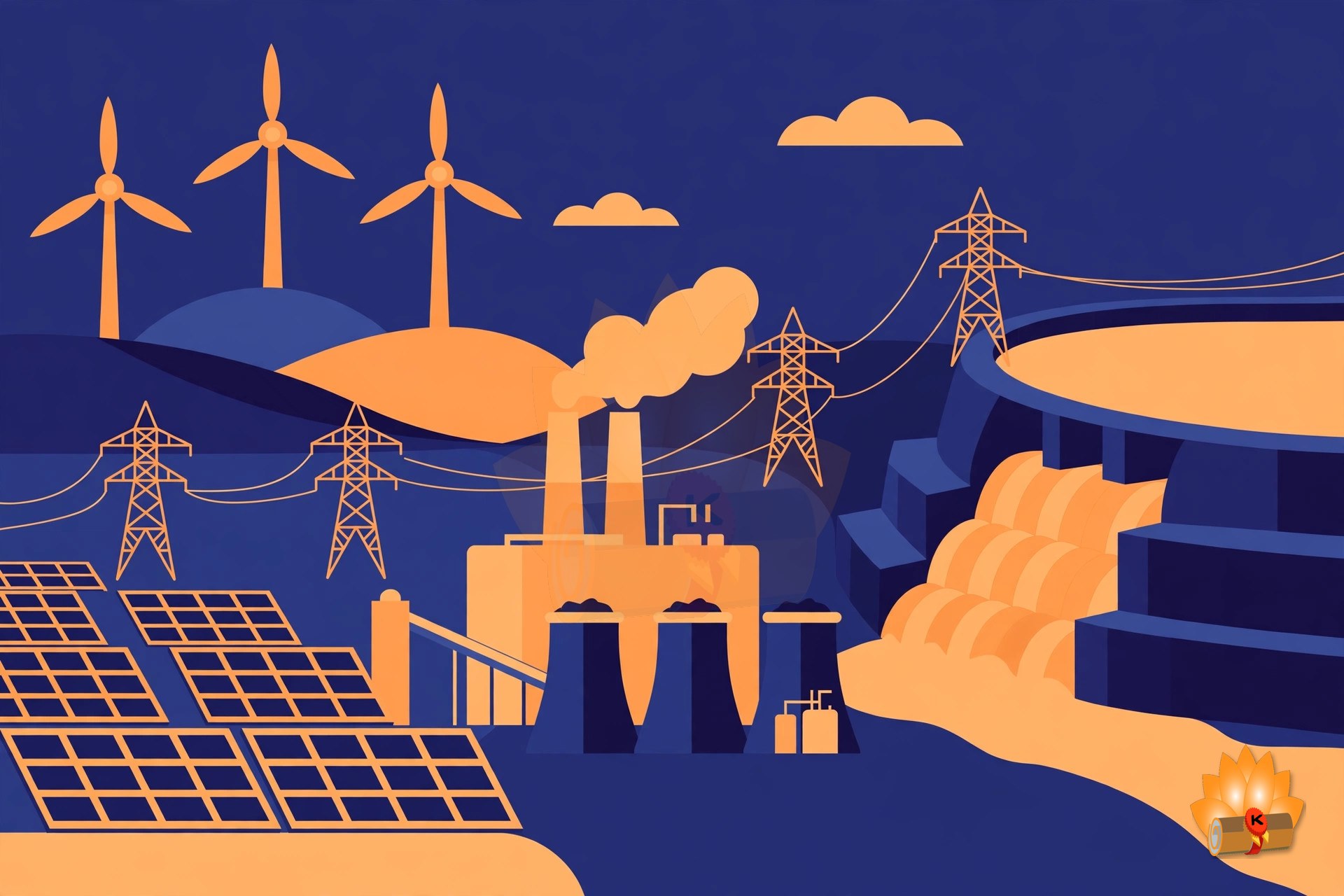
Every unit of electricity you use was made somewhere — in a coal plant, a hydro dam, a solar farm or a wind turbine. Basics of Power Generation Systems is the subject that shows you how each of those plants works and how to choose the right mix of them. It teaches you to maintain the efficient operation of various electric power generating plants — thermal, hydro, solar, wind, biomass and others — and to select the adequate mix of power generation based on economic operation.
The five units move from the familiar to the new: coal, gas, diesel and nuclear plants first, then large hydro and MHD, then solar and wind, then other stations like biomass, geothermal, tidal and fuel cells, and finally the economics of generation — load curves, demand factors and the smart grid. The first unit carries the most weightage at 24%; the other four are 19% each. It is a theory subject (L 3 – P 0), worth 100 marks and 3 credits, with 12 reference books.
Subject 3.1 (Theory) • Total 100 Marks • 3 Credits • L 3 – P 0 • 3rd Semester — Electrical Engineering • Session 2026–27
What You Will Study
Unit – I: Power Plants: Coal, Gas, Diesel and Nuclear-based (08 Periods, 24%)
Schematic arrangement of power plant (coal-based, gas-based, diesel-based, nuclear-based); Functions of the various types of power plants and their major auxiliaries; Safe working Practices of various power plants: coal-based, gas-based, diesel-based, nuclear-based.
Unit – II: Large Hydro Power Plants and MHD (08 Periods, 19%)
Hydrology, stream flow, hydrograph, flow duration curves; Types of hydroelectric plants and their fields of use, capacity calculations for hydropower, Dams, head water control, penstocks, water turbines, specific speeds, turbine governors; Hydro plant auxiliaries, plant layout; Concepts and principles of Magneto Hydro Dynamic (MHD) generation.
Unit – III: Solar and Wind Power Plants (08 Periods, 19%)
Solar Power Technology: (a) Concentrated Solar Power (CSP) plants, construction and working of: Power Tower, Parabolic Trough, Parabolic Dish, Fresnel Reflectors; (b) Solar Photovoltaic (PV) power plant: layout, construction, working; Wind power density in watts per square meter, Horizontal and vertical axis large wind power plant, Geared wind power plant, Direct-drive wind power plant.
Unit – IV: Other Generating Stations (08 Periods, 19%)
Biomass: Biomass conversion technologies, methods for obtaining energy from biomass; Geothermal and Tidal Energy: Geothermal sources and its significance, geo-thermal power plant – dry steam, flash steam, and binary cycle, Tidal energy and its significance, Different types of tidal power plants: single basin, double basin; Fuel Cells: Concept, types and principles of fuel cells.
Unit – V: Economics of Power Generation and Interconnected Power System (10 Periods, 19%)
Related terms: connected load, firm power, cold reserve, hot reserve, spinning reserve; Base load and peak load plants; Load curve, load duration curve, integrated duration curve; Cost of generation: Average demand, maximum demand, demand factor, plant capacity factor, plant use factor, diversity factor, load factor and plant load factor; Choice of size and number of generator units, combined operation of power station; Smart Grid.
Complete Syllabus
The full examination scheme, the complete practicals list and the reference books from the official syllabus. The unit-wise topics are in the "What You Will Study" section above.
Examination Scheme
| Code | Paper | Type | L – P | Credits | Internal | External | Total |
|---|---|---|---|---|---|---|---|
| 3.1 | Basics of Power Generation Systems | Theory | 3 – 0 | 3 | 40 | 60 (3 hrs) | 100 |
| Basics of Power Generation Systems Total | 3 | 40 | 60 | 100 | |||
Units at a Glance
| Unit | Topic | Periods | Marks Share |
|---|---|---|---|
| I | Power Plants: Coal, Gas, Diesel and Nuclear-based | 08 | 24% |
| II | Large Hydro Power Plants and MHD | 08 | 19% |
| III | Solar and Wind Power Plants | 08 | 19% |
| IV | Other Generating Stations | 08 | 19% |
| V | Economics of Power Generation and Interconnected Power System | 10 | 19% |
Reference Books
As listed in the syllabus:
- Nag. P. K. Power Plant Engineering, McGraw Hill, New Delhi, ISBN: 978-9339204044
- Tanmoy Deb, Electrical Power Generation, Khanna Publishing House, Delhi (Ed. 2018)
- Gupta, B.R., Generation of Electrical Energy, S. Chand & Co. New Delhi
- Ashish Sahu, Pooja Yadav Power Plant Engineering, Asian Publishers, Muzaffarnagar ISBN no. 978-93-5502-025-3
- Rachel, Sthuthi; Earnest, Joshua – Wind Power Technologies, PHI Learning, New Delhi, ISBN: 978-93-88028-49-3; E-book 978-93-88028-50-9
- Solanki, Chetan Singh, – Solar Photovoltaics: Fundamentals, Technologies and Applications, PHI Learning, New Delhi, ISBN: 9788120351110
- Hau, Erich, Wind Turbines, Springer-Verlag, Berlin Heidelberg, Germany, ISBN: 978-3-642-27150-2
- Gipe, Paul, Wind Energy Basics, Chelsea Green Publishing Co; ISBN: 978-1603580304
- Wizelius, Tore; Earnest, Joshua – Wind Power Plants and Project Development, PHI
- Gupta, J.B. A Course in Electrical Power – S. K Kataria and Sons, New Delhi. 2014
- Soni, Gupta, Bhatnagar, A Course in Electrical Power. – Dhanpat rai and Sons
- System, S.Chand & Co. New Delhi, 2005, ISBN: 9788121924962
Frequently Asked Questions
How many marks is Basics of Power Generation Systems worth in the 3rd semester?
100 marks, 3 credits. It is a theory subject (L 3 – 0): internal 40, external 60 (3 hrs).
Which unit carries the most weightage in Basics of Power Generation Systems?
Power Plants: Coal, Gas, Diesel and Nuclear-based, 24% (08 periods).
Is there any practical work in Basics of Power Generation Systems?
No — the official syllabus lists no practicals for this subject.
Which books should I read for Basics of Power Generation Systems?
12 reference books are listed in the official syllabus — the full list is in the Complete Syllabus section above.
How can I download the Basics of Power Generation Systems syllabus PDF?
The PDF is free to download — use the download link in the Download section below. It is prepared by KAMALDNP Academy from the official BTEUP syllabus.
Which power plants does this subject cover?
Coal, gas, diesel and nuclear plants; large hydro and MHD; solar (CSP and PV) and wind; biomass, geothermal, tidal and fuel cells — and the economics of choosing between them.
Related Syllabus Posts
- BTEUP Electrical 3rd Semester Syllabus 2026-27
- Electrical Engineering Complete Syllabus 2026-27
- Electric Machine-1 — BTEUP Electrical 3rd Semester Syllabus 2026-27
- Electrical Circuits — BTEUP Electrical 3rd Semester Syllabus 2026-27
- Electrical and Electronic Measurements — BTEUP Electrical 3rd Semester Syllabus 2026-27
Download the Basics of Power Generation Systems Syllabus PDF
Download the complete Basics of Power Generation Systems syllabus PDF below — prepared by KAMALDNP Academy, with the full topic list and reference books.
Download the Basics of Power Generation Systems Syllabus PDF
Source: BTEUP 2nd Year Electrical Engineering curriculum (folder2627). The file's cover prints "YEAR 2025-2026", but the approval line "UPDATED AND APPROVED BY BOARD OF TECHNICAL EDUCATION U.P. LUCKNOW IN C.D.C MEETING HELD ON 16.07.2026" appears on every page (95 times), and the file is treated here as the 2026-27 syllabus on the strength of that approval. Topic lists follow the official syllabus; short explanations are the author's own plain-English summaries, not syllabus text. Please confirm with your own polytechnic for any local changes.




Comments (0)
Share your question or experience about this syllabus. Your comment will appear after review.
No comments yet — be the first to share your thoughts!