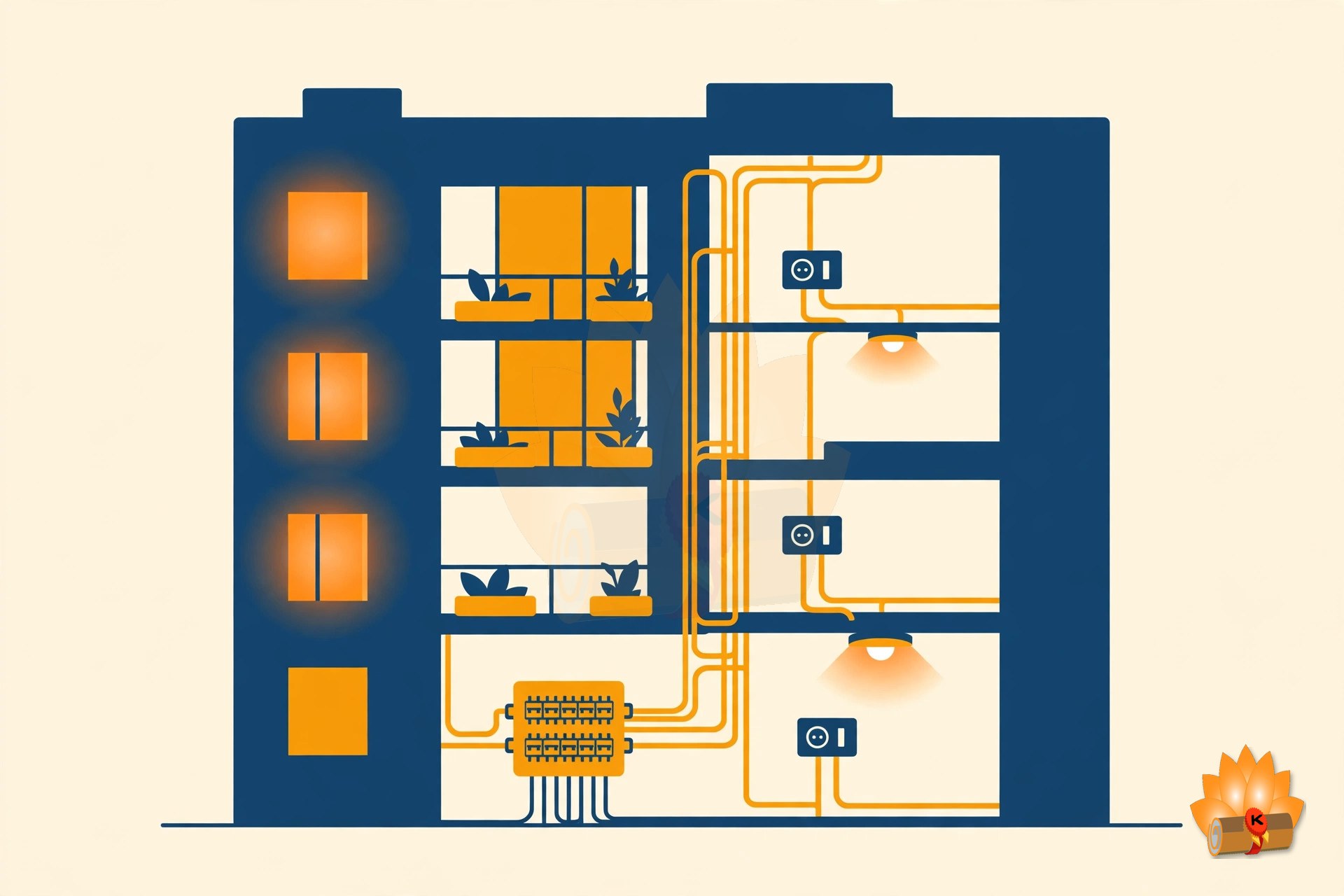
Building Electrification — What This Subject Is About
Building Electrification is the subject that turns a building's drawings into a working electrical system — the wiring, the cables, the protective devices and the earthing that make a home or a commercial complex safe to live and work in. It teaches you to design electrical installation systems in building complexes, and it is the first subject of the final semester. It is a practicum subject (L 2 – P 4) with 11 practicals.
The five units follow the order of a real job: wiring tools and accessories, electrical wires and underground cables, wiring methods and layout, residential building electrification — the heaviest unit at 23% — and protective devices and earthing for electrical installation. One honest note: the unit headings give 04/06/06/08/04 periods (total 28), but the Suggested Distribution of Marks table in the official PDF gives 11/11/11/13/10 (total 56); this page uses the unit-heading figures, since the marks-table figures look copied from a theory subject.
Subject 6.1 (Practicum) • Total 100 Marks • 4 Credits • L 2 – P 4 • 6thth Semester — Electrical Engineering • Session 2026–27
Note: In the PDF the unit headings give 04/06/06/08/04 periods (total 28), but the Suggested Distribution of Marks table gives 11/11/11/13/10 periods (total 56). The unit headings are used here; the marks-table periods look copied from a theory subject.
What You Will Study
Unit – I: Wiring Tools and Accessories (04 Periods, 20%)
Various tools required for wiring; Application, care & maintenance of tools: Screwdrivers, pliers, Try square, saws, hacksaw, chisel, hammers, mallet, rawal punch, hand drill machine, portable drilling machine, files, plumb bob, line thread, electricians' knife, test lamp, tester; Switch – Their types according to construction such as surface switch, flush switch, and pull switch, rotary switch, knife switch, pendent switch, Main-switch (ICDP, ICTP); Their types according to working such as single pole, double pole, two-way, two-way centre off, intermediate, series parallel switch; Holders - Their types such as bayonet cap lamp holder, pendent holder, batten lamp holder, angle holder, bracket holder, tube light holder, screw type Edison and goliath Edison lamp holder, swivel lamp holder; Socket outlets and plugs - two pin, three-pin, multi pin sockets, two-pin and three-pin plug; Others - Iron connector, adaptor, and ceiling rose, distribution box, neutral link, bus-bar chamber; Wooden/ mica boards, Moulded/ MS Concealed boxes of different sizes; Modular accessories; BIS symbols of various electrical accessories.
Unit – II: Electrical Wires and Underground Cables (06 Periods, 20%)
Conductors: Wire, cable, bus bar, stranded conductor, cable, armoured cable, flexible cable, solid conductor, PVC wires, CTS wire, LC wire, FR (Fire retardant) wire; Tools used for measurement of wire size, Wire jointing methods; Classification of cables, low tension, high tension, and extra high-tension cables, solid, oil filled and gas filled type; Cable insulation materials – Polyvinyl chloride (PVC), cross linked polythene (XLPE); Selection of suitable cable size and type from standard data; Cable jointing methods; Cable laying methods; Factors determining selection of electric cables.
Unit – III: Wiring Methods and wiring layout (06 Periods, 20%)
Factors determining the selection of wiring methods; Classification of wiring methods; PVC casing-capping wiring - wiring rules according to IS: 732-2019; Conduit wiring - Types of conduit, types of conduit wiring (Surface/Concealed); Conduit wiring accessories; Comparison of various wiring systems; General BIS rules for domestic installations; Design, working and drawing of following electrical circuits: Simple light and fan circuits, Staircase wiring, Go-down wiring circuit, Bedroom lighting circuit, Corridor lighting circuit, Series parallel circuit, Master switch control circuit, Different lighting circuit using - Intermediate switch, Call bell circuit using bell indicator, Design of wiring circuits according to user's requirement.
Unit – IV: Residential Building Electrification (08 Periods, 23%)
Domestic Dwellings/Residential Buildings: Reading of Civil Engineering building drawing, Interpretation of electrical installation plan and electrical diagrams, electrical symbols as per IS: 732:2019; Electrical installation for residential building as per NEC 2023; Difference between residential and industrial load, rules/requirements related to lighting load followed in electrical installations, Positioning of equipment; Lighting and power circuits: Light and fan circuit, Power circuit wiring and circuit Schematic diagram according to IS: 2042(Part-I)-1962: multiline and single line representation; Load assessment: Selection of size of conductors, Selection of rating of main switch and protective switch gear; Design and drawing, estimation and costing of a residential installation having maximum 5 KW load; Sequence to be followed for preparing estimate; Calculation of length of wire and other materials, labour cost; Testing of wiring installation as per IS: 732-2019: Insulation resistance - between earth and conductors, between conductors, polarity test of single pole switches; Testing of earth continuity path; Residential building Service Connection - types Underground and overhead; Calculation of Material required for service connection.
Unit – V: Protective Devices and Earthing for Electrical Installation (04 Periods, 17%)
Miniature circuit Breaker (MCB), Construction, Principle, rating and uses; MCCB - Construction, Principal rating and uses; Earth Leakage Circuit Breaker (ELCB) - Construction, Principle, rating and uses; Residual Current Circuit Breaker (RCCB) - Construction, Principle rating and uses; System and equipment earthing and its requirements, Measurement of earth resistance using earth tester, Methods of reducing earth resistance, Methods of earthing and their procedure - Driven pipe, pipe and plate earthing, modern methods of earthing.
Practical Work
- Unit I — Prepare the chart of electrical accessories with their symbols.
- Unit II — Select the electric wire using measuring and testing instruments for particular applications.
- Unit II — Identify cables of different current ratings.
- Unit III — Prepare wiring installation on a board showing control of one lamp, one fan and one socket from one switch board in PVC surface conduit wiring system.
- Unit III — Control one lamp from two different places using PVC surface conduit wiring system.
- Unit III — Prepare wiring installation on a board. Control one lamp from three different places using PVC surface conduit wiring system.
And more — the complete list of 11 practicals is inside the PDF.
Complete Syllabus
The full examination scheme, the complete practicals list and the reference books from the official syllabus. The unit-wise topics are in the "What You Will Study" section above.
Examination Scheme
| Code | Paper | Type | L – P | Credits | Internal | External | Total |
|---|---|---|---|---|---|---|---|
| 6.1 | Building Electrification | Practicum | 2 – 4 | 4 | 60 | 40 (3 hrs) | 100 |
| Building Electrification Total | 4 | 60 | 40 | 100 | |||
Units at a Glance
| Unit | Topic | Periods | Marks Share |
|---|---|---|---|
| I | Wiring Tools and Accessories | 04 | 20% |
| II | Electrical Wires and Underground Cables | 06 | 20% |
| III | Wiring Methods and wiring layout | 06 | 20% |
| IV | Residential Building Electrification | 08 | 23% |
| V | Protective Devices and Earthing for Electrical Installation | 04 | 17% |
Complete Practicals List
This is the complete list of practicals from the official syllabus.
- Unit I — Prepare the chart of electrical accessories with their symbols.
- Unit II — Select the electric wire using measuring and testing instruments for particular applications.
- Unit II — Identify cables of different current ratings.
- Unit III — Prepare wiring installation on a board showing control of one lamp, one fan and one socket from one switch board in PVC surface conduit wiring system.
- Unit III — Control one lamp from two different places using PVC surface conduit wiring system.
- Unit III — Prepare wiring installation on a board. Control one lamp from three different places using PVC surface conduit wiring system.
- Unit IV — Design 2 BHK residential installation scheme and estimate the material required. And draw the details required for installation on A4 size sheet.
- Unit IV — Perform go-down wiring for three blocks using PVC casing capping.
- Unit IV — Test wiring installation using megger.
- Unit V — Measurement of Earth Resistance by using Earth tester.
- Unit V — Dismantling of MCB and identify various parts.
Reference Books
As listed in the syllabus:
- Raina, K.B. and S.K. Bhattacharya, Electrical Design Estimating and Costing, New Age International Ltd., New Delhi, ISBN 978-81-224-0363-3
- Allagappan, N., S. Ekambarram, Electrical Estimating and Costing, New Delhi, ISBN-13: 9780074624784
- Singh, Surjit, Electrical Estimating and Costing, Dhanpat Rai and Co. New Delhi, ISBN: 1234567150995
- Gupta, J B: A Course in Electrical Installation Estimating and Costing, S K Kataria and Sons, New Delhi, ISBN: 978-93-5014-279-0
- Bureau of Indian Standard, IS: 732-2019, Code of practice for electrical wiring installation
- Bureau of Indian Standard, SP 30 National Electrical Code 2023
- Bureau of Indian Standard, SP 72 National Lighting Codes 2010
Frequently Asked Questions
How many marks is Building Electrification worth in the 6th semester?
100 marks, 4 credits. It is a practicum subject (L 2 – 4): internal 60, external 40 (3 hrs).
Which unit carries the most weightage in Building Electrification?
Residential Building Electrification, 23% (08 periods).
How many practicals are there in Building Electrification?
11 practicals — the complete list is in the Complete Syllabus section above, and in the PDF.
Which books should I read for Building Electrification?
7 reference books are listed in the official syllabus — the full list is in the Complete Syllabus section above.
How can I download the Building Electrification syllabus PDF?
The PDF is free to download — use the download link in the Download section below. It is prepared by KAMALDNP Academy from the official BTEUP syllabus.
Why do the unit periods differ between two tables in the PDF?
The unit headings give 04/06/06/08/04 periods (total 28), but the Suggested Distribution of Marks table gives 11/11/11/13/10 periods (total 56). This page uses the unit-heading figures; the marks-table periods look copied from a theory subject. The weightages (20/20/20/23/17) are from the marks table and sum to 100.
Related Syllabus Posts
- BTEUP Electrical 6th Semester Syllabus 2026-27
- BTEUP Electrical Complete Syllabus 2026-27 — 5th & 6th Semester (All Subjects)
- Entrepreneurship and Start-Ups — BTEUP Electrical 6th Semester Syllabus 2026-27
- In-House Project — BTEUP Electrical 6th Semester Syllabus 2026-27
- Project Management — BTEUP Electrical 6th Semester Syllabus 2026-27
Download the Building Electrification Syllabus PDF
Download the complete Building Electrification syllabus PDF below — prepared by KAMALDNP Academy, with the full topic list, practicals and reference books.
Download the Building Electrification Syllabus PDF
Source: BTEUP 3rd Year Electrical Engineering curriculum (folder2627), approved in C.D.C. meeting held on 16.07.2026. Topic lists follow the official syllabus; short explanations are the author's own plain-English summaries, not syllabus text. Please confirm with your own polytechnic for any local changes.



Comments (0)
Share your question or experience about this syllabus. Your comment will appear after review.
No comments yet — be the first to share your thoughts!