
Please note — cover year vs approval: BTEUP's own file for this curriculum prints "YEAR 2025-2026" on its cover, while carrying the approval line "UPDATED AND APPROVED BY BOARD OF TECHNICAL EDUCATION U.P. LUCKNOW IN C.D.C MEETING HELD ON 16.07.2026" on every page. It is filed in BTEUP's 2026-27 folder (folder2627), so it is treated here as the 2026-27 syllabus on the strength of that approval. The scheme it carries is identical, subject for subject and mark for mark, to the 2025-26 scheme.
Electric Power Transmission and Distribution — What This Subject Is About
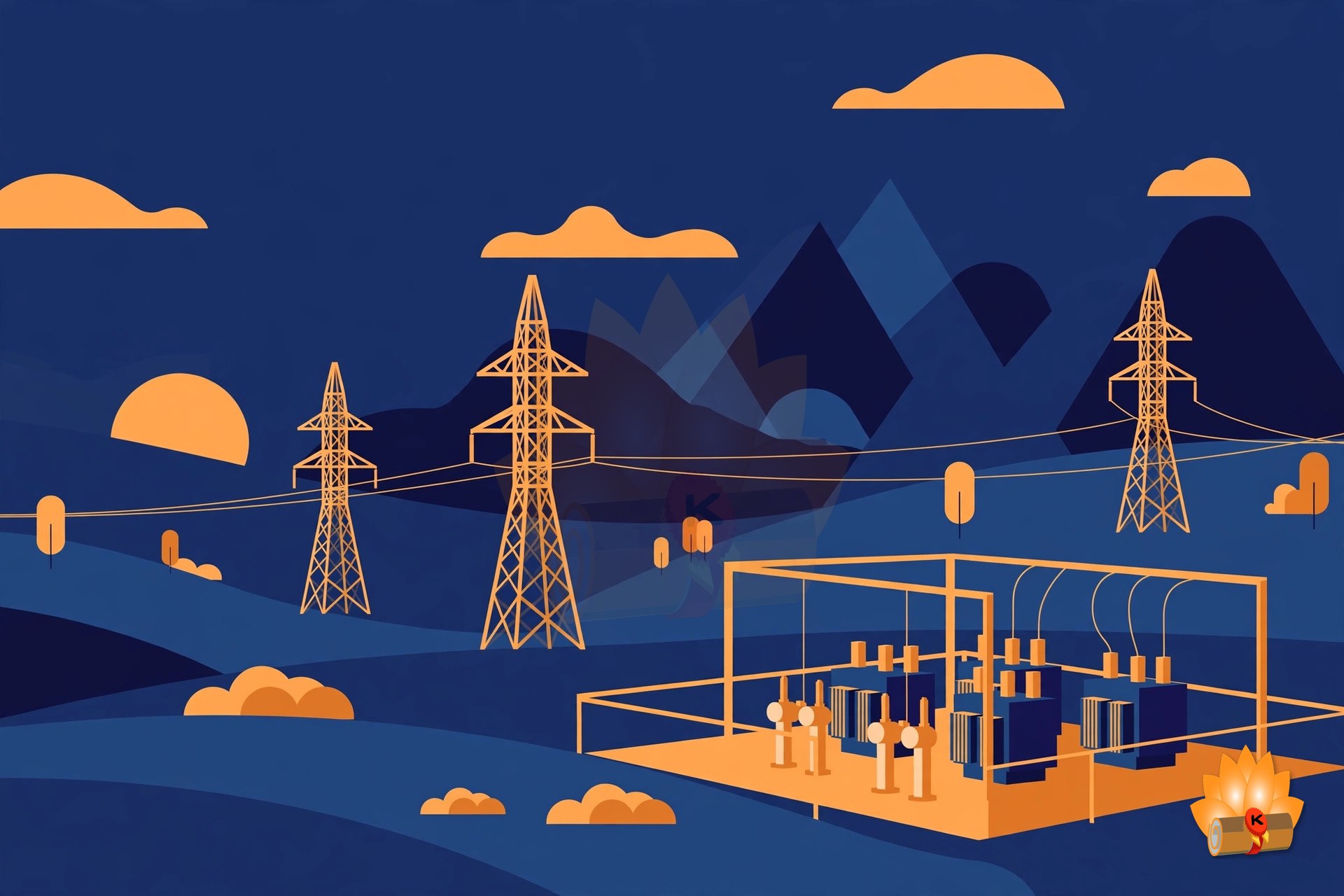
Power is generated in one place and used in another — sometimes hundreds of kilometres away. Electric Power Transmission and Distribution teaches you to maintain the proper functioning of the electrical transmission and distribution systems that carry it: the lines, the insulators, the cables and the substations in between.
The five units are the basics of transmission and distribution, AC transmission, HVDC transmission and FACTS, line insulators and underground cables, and substations and distribution systems. AC transmission and line insulators share the highest weightage at 25% each (10 periods each). It is a theory subject (L 3 – P 0), worth 100 marks and 3 credits, with 11 reference books.
Subject 4.1 (Theory) • Total 100 Marks • 3 Credits • L 3 – P 0 • 4th Semester — Electrical Engineering • Session 2026–27
What You Will Study
Unit – I: Basics of Transmission and Distribution (06 Periods, 10%)
Single line diagrams of the electric supply transmission and distribution systems; Standard voltage level used in India; Classification of Transmission lines; Characteristics of high voltage for both AC and DC power transmission.
Unit – II: AC Transmission (10 Periods, 25%)
Typical Layout of A.C. Power supply scheme - Elements of a Transmission Line Over Head Line, Conductor materials and their properties, Line supports and their properties - Types of supports and their applications, Sag in overhead lines, Calculation of Sag - When the supports are at equal and unequal levels - Simple Numerical Problems; Constants of a Transmission line, Transposition of Transmission lines, Skin Effect, Ferranti Effect, Corona Formation, Factors affecting Corona, Classification of O.H. Transmission lines - Voltage regulation and Transmission Efficiency (No Numerical Problems); Concept of power factor, effects of low power factor, methods of improving low power factor: static capacitor, synchronous condenser, SVC.
Unit – III: Hvdc Transmission & Facts (08 Periods, 20%)
H.V.D.C Transmission: Layout Scheme, D.C Link configurations - Mono polar, Bipolar and Homo polar links; HVDC Convertor Station (Schematic diagram only) – Integration of HVDC & Renewable energy into existing AC grids; HVDC Locations in India; FACTS: Definition, Need for FACTS controllers, Types of FACTS controllers, SVS, STATCOM, UPFC (Block diagram explanation only).
Unit – IV: Line Insulators and Underground Cables (10 Periods, 25%)
Natural insulating materials, properties and their applications-mica, asbestos, ceramic materials, glass, cotton, silk, jute, paper (dry and impregnated), rubber, bitumen, gaseous materials (air, hydrogen, nitrogen, SF6); Line Insulators: Properties of Insulators, Materials, Types, Causes of failure of Insulators, Testing of Insulators; Potential Distribution over suspension Insulator string, String Efficiency - Methods of improving string Efficiency – Simple Problems; Underground Cables: Construction of a three core cable, Classification of cables, Cables for three phase service, Construction of Belted cable, Screened cable, Pressure cables, Laying of underground cables and cable jointing, Faults in cables, fault localization using Blavier and Loop tests.
Unit – V: Sub-Stations & Distribution Systems (08 Periods, 20%)
Sub-Stations: Classification, advantages, disadvantages and applications; Single Line diagram (layout) of 33/11KV and 11KV/400V sub-station, functions of various auxiliaries and equipments associated with it; Gas Insulated Substation (GIS); Distribution system - Requirements and parts of Distribution system, Classification; Comparison of different distribution systems (A.C and D.C, Overhead & Underground); A.C Distribution - Types - Connection schemes of AC Distribution system.
Complete Syllabus
The full examination scheme, the complete practicals list and the reference books from the official syllabus. The unit-wise topics are in the "What You Will Study" section above.
Examination Scheme
| Code | Paper | Type | L – P | Credits | Internal | External | Total |
|---|---|---|---|---|---|---|---|
| 4.1 | Electric Power Transmission and Distribution | Theory | 3 – 0 | 3 | 40 | 60 (3 hrs) | 100 |
| Electric Power Transmission and Distribution Total | 3 | 40 | 60 | 100 | |||
Units at a Glance
| Unit | Topic | Periods | Marks Share |
|---|---|---|---|
| I | Basics of Transmission and Distribution | 06 | 10% |
| II | AC Transmission | 10 | 25% |
| III | Hvdc Transmission & Facts | 08 | 20% |
| IV | Line Insulators and Underground Cables | 10 | 25% |
| V | Sub-Stations & Distribution Systems | 08 | 20% |
Reference Books
As listed in the syllabus:
- G.C. Garg, Utilization of Electric Power & Electric Traction, Khanna Book Publishing Co., New Delhi (ISBN: 978-93-86173-355)
- Mehta, V.K., Principles of Power System, S. Chand and Co. New Delhi, ISBN: 9788121924962
- Soni; Gupta; Bhatnagar, A Course in Electrical Power, Dhanpat Rai and Sons New Delhi, ISBN: 9788177000207
- Gupta, J.B., A Course in Power Systems, S.K. Kataria and sons, New Delhi, ISBN: 9788188458523
- Theraja, B.L.; Theraja, A.K., A Textbook of Electrical Technology Vol. III, S. Chand and Co. New Delhi, ISBN: 9788121924900
- Uppal, S.L., A Course in Electrical Power, S.K. Khanna Publisher New Delhi, ISBN: 9788174092380
- Ashish Sahu, Pooja Yadav, Transmission & Distribution of Electrical Power, Asian Publishers, Muzaffarnagar. ISBN: 978-93-5502-044-4
- Sivanagaraju S.; Satyanarayana S., Electrical Power Transmission and Distribution, Pearson Education, New Delhi, ISBN: 9788131707913
- Ned Mohan, Electrical Power System: A First Course, Wiley India Pvt. Ltd. New Delhi, ISBN: 9788126541959
- Gupta, B.R., Power System Analysis and Design, S. Chand and Co. New Delhi, ISBN: 9788121922388
- Kamraju, V., Electrical Power Distribution System, Tata McGraw-Hill, New Delhi, ISBN: 9780070151413
Frequently Asked Questions
How many marks is Electric Power Transmission and Distribution worth in the 4th semester?
100 marks, 3 credits. It is a theory subject (L 3 – 0): internal 40, external 60 (3 hrs).
Which unit carries the most weightage in Electric Power Transmission and Distribution?
AC Transmission, 25% (10 periods).
Is there any practical work in Electric Power Transmission and Distribution?
No — the official syllabus lists no practicals for this subject.
Which books should I read for Electric Power Transmission and Distribution?
11 reference books are listed in the official syllabus — the full list is in the Complete Syllabus section above.
How can I download the Electric Power Transmission and Distribution syllabus PDF?
The PDF is free to download — use the download link in the Download section below. It is prepared by KAMALDNP Academy from the official BTEUP syllabus.
What is the difference between transmission and distribution?
Transmission carries power in bulk over long distances at high voltage; distribution delivers it to homes and factories at lower voltage through substations and distribution lines. Both are covered here — transmission in Units I–IV and substations and distribution systems in Unit V.
Related Syllabus Posts
- BTEUP Electrical 4th Semester Syllabus 2026-27
- Electrical Engineering Complete Syllabus 2026-27
- Electric Machine-2 — BTEUP Electrical 4th Semester Syllabus 2026-27
- Fundamentals of Power Electronics — BTEUP Electrical 4th Semester Syllabus 2026-27
- Industrial Automation and Control — BTEUP Electrical 4th Semester Syllabus 2026-27
Download the Electric Power Transmission and Distribution Syllabus PDF
Download the complete Electric Power Transmission and Distribution syllabus PDF below — prepared by KAMALDNP Academy, with the full topic list and reference books.
Download the Electric Power Transmission and Distribution Syllabus PDF
Source: BTEUP 2nd Year Electrical Engineering curriculum (folder2627). The file's cover prints "YEAR 2025-2026", but the approval line "UPDATED AND APPROVED BY BOARD OF TECHNICAL EDUCATION U.P. LUCKNOW IN C.D.C MEETING HELD ON 16.07.2026" appears on every page (95 times), and the file is treated here as the 2026-27 syllabus on the strength of that approval. Topic lists follow the official syllabus; short explanations are the author's own plain-English summaries, not syllabus text. Please confirm with your own polytechnic for any local changes.
Comments (0)
Share your question or experience about this syllabus. Your comment will appear after review.
No comments yet — be the first to share your thoughts!