
Please note — cover year vs approval: BTEUP's own file for this curriculum prints "YEAR 2025-2026" on its cover, while carrying the approval line "UPDATED AND APPROVED BY BOARD OF TECHNICAL EDUCATION U.P. LUCKNOW IN C.D.C MEETING HELD ON 16.07.2026" on every page. It is filed in BTEUP's 2026-27 folder (folder2627), so it is treated here as the 2026-27 syllabus on the strength of that approval. The scheme it carries is identical, subject for subject and mark for mark, to the 2025-26 scheme.
Essence of Indian Knowledge and Tradition — What This Subject Is About
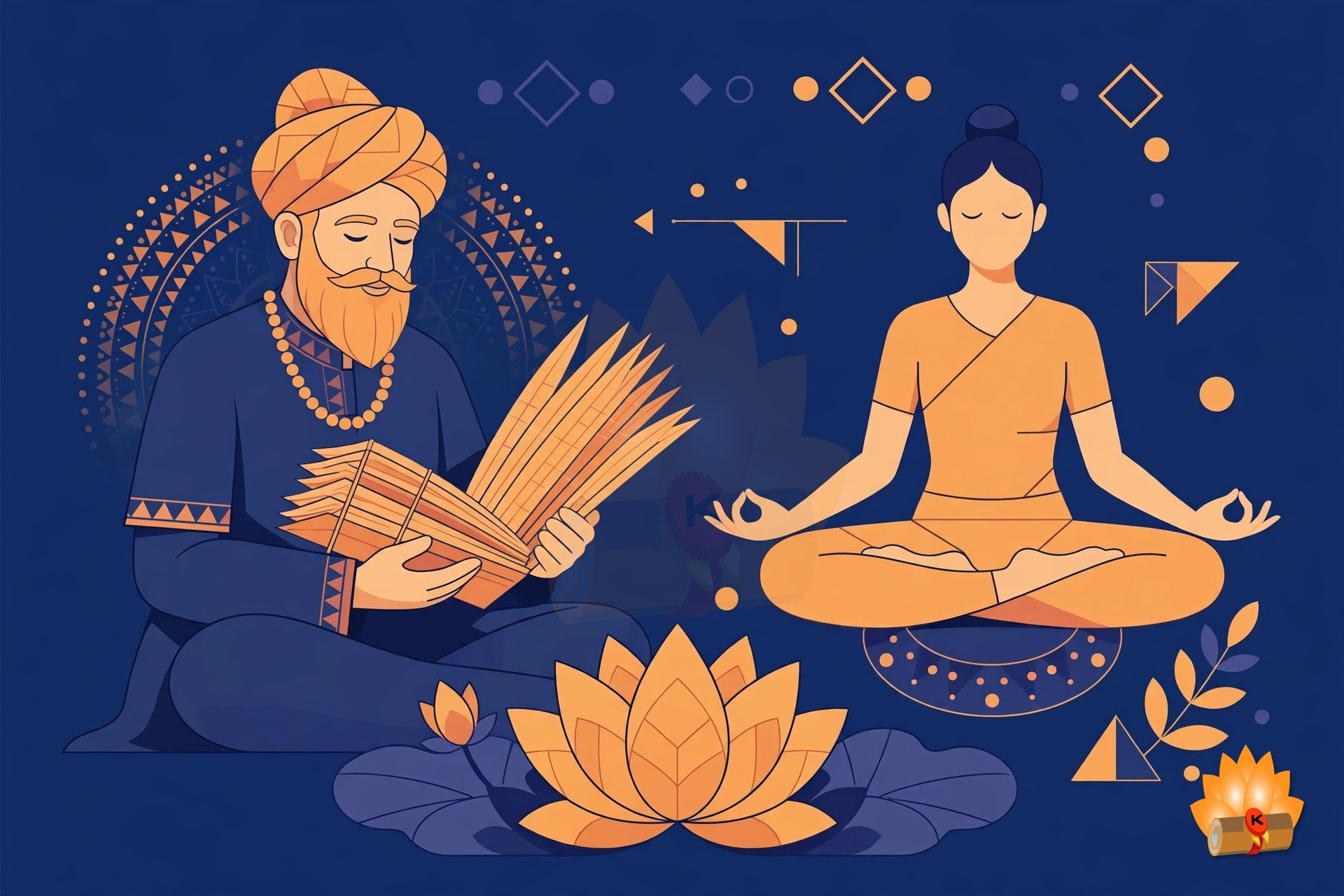
This is the one subject in your diploma that looks backwards to move forwards — at the Indian Knowledge System, its integration with modern science, the principles of Yoga and holistic healthcare, and their practical applications today. It teaches you to understand the fundamental aspects of the Indian Knowledge System and how they apply in contemporary contexts.
There are four units: an introduction to the Indian Knowledge System, modern science and the Indian Knowledge System, Yoga and holistic healthcare, and case studies or an assignment. The first unit — the Vedas, Upavedas, Vedangas and Upangas — carries half the weightage at 50% (16 periods). Note the marks carefully: this is an audit course marked (Q) — 50 marks internal, 0 credits, assessed by a viva-voce exam. Passing is compulsory, but the marks are not counted for your percentage or division. No reference books are listed in the official syllabus for this subject.
Subject 4.8 (Audit Course) (Q) • 50 Marks internal • 0 Credits • L 2 – P 0 • Qualifying only • Assessment: Viva-Voce Exam • 4th Semester — Electrical Engineering • Session 2026–27
About this document: 4.8 is an audit course marked (Q) — compulsory to appear and pass, but marks are not included for percentage and division. Assessment is by viva-voce exam.
What You Will Study
Unit – I: Introduction to Indian Knowledge System (16 Periods, 50%)
Overview of Indian Knowledge System; Importance and relevance: 1. Introduction to the Vedas, 2. Upavedas, 3. Vedangas, 4. Upangas.
Unit – II: Modern Science and Indian Knowledge System (06 Periods, 20%)
1. Relevance of Science and Spirituality, 2. Science and Technology in Ancient India.
Unit – III: Yoga and Holistic Healthcare (04 Periods, 15%)
1. Basic principles of Yoga, 2. Benefits of holistic healthcare practices, 3. Integration with modern healthcare.
Unit – IV: Case Studies / Assignment (02 Periods, 15%)
Practical Applications / Case studies demonstrating the relevance of Indian Knowledge System in modern times.
Complete Syllabus
The full examination scheme, the complete practicals list and the reference books from the official syllabus. The unit-wise topics are in the "What You Will Study" section above.
Examination Scheme
| Code | Paper | Type | L – P | Credits | Internal | External | Total |
|---|---|---|---|---|---|---|---|
| 4.8 | Essence of Indian Knowledge and Tradition (Q) | Audit Course | 2 – 0 | — | 50 | — | NA |
| Essence of Indian Knowledge and Tradition Total | — | 50 | — | NA | |||
Units at a Glance
| Unit | Topic | Periods | Marks Share |
|---|---|---|---|
| I | Introduction to Indian Knowledge System | 16 | 50% |
| II | Modern Science and Indian Knowledge System | 06 | 20% |
| III | Yoga and Holistic Healthcare | 04 | 15% |
| IV | Case Studies / Assignment | 02 | 15% |
Reference Books
Reference books are not listed in the official syllabus for this subject.
Frequently Asked Questions
How many marks is Essence of Indian Knowledge and Tradition worth in the 4th semester?
It is a (Q) qualifying subject — 50 marks internal, — credits. Passing is compulsory, but the marks are not included for percentage and division.
Which unit carries the most weightage in Essence of Indian Knowledge and Tradition?
Introduction to Indian Knowledge System, 50% (16 periods).
Is there any practical work in Essence of Indian Knowledge and Tradition?
No — the official syllabus lists no practicals for this subject.
How can I download the Essence of Indian Knowledge and Tradition syllabus PDF?
The PDF is free to download — use the download link in the Download section below. It is prepared by KAMALDNP Academy from the official BTEUP syllabus.
Do the marks of this subject count towards my percentage?
No. It is an audit course marked (Q): 50 marks internal, 0 credits. Passing is compulsory, but the marks are not included for percentage and division.
Related Syllabus Posts
- BTEUP Electrical 4th Semester Syllabus 2026-27
- Electrical Engineering Complete Syllabus 2026-27
- Electric Power Transmission and Distribution — BTEUP Electrical 4th Semester Syllabus 2026-27
- Electric Machine-2 — BTEUP Electrical 4th Semester Syllabus 2026-27
- Fundamentals of Power Electronics — BTEUP Electrical 4th Semester Syllabus 2026-27
Download the Essence of Indian Knowledge and Tradition Syllabus PDF
Download the complete Essence of Indian Knowledge and Tradition syllabus PDF below — prepared by KAMALDNP Academy, with the full topic list.
Download the Essence of Indian Knowledge and Tradition Syllabus PDF
Source: BTEUP 2nd Year Electrical Engineering curriculum (folder2627). The file's cover prints "YEAR 2025-2026", but the approval line "UPDATED AND APPROVED BY BOARD OF TECHNICAL EDUCATION U.P. LUCKNOW IN C.D.C MEETING HELD ON 16.07.2026" appears on every page (95 times), and the file is treated here as the 2026-27 syllabus on the strength of that approval. Topic lists follow the official syllabus; short explanations are the author's own plain-English summaries, not syllabus text. Please confirm with your own polytechnic for any local changes.
Comments (0)
Share your question or experience about this syllabus. Your comment will appear after review.
No comments yet — be the first to share your thoughts!