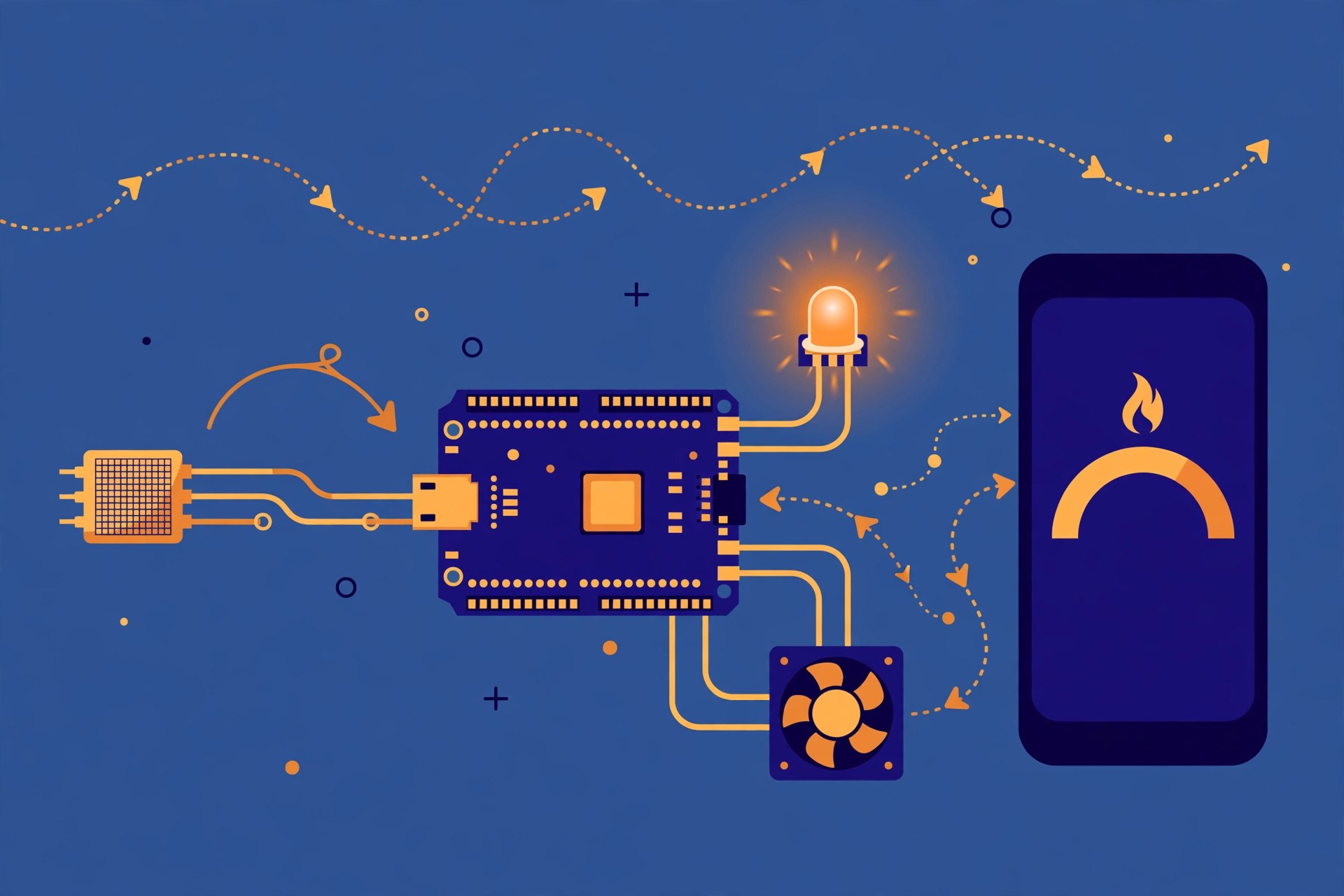
Fundamentals of Internet of Things — What This Subject Is About
IoT is a hot technology worldwide, cutting across agriculture, space, healthcare, manufacturing, construction, water and mining, with applications such as innovative shopping systems, infrastructure management, remote health monitoring, emergency notification and transportation systems. By the end you should be able to: understand the concepts of the Internet of Things; understand what constitutes an IoT design solution; identify the sensors and other devices needed for different IoT solutions; understand the component parts of an IoT network and its connections; and build small IoT applications.
Subject 5.2 (Practicum) • Total 100 Marks • 3 Credits • L 1 – P 4 • 5th Semester — Computer Science & Engineering • Session 2026–27
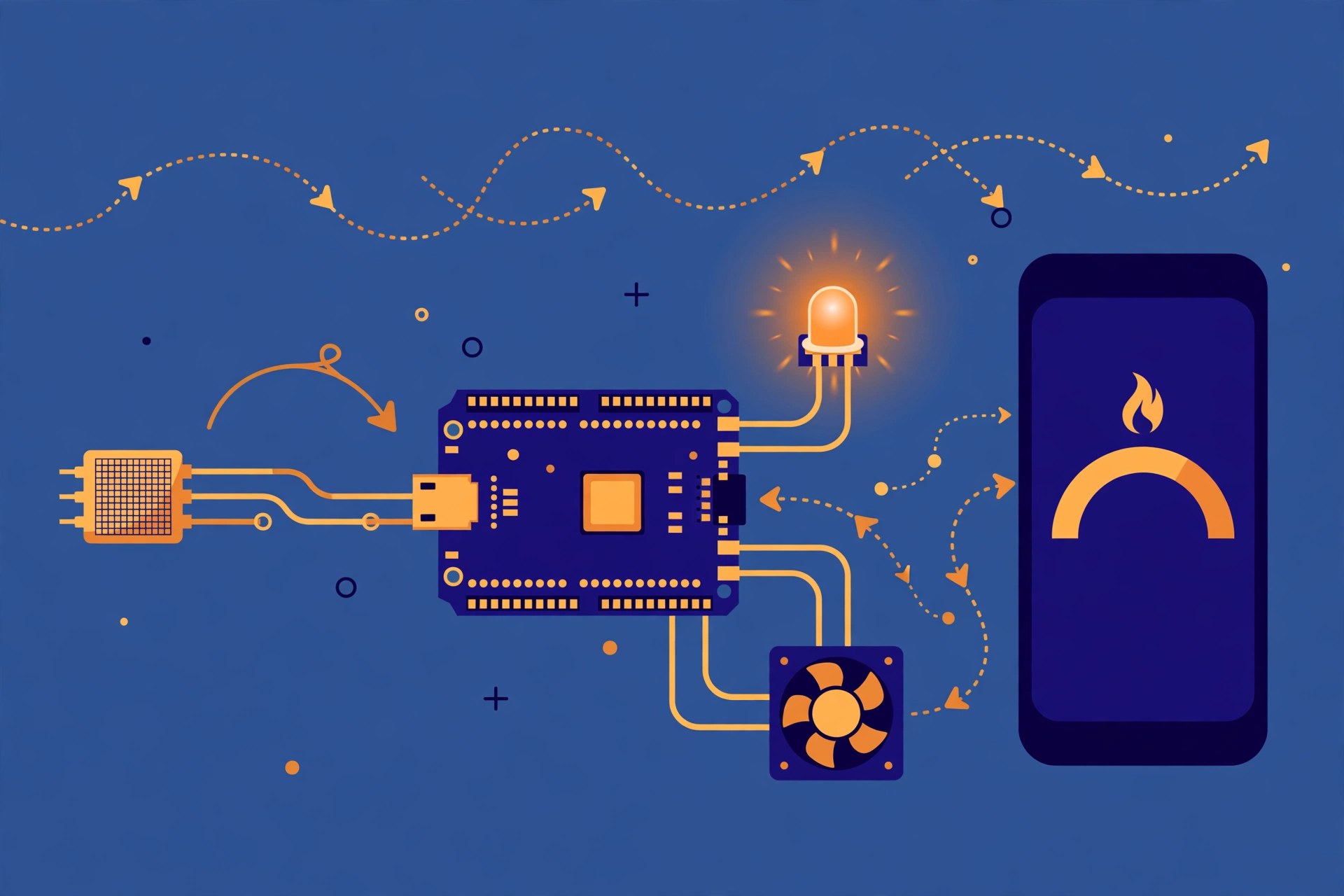
What You Will Study
Unit 1 — Introduction to Internet of Things (10 Periods)
Introduction to IoT; defining IoT; things in IoT; characteristics of IoT; physical design of IoT; logical design of IoT; functional blocks of IoT; IoT protocols; IoT communication models; IoT communication APIs; IoT enabling technologies.
What IoT really means, what its building blocks are, and how things talk to each other and to the internet.
Unit 2 — IoT Devices (12 Periods)
How electronic devices fit with the Internet of Things and why they are important: breadboard and its internal connections; LED and its connections; tri-colour LED; resistor; introduction to end devices, sensors and actuators; differentiating between different sensor types.
The hands-on electronics foundation: breadboards, LEDs, resistors, and the sensors and actuators that let a device sense and affect the real world.
Unit 3 — IoT Networks (12 Periods)
Introduction to the components of basic IoT networks; types of network connections and how data travels through them; the role of internet protocols; understanding of microcontrollers/Arduino and communication protocols.
How IoT devices connect and send data — network types, internet protocols, and the microcontroller at the centre of it all.
Unit 4 — Arduino (12 Periods)
Features of Arduino device; Arduino device introduction; components of Arduino board; C Arduino programming language; understanding basics of Arduino IDE; functions; control statements; loops; data types; variables.
Meet Arduino: the board, its parts, its programming environment, and the C-style code that makes it do things.
Unit 5 — IoT and M2M (10 Periods)
Introduction; M2M; difference between IoT and M2M; SDN and NFV for IoT — software defined networking, network function virtualisation; IoT and WoT (Web of Things).
How IoT differs from the older machine-to-machine idea, and the newer networking ideas (SDN, NFV) and the Web of Things that sit behind large IoT systems.
Practical Work
- Installation of Arduino IDE.
- Interfacing Light Emitting Diode (LED) — blinking LED.
- Interfacing button and LED — LED blinking when the button is pressed.
- Interfacing Light Dependent Resistor (LDR) and LED — displaying an automatic night lamp.
- Interfacing temperature sensor (LM35) and/or humidity sensor (e.g. DHT11).
- Interfacing Liquid Crystal Display (LCD) — display data generated by a sensor on the LCD.
And more — the complete list of 9 practicals is inside the PDF.
Complete Syllabus
The full examination scheme and the complete practicals list from the official syllabus. The unit-wise topics are in the "What You Will Study" section above.
Examination Scheme
| Code | Paper | Type | L – P | Credits | Internal | External | Total |
|---|---|---|---|---|---|---|---|
| 5.2 | Fundamentals of Internet of Things | Practicum | 1 – 4 | 3 | 60 | Practical 40 (3 hrs) | 100 |
| IoT Total | 3 | 60 | 40 | 100 | |||
Complete Practicals List
This is the complete list of practicals from the official syllabus.
- Installation of Arduino IDE.
- Interfacing Light Emitting Diode (LED) — blinking LED.
- Interfacing button and LED — LED blinking when the button is pressed.
- Interfacing Light Dependent Resistor (LDR) and LED — displaying an automatic night lamp.
- Interfacing temperature sensor (LM35) and/or humidity sensor (e.g. DHT11).
- Interfacing Liquid Crystal Display (LCD) — display data generated by a sensor on the LCD.
- Interfacing Air Quality Sensor — pollution (e.g. MQ135) — display data on LCD, switch on LED when the sensed data is higher than a specified value.
- Interfacing Bluetooth module (e.g. HC05) — receiving data from a mobile phone on Arduino and displaying it on the LCD.
- Interfacing Relay module to demonstrate a Bluetooth-based home automation application (using Bluetooth and relay).
Frequently Asked Questions
How many marks is IoT worth in the 5th semester?
100 marks, 3 credits. It is a practicum subject (1 lecture + 4 practical hours a week): internal 60, practical 40.
How many periods is each unit of IoT?
Introduction 10 periods, IoT Devices 12, IoT Networks 12, Arduino 12, and IoT and M2M 10 — 56 periods in total.
What practical work is there in IoT?
Arduino IDE installation, LED blink, button and LED, LDR night lamp, LM35/DHT11 temperature and humidity sensors, LCD display, MQ135 air quality sensor, HC-05 Bluetooth and relay-based home automation. The complete list is in the Complete Syllabus section above.
What is the difference between IoT and M2M?
Unit 5 covers it: M2M is the older machine-to-machine idea, while IoT is covered with SDN (software defined networking), NFV (network function virtualisation) and the Web of Things.
How can I download the Fundamentals of IoT syllabus PDF?
The PDF is free to download — use the download link in the Download section below. It is prepared by KAMALDNP Academy from the official BTEUP syllabus.
Related Syllabus Posts
- BTEUP CSE 5th Semester Syllabus 2026-27
- BTEUP CSE Complete Syllabus 2026-27 — 1st, 3rd & 5th Semester (All Subjects)
- Object Oriented Programming Using Java — BTEUP CSE 5th Semester Syllabus 2026-27
- Computer Network — BTEUP CSE 3rd Semester Syllabus 2026-27
- Mobile App Development — BTEUP CSE 5th Semester Syllabus 2026-27
Download the Fundamentals of Internet of Things Syllabus PDF
Download the complete Fundamentals of Internet of Things syllabus PDF below — prepared by KAMALDNP Academy, with the full topic list, practicals and reference books.
Download the Fundamentals of Internet of Things Syllabus PDF
Source: BTEUP 3rd Year curriculum (folder2627), approved in C.D.C. meeting held on 16.07.2026. Topic lists follow the official syllabus; short explanations are the author's own plain-English summaries, not syllabus text. Please confirm with your own polytechnic for any local changes.