Repair and Maintenance of Building — What This Subject Is About
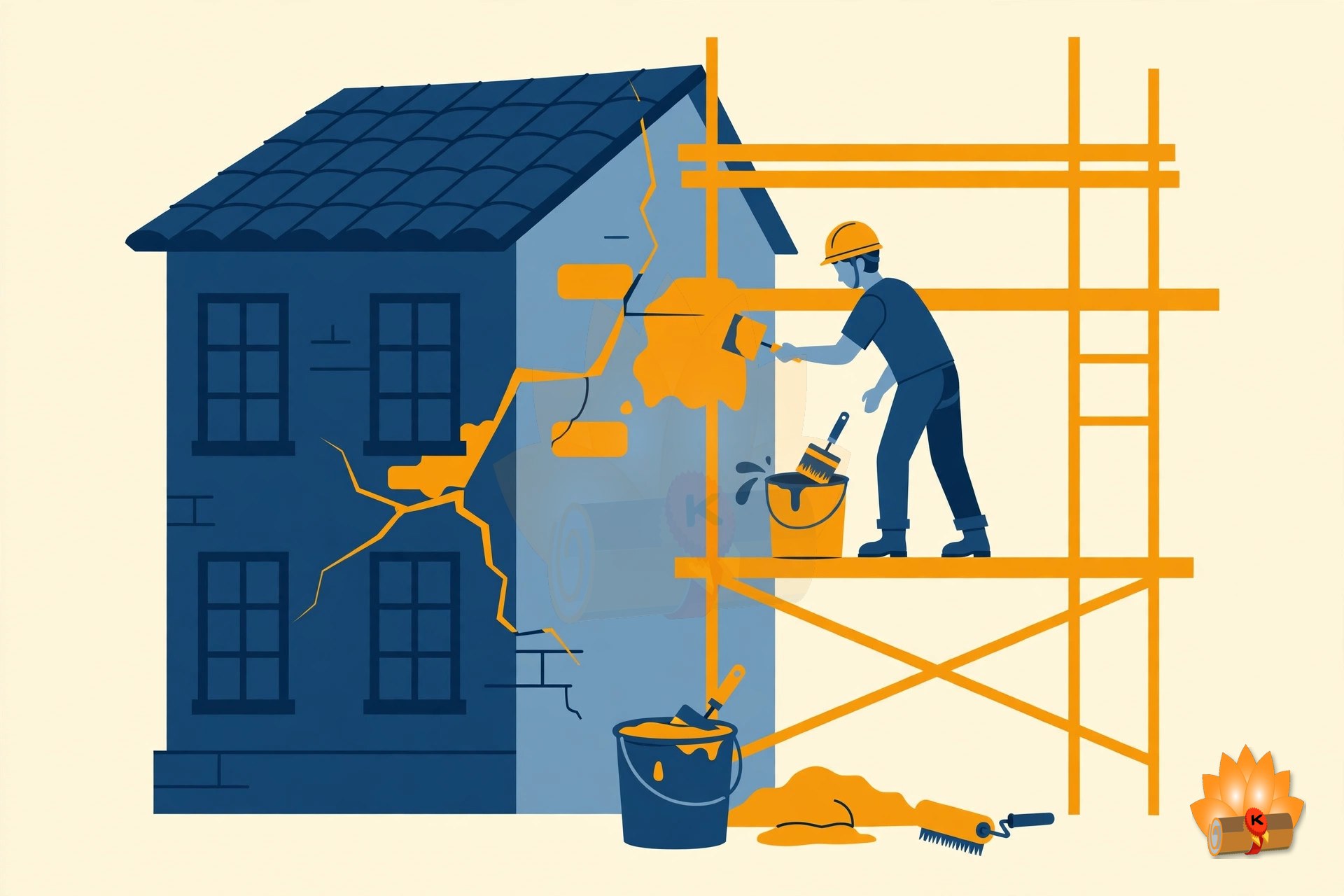
Most of the buildings a civil engineer will ever work on already exist — and they crack, leak, corrode and age. Repair and Maintenance of Building is Program Elective-1, Option B: you take this or Green Building and Energy Conservation, not both. It teaches you to find out why a building is failing and how to fix it properly, instead of just covering the damage up.
The subject starts with why maintenance matters and what damages buildings — human, chemical and environmental causes — then classifies defects element by element (foundations, walls, columns, roofs, finishes), and ends with the biggest unit (30%): the actual repair methods — epoxy injection, stitching, corrosion repair in RCC, DPC repair and waterproofing.
Subject 5.5 (Program Elective-1, Option B) • Total 100 Marks • 2 Credits • L 2 • Choose this OR Green Building and Energy Conservation • 5th Semester — Civil Engineering • Session 2026–27
What You Will Study
Unit 1 — Basics of Maintenance (5 Periods, 15%)
Need for maintenance: importance and significance of repair and maintenance of buildings, meaning of maintenance, objectives of maintenance, factors influencing the repair and maintenance.
Why buildings need maintenance, what maintenance means, and the factors that decide how much repair a building needs.
Unit 2 — Damages: Causes and Its Detection (6 Periods, 20%)
Agencies causing deterioration (sources, causes, effects): definition of deterioration/decay; factors causing deterioration, their classification, human factors causing deterioration, chemical factors causing deterioration, environmental conditions causing deterioration, miscellaneous factors; effects of various agencies of deterioration on various building materials i.e. bricks, timber, concrete, paints, metals, plastics, stones; investigation and diagnosis of defects: systematic approach/procedure of investigation, sequence of detailed steps for diagnosis of building defects/problems, list of non-destructive and other tests on structural elements and materials to evaluate the condition of the building, and study of three most commonly used tests.
What damages buildings — human, chemical and environmental causes — and how defects are investigated and diagnosed, including non-destructive tests.
Unit 3 — Defects and Their Root Causes (5 Periods, 20%)
Define defects in buildings, classification of defects; main causes of building defects in various building elements: foundations, basements and DPC, walls, column and beams, roof and terraces, joinery, decorative and protective finishes, services, defects caused by dampness.
The defects themselves, classified by element — foundations, walls, columns, roofs, joinery and finishes — and their root causes, including dampness.
Unit 4 — Materials for Repair, Maintenance and Protection (3 Periods, 15%)
Compatibility aspects of repair materials; state application of following materials in repairs: anti-corrosion coatings, adhesives/bonding aids, repair mortars, curing compounds, joints sealants, waterproofing systems for roofs, protective coatings.
The materials used for repair — anti-corrosion coatings, adhesives, repair mortars, curing compounds, sealants and waterproofing systems.
Unit 5 — Remedial Measures for Building Defects (9 Periods, 30%)
Preventive maintenance considerations; surface preparation techniques for repair; crack repair methods: epoxy injection, grooving and sealing, stitching, adding reinforcement and grouting, and flexible sealing by sealant; repair of surface defects of concrete: bug holes, form tie holes, honey comb and larger voids; repair of corrosion in RCC elements: steps in repairing and prevention of corrosion in reinforcement; material placement techniques with sketches: pneumatically applied (the gunite techniques), open top placement, pouring from the top to repair bottom face, birds mouth, dry packing, form and pump, preplaced-aggregate concrete, trowel applied method; repair of DPC against rising dampness: physical methods, electrical methods, chemical methods; repair of walls: repair of mortar joints against leakage and efflorescence removal; waterproofing of wet areas and roofs: waterproofing of wet areas, waterproofing of flat RCC roofs, various waterproofing systems and their characteristics; repair of joints in buildings: types of sealing joints with different types of sealants, techniques for repair of joints, and repair of overhead and underground water tanks.
How defects are actually fixed — crack repair by epoxy injection and stitching, corrosion repair in RCC, DPC repair, waterproofing of roofs and wet areas, and joint repair.
Complete Syllabus
The full examination scheme, the complete practicals list and the reference books from the official syllabus. The unit-wise topics are in the “What You Will Study” section above.
Examination Scheme
| Code | Paper | Type | L – P | Credits | Internal | External | Total |
|---|---|---|---|---|---|---|---|
| 5.5 | Program Elective-1: Repair and Maintenance of Building | Theory | 2 – 0 | 2 | Theory 40 | Theory 60 (3 hrs) | 100 |
| Repair and Maintenance of Building Total | 2 | 40 | 60 | 100 | |||
Units at a Glance
| Unit | Topic | Periods | Marks Share |
|---|---|---|---|
| 1 | Basics of Maintenance | 5 | 15% |
| 2 | Damages: Causes and Its Detection | 6 | 20% |
| 3 | Defects and Their Root Causes | 5 | 20% |
| 4 | Materials for Repair, Maintenance and Protection | 3 | 15% |
| 5 | Remedial Measures for Building Defects | 9 | 30% |
Reference Books
As listed in the syllabus:
- Gahlot, P. S., Sharma, S., Building Repair and Maintenance Management, CBS Publishers & Distributors Pvt. Ltd., New Delhi.
- Guha, P. K., Maintenance and Repairs of Buildings, New Central Book Agencies.
- Hutchin Son, B. D., Maintenance and Repairs of Buildings, Newnes-Butterworth.
- Relevant BIS codes.
- Aarti Chaurasiya, Repair & Maintenance of Buildings, Asian Publishers, Muzaffarnagar, ISBN No. 978-93-5502-178-6.
Frequently Asked Questions
How many marks is Repair and Maintenance of Building worth in the 5th semester?
100 marks in total and 2 credits. Program Elective-1: Repair and Maintenance of Building: 100 marks (internal Theory 40, external Theory 60 (3 hrs)).
Which units carry the most weightage in Repair and Maintenance of Building?
Remedial Measures for Building Defects (30%, 9 periods) — the highest weightage in the subject. The complete unit-wise weightage table is in the Complete Syllabus section above.
Which books should I refer to for Repair and Maintenance of Building?
The syllabus lists 5 books, including Gahlot, P. S., Sharma, S., Building Repair and Maintenance Management, CBS Publishers &… and Guha, P. K., Maintenance and Repairs of Buildings, New Central Book Agencies., among others. The full list is in the Complete Syllabus section above.
Is Repair and Maintenance of Building a theory subject or a practical subject?
Program Elective-1: Repair and Maintenance of Building is theory (L–P 2 – 0).
Do I have to study both Repair and Maintenance of Building and Green Building?
No. Repair and Maintenance of Building is Program Elective-1, Option B, and Green Building and Energy Conservation is Option A. You choose one of the two. Both are 100 marks and 2 credits.
How can I download the Repair and Maintenance of Building syllabus PDF?
The PDF is free to download — use the download link in the Download section below. It is prepared by KAMALDNP Academy from the official BTEUP syllabus.
Related Syllabus Posts
- BTEUP Civil 5th Semester Syllabus 2026-27
- BTEUP Civil Complete Syllabus 2026-27 — 5th & 6th Semester (All Subjects)
- Transportation Engineering — BTEUP Civil 5th Semester Syllabus 2026-27
- Estimating Costing and Valuation — BTEUP Civil 5th Semester Syllabus 2026-27
- Geotechnical Engineering — BTEUP Civil 5th Semester Syllabus 2026-27
- Design of Steel Structure and Drawing — BTEUP Civil 5th Semester Syllabus 2026-27
Download the Repair and Maintenance of Building Syllabus PDF
Download the complete Repair and Maintenance of Building syllabus PDF below — prepared by KAMALDNP Academy, with the full topic list, practicals and reference books.
Download the Repair and Maintenance of Building Syllabus PDF
Source: BTEUP 3rd Year curriculum (folder2627), approved in C.D.C. meeting held on 16.07.2026. Topic lists follow the official syllabus; short explanations are the author's own plain-English summaries, not syllabus text. Please confirm with your own polytechnic for any local changes.

Comments (0)
Share your question or experience about this syllabus. Your comment will appear after review.
No comments yet — be the first to share your thoughts!