

Good news for every CSE 3rd-semester student: the complete Operating System book and question bank for your subject 3.1, Operating System, is ready. KAMALDNP has published both as PDFs on this website: the full subject book that teaches you the whole syllabus in simple language, and a question bank that gives you unit-wise questions with answers, solved numericals, model papers and real previous board papers. Both books come in two separate versions, English and Hindi, so you can study in the language you actually think in.
Price, stated plainly — last checked: 18 November 2026. This page is free; the study material below is a paid product: buy once for just ₹10. The Complete Book costs ₹10 and the Question Bank costs ₹10, and one payment for either product includes both the English and Hindi PDFs. There is no free download of these two books on this page. The buttons below take you to the Books page, where you buy them.
The Two Books at a Glance
| Product | English PDF | Hindi PDF | Price |
|---|---|---|---|
| Operating System — Complete Book All 13 chapters + lab appendix (12 experiments) | 100 pages · about 6.5 MB | 88 pages · about 6.7 MB | Buy on the Books page — ₹10 |
| Operating System — Question Bank Unit-wise questions with answers + model papers + previous papers | 55 pages · about 3.2 MB | 47 pages · about 3.3 MB | Buy on the Books page — ₹10 |
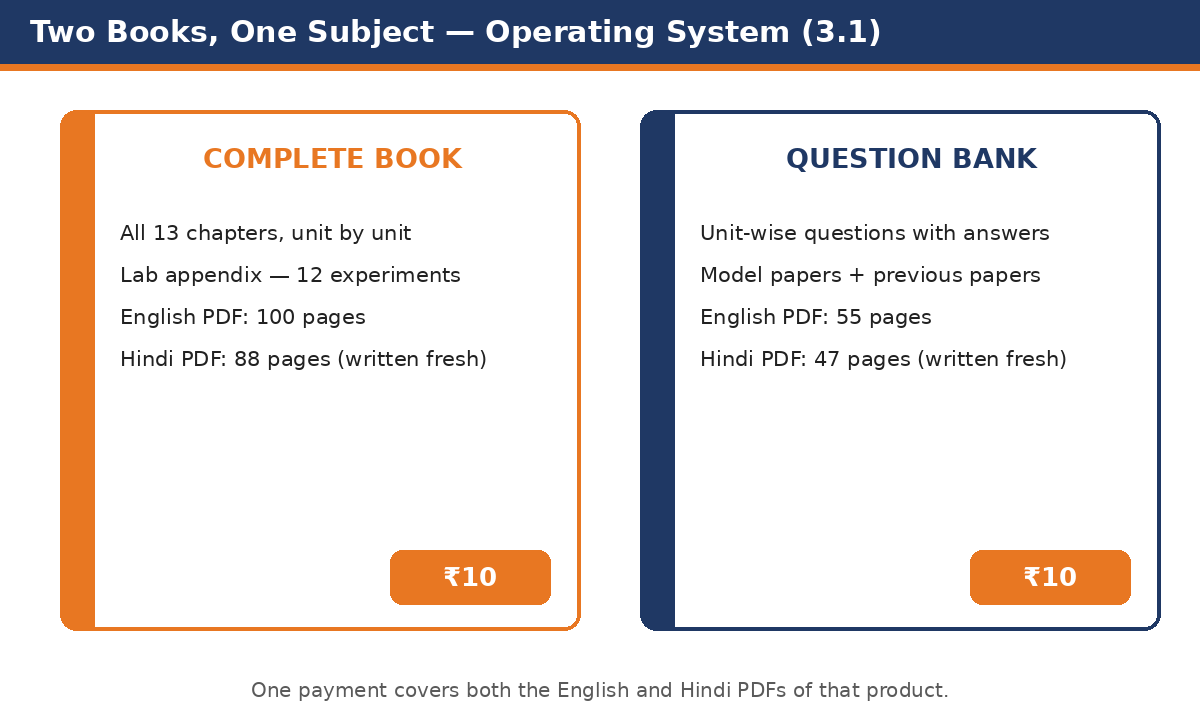
One small thing students always ask: the Hindi books are not a machine translation of the English books. The Hindi book is written fresh in Hindi, in simple everyday words, so it reads naturally, the language you would use to explain the topic to a friend.
What Is Inside the Book?
The book follows the official syllabus unit by unit, in the same order your paper is set. Here is the full journey of its 13 chapters. The weightage figures come from the official syllabus: the two 25% units are the ones your paper leans on most.
Unit 1 — Overview of Operating System (Chapters 1–2; 14% of the syllabus). What an operating system is, its types, its functions and services, and then the kernel, system calls and system programs, explained with daily-life examples, like the manager of a hotel who gives every guest what they need without letting them disturb each other.
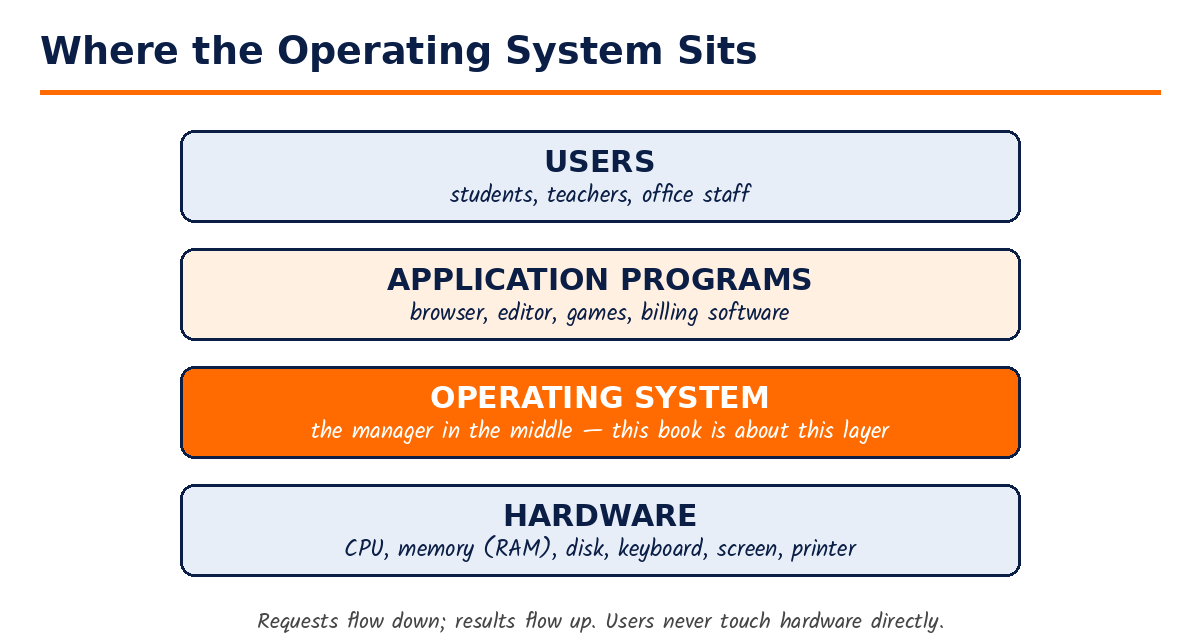
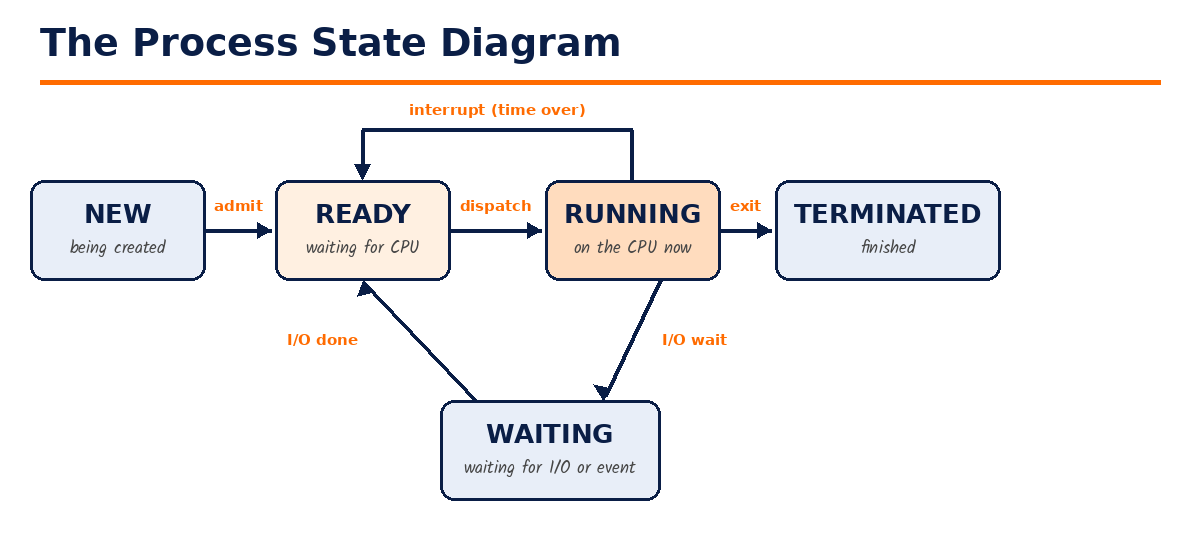
Unit 2 — Process Management (Chapters 3–6; 25%). Process concepts and operations, CPU scheduling with its algorithms, inter-process communication, synchronisation and the critical section, and finally deadlock with the Banker's Algorithm. This is one of the two biggest units of the paper, so it gets four full chapters.
Unit 3 — Memory Management (Chapters 7–9; 25%). Memory allocation (First Fit, Best Fit, Worst Fit), swapping, paging and segmentation, page faults, page replacement, fragmentation and virtual memory, the second big unit, with every numerical method shown step by step.
Unit 4 — I/O System (Chapters 10–11; 18%). Mass storage and disk structure, disk scheduling, swap space and RAID.
Unit 5 — File Management (Chapters 12–13; 18%). File concepts, access methods, directory structure and mounting, then file sharing, protection, implementation and file system types.
Lab Appendix — 12 experiments. The complete Operating System lab work, written out so you can prepare your practical file and viva from one place: Linux/Unix commands, CPU scheduling simulations, the Dining Philosophers problem, Banker's Algorithm, memory allocation and page replacement simulations, disk scheduling, and file organisation and allocation.
The book is written with one rule: every definition is complete in a single reading. You should not need a second book, a video or a senior's notes to finish a topic. Simple language, real-life examples and diagrams run through every chapter, so the topic stays in your head, not just on the page.
What Is Inside the Question Bank?
The question bank is built for practice, not just reading. For each of the 5 units you get:
- 15 MCQs with answers — for quick revision and objective practice;
- 8 short-answer questions with full answers — the two-to-five-mark questions of your paper;
- 4 long-answer questions with complete answers — written the way you should write them in the exam;
- Worked numericals — scheduling calculations, page replacement and similar problems solved step by step, so you can copy the method, not just the answer.
After the five units you get 2 model papers set on the 60-mark pattern of your theory paper, so you can sit a full paper at home before the real one. And at the end there is a previous-papers chapter: real questions from previous BTEUP board papers, each one tagged with the paper it was asked in, so you can see with your own eyes which topics the board returns to again and again.
An honest word about previous papers. Only two genuine diploma papers for this subject could be verified and collected: the May 2025 paper (code 2207) and one undated code-2207 paper. The previous-papers chapter is built from those two papers, and from nothing else. We do not claim "all papers of the last ten years", because nobody can honestly promise that, and we do not dress up papers from other courses as diploma papers. If more genuine papers are verified, they will be added and this note will be updated.
How to Buy, and What You Get After Purchase
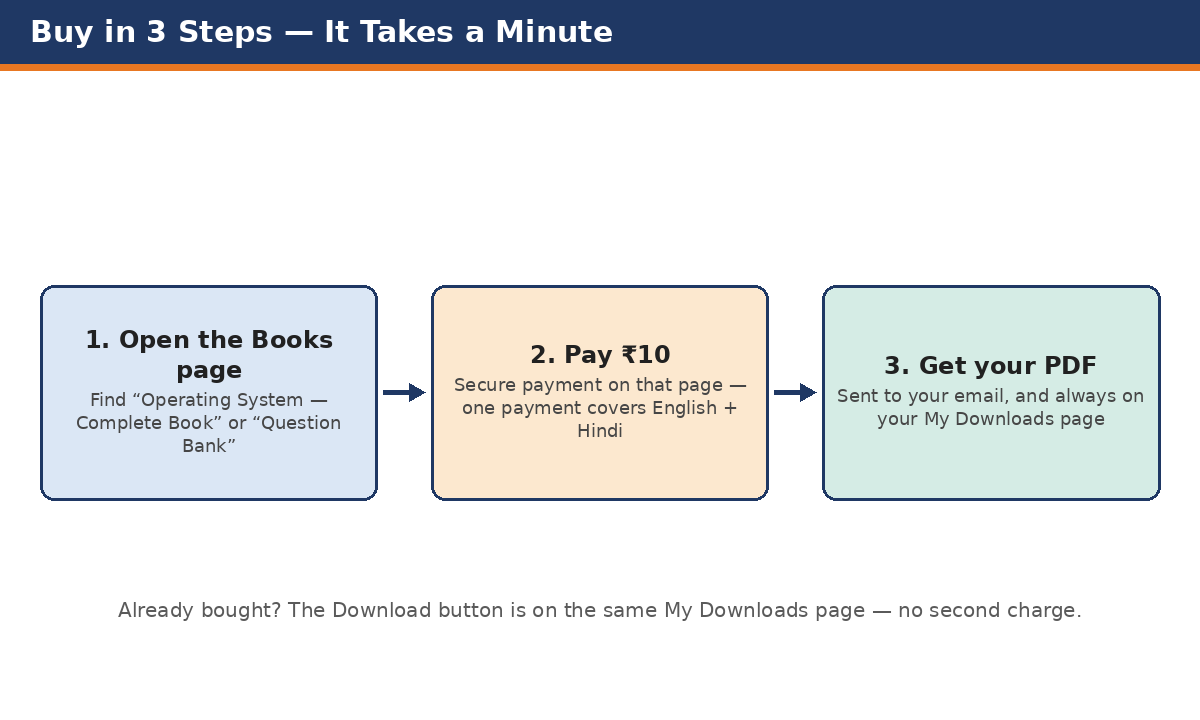
Buying takes a minute:
- Open the Books page and find "Operating System — Complete Book" or "Operating System — Question Bank".
- Pay ₹10 for the product you want, through the secure payment on that page. One payment covers both the English and Hindi PDFs of that product.
- After purchase, the PDF is sent to your email, and it stays available for download on the My Downloads page. If you already bought it, you will find the Download button on the same page, and you will not be charged again.
Two things to know before you buy. The question bank, like the notes and practice sets on this site, is generated with your name and enrolment number and is password-locked, so it stays personal to you. And every digital product on this site carries a single-user licence: it is for your own study only, and distribution is not allowed. That is why there is no free copy floating around, and why sharing the file, however well meant, is not permitted. Share this page with your classmates instead, so they can get their own copies for ₹10 each.
How to Use the Two Books Together
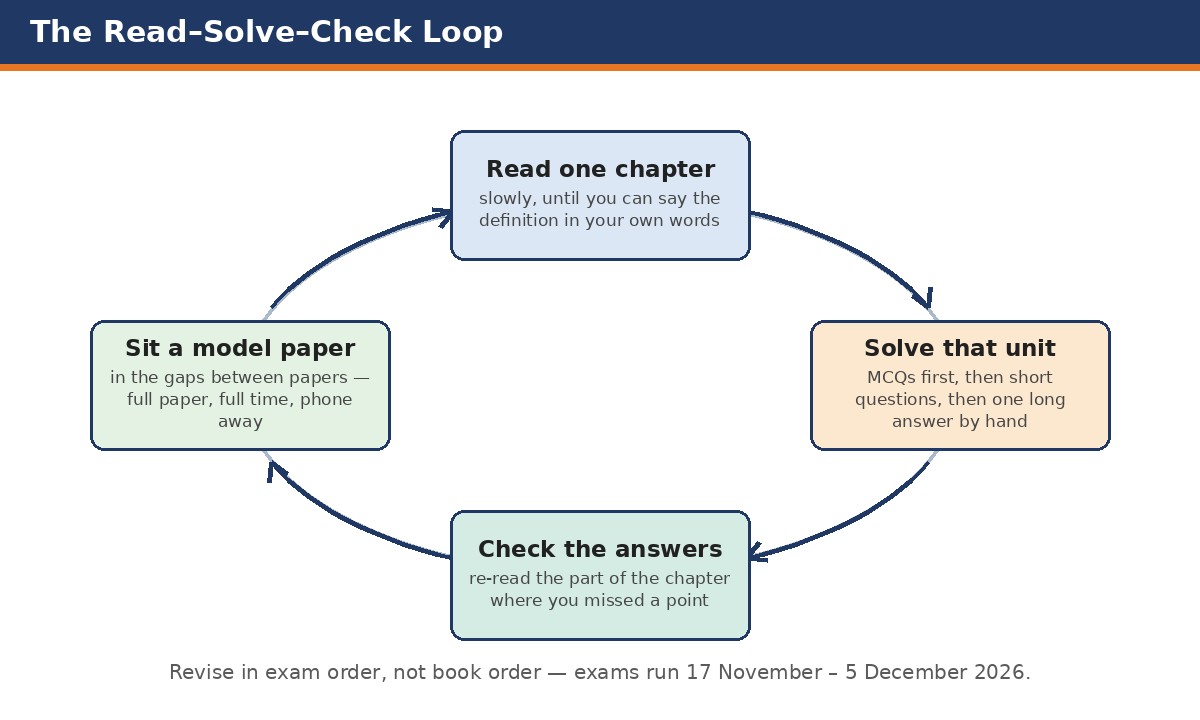
The odd-semester examinations are running now (17 November – 5 December 2026), so revise in exam order, not book order. For each unit, follow this loop:
- Read one chapter of the book. Go slowly; make sure you can say the definition in your own words before moving on.
- Solve that unit in the question bank. First the MCQs, then the short questions, then one long answer written by hand without looking.
- Check with the given answers. Where your answer missed a point, go back to that part of the chapter and read it once more. This loop, read, solve, check, is where marks are actually made.
- In the gaps between papers, sit a model paper. Full paper, full time, phone away. Then revise the units where you lost marks.
Who Should Buy These Books?
Every BTEUP Polytechnic Diploma CSE 3rd-semester student, this is your subject 3.1, complete, with the lab appendix for subject 3.5. Together the theory paper and the lab carry 200 marks and 4 credits, so this subject alone is a large part of your semester. IT (Information Technology) students whose Operating System syllabus matches the same units can also use both books. And if you are a Hindi-medium student who has always struggled with English textbooks, the Hindi versions were made exactly for you: same syllabus, same chapters, in your own language.
One honest line, as always: these books are made by KAMALDNP. They are not published by BTEUP. They are built strictly on BTEUP's official 2026-27 syllabus for this subject, the 2nd Year curriculum approved in the C.D.C. meeting held on 16 July 2026, which is the list that governs your paper. Inside the PDFs you will find no phone number and no advertisement, only the subject. The free syllabus PDF for this subject is on the Operating Systems syllabus page.
More Material for the Rest of Your Semester
Operating System is one subject of your semester. For the rest, our BTEUP notes and model papers page lists short notes and practice papers for 1st semester (all branches), CSE 3rd semester and CSE 5th semester, 29 notes PDFs and 13 model papers in all, each subject's material ₹10 on the Books page, with every subject's syllabus PDF free. And the BTEUP exam preparation 2026-27 complete guide ties together the syllabus, admit card steps, previous-paper practice and results in one place. For the exam dates themselves, follow the date sheet and admit card update post: the date sheet is out and the examinations run 17 November to 5 December 2026.
Frequently Asked Questions
Q. How much do the Operating System book and question bank cost?
₹10 each. The Complete Book is ₹10 and the Question Bank is ₹10, on the Books page. One payment for either product includes both the English and Hindi PDFs, so you never pay twice for the two languages.
Q. Is there a free download of these books anywhere on this page?
No. The book and the question bank are paid products, and this page does not host a free copy of either. What is free here is this page itself, and the Operating System syllabus PDF, which you can download free from the subject's syllabus page (linked above). Never pay any other website for these books: they are sold only on kamaldnp.com.
Q. Is the Hindi version available separately?
Yes. The Hindi book and the Hindi question bank are separate PDFs, written fresh in simple Hindi, not a translation of the English text, and both are included in the same ₹10 payment as the English version.
Q. Which semester and branch are these books for?
BTEUP Polytechnic Diploma, CSE 3rd semester, subject 3.1 Operating System (5 units, 60-mark external theory paper, 3 hours) plus the lab appendix for subject 3.5. Together the theory and lab carry 200 marks and 4 credits. IT students with the same Operating System syllabus can use them too.
Q. Does the question bank give answers, or only questions?
Answers are given with the questions: MCQs with answer keys, short and long questions with complete answers, and numericals solved step by step. That is the whole point of the book: read, practise, and check yourself.
Q. What do I get after I pay?
The PDF is sent to your email, and it stays available for download on the My Downloads page. The question bank is generated with your name and enrolment number and is password-locked. If you ever lose the file, download it again from My Downloads: you are not charged twice.
Q. Are the PDFs easy to print?
Yes. The PDFs are clean text with diagrams, made to print well in black and white as well. Many students print the question bank and keep the book on the phone, do what suits your study style.
Q. Can I share these PDFs with my classmates?
No, please do not share the files. Every PDF on this site is sold under a single-user licence for your own study, and the question bank is personalised with your name and enrolment number. Share this page with your classmates instead, so they can buy their own copies for ₹10 each.
Sources: the product listings on the kamaldnp.com Books page (prices and page counts, checked 18 November 2026); the Operating Systems syllabus post on this site (subject 3.1/3.5 scheme, unit weightages, 12 practicals, previous-papers note: May 2025 code 2207 + one undated code-2207 paper; source: BTEUP 2nd Year curriculum, approved in the C.D.C. meeting held on 16 July 2026); the BTEUP date-sheet update post on this site (examinations 17 November – 5 December 2026). Last checked: 18 November 2026.


Comments (0)
Share your question or experience about this syllabus. Your comment will appear after review.
No comments yet — be the first to share your thoughts!