
कृपया ध्यान दें — कवर वर्ष बनाम स्वीकृति: इस पाठ्यक्रम के लिए BTEUP की अपनी फ़ाइल के कवर पर "YEAR 2025-2026" छपा है, जबकि उसके हर पृष्ठ पर स्वीकृति पंक्ति "UPDATED AND APPROVED BY BOARD OF TECHNICAL EDUCATION U.P. LUCKNOW IN C.D.C MEETING HELD ON 16.07.2026" है। यह BTEUP के 2026-27 फ़ोल्डर (folder2627) में रखी है, इसलिए उस स्वीकृति के आधार पर इसे यहाँ 2026-27 सिलेबस माना गया है। इसमें दी गई योजना 2025-26 की योजना से विषय-दर-विषय और अंक-दर-अंक समान है।
Electrical and Electronic Measurements — यह विषय किस बारे में है
जिसे आप माप नहीं सकते, उसे maintain भी नहीं कर सकते। Electrical and Electronic Measurements आपको विभिन्न electrical applications में सही measuring instrument का उपयोग करना सिखाता है — voltage, current, power, energy और circuit parameters। यह practicum विषय है (L 2 – P 4) जिसमें 15 practicals हैं, इसलिए ज़्यादातर सीखना instruments हाथ में लेकर होता है।
पाँचों units measurement की बुनियादी बातों से शुरू होकर voltage और current, power और energy, और फिर CRO और अन्य meters से circuit-parameter measurement तक जाती हैं। अंतिम unit का weightage सबसे ज़्यादा है — 30% (06 पीरियड): resistance, inductance और capacitance का मापन, CRO मापन, और earth tester, L-C-R meter और tri-vector meter जैसे meters। 7 संदर्भ पुस्तकें हैं।
Subject 3.4 (Practicum) • Total 100 Marks • 4 Credits • L 2 – P 4 • 3rd सेमेस्टर — Electrical Engineering • सत्र 2026–27
आप क्या पढ़ेंगे
Unit – I: Fundamentals of Measurements (06 Periods, 10%)
Measurement: Significance, units, fundamental quantities and standards; Classification of Instrument Systems, Classifications of Analog Instruments (Indicating, Recording and Integrating); Essential requirements of an indicating instruments: deflecting, controlling, damping torque; Static and dynamic characteristics, types of errors; Calibration: need and procedure.
Unit – II: Measurement of voltage and current (06 Periods, 23%)
Concept and working principles of moving iron (MI) and moving coil (MC) instruments; DC Ammeter: Basic, Multi range, Universal shunt; DC Voltmeter: Basic, Multi-range, concept of loading effect and sensitivity; AC voltmeter: Rectifier type (half wave and full wave); CT and PT: working principle and applications; Clamp-on meter.
Unit – III: Measurement of Electric Power (06 Periods, 22%)
Analog meters: Permanent magnet moving coil (PMMC) and Permanent magnet moving iron (PMMI) meter, their construction, working, salient features, merits and demerits; Dynamometer type wattmeter: Construction, working, merits and demerits; Range extension: Multiplying factor and extension of range using CT and PT; Errors and compensations; Active and reactive power measurement: One, two and three wattmeter method; Effect of Power factor on wattmeter reading in two wattmeter method; Maximum Demand indicator: construction and working principle; Digital wattmeter.
Unit – IV: Measurement of Electric Energy (04 Periods, 15%)
Single and three phase electronic energy meter: Constructional features and working principle; Errors and their compensations; Calibration of single-phase electronic energy meter using direct loading; Digital energy meter.
Unit – V: Circuit Parameter Measurement through CRO and Other Meters (06 Periods, 30%)
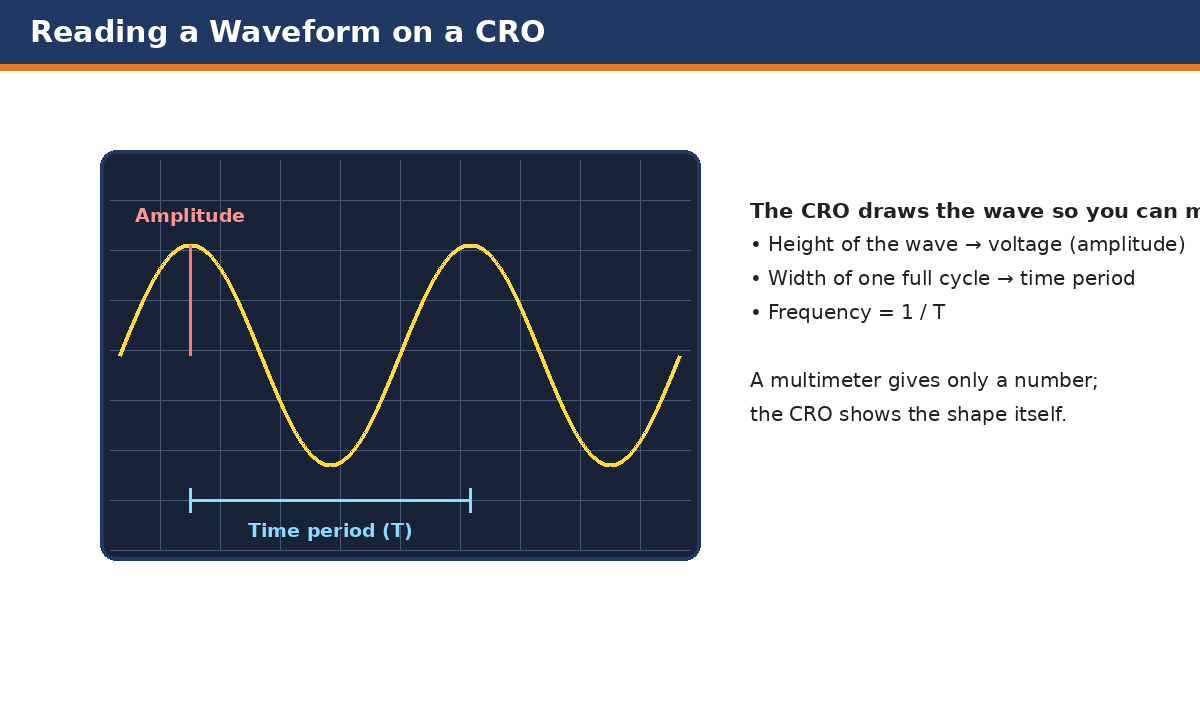
Measurement of resistance: (a) Low resistance: Kelvin's double bridge, (b) Medium Resistance: Voltmeter and ammeter method, and (c) High resistance: Megger and Ohm meter: Series and shunt; Measurement of inductance using Anderson bridge (no derivation and phasor diagram); Measurement of capacitance using Schering bridge (no derivation and phasor diagram); Measurement of voltage/ amplitude/ time period/ frequency/ phase angle delay line, through CRO; Other meters: Earth tester, Digital Multimeter; L-C-R meter, Frequency meter (ferromagnetic and Weston type), Phase sequence indicator, power factor meter (single phase and three phase dynamometer type), Synchro scope, Tri-vector meter.
प्रैक्टिकल कार्य
- Unit I — Identify measuring instruments on the basis of symbols on dial, type, accuracy, class position and scale.
- Unit II — Measure AC and DC quantities in a working circuit.
- Unit II — Use Voltmeter, Ammeter and Wattmeter for different loads to conduct an experiment to measure voltage, current and power respectively in single phase a.c circuit.
- Unit II — Use Clamp-On Meter to conduct an experiment to measure current in a.c circuit.
- Unit III — Use single wattmeter for measurement of active power and power factor of single-phase circuit.
- Unit III — Use two wattmeters for measuring active power of three-phase balanced load.
और भी हैं — 15 प्रैक्टिकल्स की पूरी सूची PDF के अंदर है।
पूरा सिलेबस
आधिकारिक सिलेबस से पूरी परीक्षा योजना, प्रैक्टिकल्स की पूरी सूची और संदर्भ पुस्तकें। यूनिट-वार विषय ऊपर "आप क्या पढ़ेंगे" वाले भाग में हैं।
परीक्षा योजना
| कोड | पेपर | प्रकार | L – P | क्रेडिट | आंतरिक | बाह्य | कुल |
|---|---|---|---|---|---|---|---|
| 3.4 | Electrical and Electronic Measurements | Practicum | 2 – 4 | 4 | 60 | 40 (3 hrs) | 100 |
| Electrical and Electronic Measurements Total | 4 | 60 | 40 | 100 | |||
यूनिट्स एक नज़र में
| यूनिट | विषय | पीरियड | अंकों का हिस्सा |
|---|---|---|---|
| I | Fundamentals of Measurements | 06 | 10% |
| II | Measurement of voltage and current | 06 | 23% |
| III | Measurement of Electric Power | 06 | 22% |
| IV | Measurement of Electric Energy | 04 | 15% |
| V | Circuit Parameter Measurement through CRO and Other Meters | 06 | 30% |
प्रैक्टिकल्स की पूरी सूची
यह आधिकारिक सिलेबस से प्रैक्टिकल्स की पूरी सूची है।
- Unit I — Identify measuring instruments on the basis of symbols on dial, type, accuracy, class position and scale.
- Unit II — Measure AC and DC quantities in a working circuit.
- Unit II — Use Voltmeter, Ammeter and Wattmeter for different loads to conduct an experiment to measure voltage, current and power respectively in single phase a.c circuit.
- Unit II — Use Clamp-On Meter to conduct an experiment to measure current in a.c circuit.
- Unit III — Use single wattmeter for measurement of active power and power factor of single-phase circuit.
- Unit III — Use two wattmeters for measuring active power of three-phase balanced load.
- Unit III — Extend range of ammeter and voltmeter by using (i) shunt and multiplier (ii) CT and PT.
- Unit IV — Calibrate single phase energy meter by direct loading.
- Unit V — Use digital multi-meter for measurement of AC/DC current, AC/DC voltage.
- Unit V — Use Kelvin's double bridge for measurement of low resistance.
- Unit V — Use voltmeter and ammeter method for measurement of medium resistance.
- Unit V — Use Megger for insulation resistance measurements.
- Unit V — Use earth tester for measurement of earth resistance.
- Unit V — Use CRO for the Measurement of supply frequency in single-phase circuit.
- Unit V — Use Tri-vector meter for measuring kW, kVAr and kVA of a power line.
संदर्भ पुस्तकें
सिलेबस में दी गई सूची के अनुसार:
- Theraja B. L., Theraja A. K., A Text Book of Electrical Technology Vol-I (Basic Electrical Engg.), S.Chand and Co. New Delhi, ISBN: 9788121924405
- Dr. T.D. Bisht, Ashish Sahu, Pooja Yadav, Electrical Instrumentation & Measurement, Asian Publishers, Muzaffarnagar. ISBN: 978-93-91541-29-3
- Mittle V. N., Basic Electrical Engineering, McGraw-Hill New Delhi, ISBN: 978-0-07-0088572-5
- Edward Hughes, Electrical Technology, Pearson Education, New Delhi, ISBN-13: 978-0582405196
- Rajput R.K., Electrical and Electronic Measurement and Instrumentation, S.Chand and Co. New Delhi, ISBN: 9789385676017
- Sawhney A.K., Electrical and Electronics Measurements and Instrumentation., Dhanpai Rai and Sons, New Delhi, ISBN: 9780000279744
- Suryanarayna N.V., Electrical Measurements and Measuring Instruments, S.Chand and Co. New Delhi, ISBN: 8121920116
अक्सर पूछे जाने वाले प्रश्न
तीसरा सेमेस्टर में Electrical and Electronic Measurements कितने अंकों का है?
कुल 100 अंक, 4 क्रेडिट। Practicum विषय (L 2 – 4): आंतरिक 60, बाह्य 40 (3 hrs)।
Electrical and Electronic Measurements में सबसे ज़्यादा भार वाली unit कौन सी है?
Circuit Parameter Measurement through CRO and Other Meters, 30% (06 पीरियड)।
Electrical and Electronic Measurements में कितने practicals हैं?
15 practicals — पूरी सूची ऊपर पूरा सिलेबस वाले भाग में है, और PDF में भी है।
Electrical and Electronic Measurements के लिए कौन सी किताबें पढ़नी चाहिए?
आधिकारिक सिलेबस में 7 संदर्भ पुस्तकें सूचीबद्ध हैं — पूरी सूची ऊपर पूरा सिलेबस वाले भाग में है।
Electrical and Electronic Measurements सिलेबस PDF कैसे डाउनलोड करूँ?
PDF मुफ़्त डाउनलोड के लिए है — नीचे Download वाले भाग में दिए गए लिंक का उपयोग करें। यह KAMALDNP द्वारा आधिकारिक BTEUP सिलेबस से तैयार किया गया है।
Lab में मैं वास्तव में क्या मापूँगा?
Working circuits में AC और DC quantities, एक और दो wattmeters से active power, direct loading से energy-meter calibration, bridges और Megger से low/medium/high resistance, earth resistance, CRO से supply frequency, और tri-vector meter से kW/kVAr/kVA।
संबंधित सिलेबस पोस्ट
- BTEUP Electrical 3rdवाँ सेमेस्टर सिलेबस 2026-27
- Electrical Engineering पूरा सिलेबस 2026-27
- Basics of Power Generation Systems — BTEUP Electrical 3rdवाँ सेमेस्टर सिलेबस 2026-27
- Electric Machine-1 — BTEUP Electrical 3rdवाँ सेमेस्टर सिलेबस 2026-27
- Electrical Circuits — BTEUP Electrical 3rdवाँ सेमेस्टर सिलेबस 2026-27
Electrical and Electronic Measurements सिलेबस PDF डाउनलोड करें
नीचे Electrical and Electronic Measurements का पूरा सिलेबस PDF डाउनलोड करें — KAMALDNP द्वारा तैयार, जिसमें topics की पूरी सूची, practicals और संदर्भ पुस्तकें हैं।
Electrical and Electronic Measurements सिलेबस PDF डाउनलोड करें
स्रोत: BTEUP द्वितीय वर्ष Electrical Engineering curriculum (folder2627)। फ़ाइल के कवर पर "YEAR 2025-2026" छपा है, लेकिन स्वीकृति पंक्ति "UPDATED AND APPROVED BY BOARD OF TECHNICAL EDUCATION U.P. LUCKNOW IN C.D.C MEETING HELD ON 16.07.2026" हर पृष्ठ पर (95 बार) है, और उस स्वीकृति के आधार पर इसे यहाँ 2026-27 सिलेबस माना गया है। विषय-सूचियाँ आधिकारिक सिलेबस के अनुसार हैं; छोटे स्पष्टीकरण लेखक के अपने सरल हिंदी सारांश हैं, सिलेबस का मूल पाठ नहीं। अपने पॉलिटेक्निक में किसी भी स्थानीय बदलाव की पुष्टि अवश्य करें।




Comments (0)
Share your question or experience about this syllabus. Your comment will appear after review.
No comments yet — be the first to share your thoughts!