
कृपया ध्यान दें — कवर वर्ष बनाम स्वीकृति: इस पाठ्यक्रम के लिए BTEUP की अपनी फ़ाइल के कवर पर "YEAR 2025-2026" छपा है, जबकि उसके हर पृष्ठ पर स्वीकृति पंक्ति "UPDATED AND APPROVED BY BOARD OF TECHNICAL EDUCATION U.P. LUCKNOW IN C.D.C MEETING HELD ON 16.07.2026" है। यह BTEUP के 2026-27 फ़ोल्डर (folder2627) में रखी है, इसलिए उस स्वीकृति के आधार पर इसे यहाँ 2026-27 सिलेबस माना गया है। इसमें दी गई योजना 2025-26 की योजना से विषय-दर-विषय और अंक-दर-अंक समान है।
Fundamentals of Power Electronics — यह विषय किस बारे में है
Power electronics वह है जिससे आप बिजली को ही नियंत्रित कर सकते हैं — उसके voltage, frequency या रूप को बदलने के लिए उसे एक सेकंड में हज़ारों बार on और off करना। Fundamentals of Power Electronics आपको power electronic devices के सही कामकाज को maintain करना सिखाता है: SCRs, IGBTs, rectifiers, inverters और choppers। यह practicum विषय है (L 2 – P 4) जिसमें 18 practicals हैं — 4th सेमेस्टर के किसी भी विषय से सबसे ज़्यादा।
इसमें चार units हैं: power electronic devices, thyristors के turn-on और turn-off methods, phase-controlled rectifiers, और inverters, choppers, dual converters और cyclo-converters। Devices वाली unit का weightage सबसे ज़्यादा है — 30% (08 पीरियड)। 9 संदर्भ पुस्तकें हैं।
Subject 4.3 (Practicum) • Total 100 Marks • 4 Credits • L 2 – P 4 • 4th सेमेस्टर — Electrical Engineering • सत्र 2026–27
आप क्या पढ़ेंगे
Unit – I: Power Electronic Devices (08 Periods, 30%)
Definition – Scope and Applications; Power Electronic Switch Specifications: Power Diode, Power transistor, IGBT, GTO, DIAC, TRIAC; SCR – rating and their importance, Symbol, Circuit, Working, Characteristics, Protection and Applications - Battery charger using SCR, Emergency light system, Temperature controller using SCR; Working Principle of UJT.
Unit – II: Turn-on and Turn-off Methods of Thyristors (08 Periods, 26%)
SCR Turn-On methods: Voltage triggering, Thermal triggering, Illumination triggering, dv/dt triggering, Gate triggering; SCR triggering using UJT, PUT: Relaxation Oscillator and Synchronized UJT circuit; Pulse transformer and opto-coupler based triggering; Application: UPS and SMPS; SCR Turn-Off methods: Natural & Forced Commutations.
Unit – III: Phase Controlled Rectifiers (06 Periods, 22%)
Phase control: firing angle, conduction angle, extinction angle; Single phase half controlled, full controlled and midpoint-controlled rectifier with R, RL load: Circuit diagram, working, input-output waveforms, equations for DC output and effect of freewheeling diode; Different configurations of bridge-controlled rectifiers: Full-Wave & Half Wave.
Unit – IV: Inverters, Choppers, Dual Converters, Cyclo-converters (06 Periods, 22%)
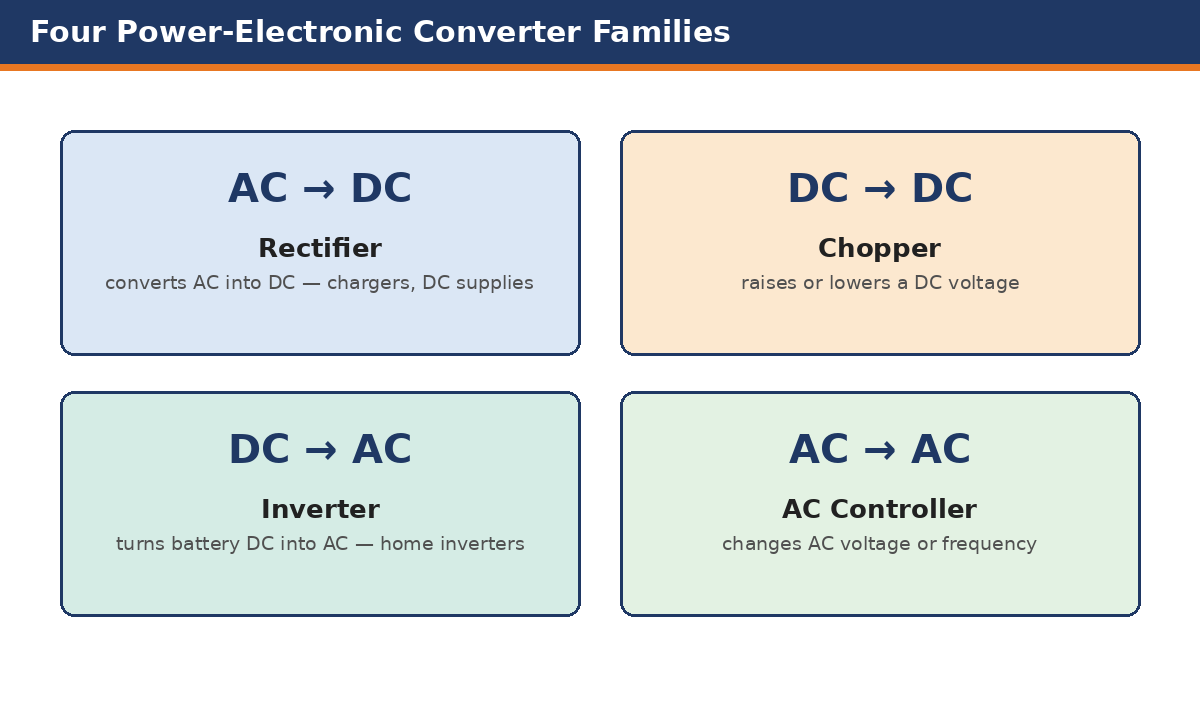
Inverter: Introduction, working principles, voltage and current driven series and parallel inverters and applications; Choppers: Introduction, types of choppers and their working principles and applications; Dual converters: Introduction, working principles and applications; Cyclo-converters: Introduction, types, working principles and applications.
प्रैक्टिकल कार्य
- Unit I — Identification & testing of SCR, TRIAC, DIAC, MOSFET and IGBT using a digital multimeter.
- Unit I — Obtain V-I characteristics of SCR.
- Unit I — Plot the V-I characteristics of IGBT and determine the break over voltage.
- Unit I — Plot the V-I characteristics of DIAC and determine the break over voltage.
- Unit I — Determine the latching current and holding current using V-I characteristics of SCR.
- Unit I — Plot the V-I characteristics of TRIAC and determine the break over voltage.
और भी हैं — 18 प्रैक्टिकल्स की पूरी सूची PDF के अंदर है।
पूरा सिलेबस
आधिकारिक सिलेबस से पूरी परीक्षा योजना, प्रैक्टिकल्स की पूरी सूची और संदर्भ पुस्तकें। यूनिट-वार विषय ऊपर "आप क्या पढ़ेंगे" वाले भाग में हैं।
परीक्षा योजना
| कोड | पेपर | प्रकार | L – P | क्रेडिट | आंतरिक | बाह्य | कुल |
|---|---|---|---|---|---|---|---|
| 4.3 | Fundamentals of Power Electronics | Practicum | 2 – 4 | 4 | 60 | 40 (3 hrs) | 100 |
| Fundamentals of Power Electronics Total | 4 | 60 | 40 | 100 | |||
यूनिट्स एक नज़र में
| यूनिट | विषय | पीरियड | अंकों का हिस्सा |
|---|---|---|---|
| I | Power Electronic Devices | 08 | 30% |
| II | Turn-on and Turn-off Methods of Thyristors | 08 | 26% |
| III | Phase Controlled Rectifiers | 06 | 22% |
| IV | Inverters, Choppers, Dual Converters, Cyclo-converters | 06 | 22% |
प्रैक्टिकल्स की पूरी सूची
यह आधिकारिक सिलेबस से प्रैक्टिकल्स की पूरी सूची है।
- Unit I — Identification & testing of SCR, TRIAC, DIAC, MOSFET and IGBT using a digital multimeter.
- Unit I — Obtain V-I characteristics of SCR.
- Unit I — Plot the V-I characteristics of IGBT and determine the break over voltage.
- Unit I — Plot the V-I characteristics of DIAC and determine the break over voltage.
- Unit I — Determine the latching current and holding current using V-I characteristics of SCR.
- Unit I — Plot the V-I characteristics of TRIAC and determine the break over voltage.
- Unit I — Illumination control / fan speed control through TRIAC.
- Unit II — Test the variation of R, C in R and RC triggering circuits on firing angle of SCR.
- Unit II — To Study UJT Triggering Techniques for Half Wave Controlled rectifiers.
- Unit II — To Study UJT Triggering Techniques for Full Wave Controlled rectifiers.
- Unit II — Perform the operation of Class – A, B, C, turn off circuits.
- Unit II — Perform the operation of Class – D, E, F turn off circuits.
- Unit III — Use CRO to observe the output waveform of half wave-controlled rectifier with resistive load and determine the load voltage.
- Unit III — Draw the output waveform of Full wave-controlled rectifier with R load, RL load, freewheeling diode and determine the load voltage.
- Unit III — Determine the firing angle using DIAC and TRIAC phase-controlled circuit on output power under different loads such as lamp, motor or heater.
- Unit IV — Test the performance of given SMPS, UPS.
- Unit IV — Performance Measurement and Analysis of DC-DC Buck Regulator.
- Unit IV — Performance Measurement and Analysis of DC-DC Boost Regulator.
संदर्भ पुस्तकें
सिलेबस में दी गई सूची के अनुसार:
- Ramamoorty M., An Introduction to Thyristors and their applications, East-West Press Pvt. Ltd., New Delhi, ISBN: 8185336679
- Sugandhi, Rajendra Kumar & Sugandhi, Krishna Kumar, Thyristors: Theory and Applications, New Age International (P) ltd. Pub., New Delhi, ISBN: 978-0-85226-852-0
- Bhattacharya, S.K., Fundamentals of Power Electronics, Vikas Publishing House Pvt. Ltd. Noida. ISBN: 978-8125918530
- Jain & Alok, Power Electronics and its Applications, Penram International Publishing (India) Pvt. Ltd, Mumbai, ISBN: 978-8187972228
- Rashid, Muhammad, Power Electronics Circuits Devices and Applications, Pearson Education India, Noida, ISBN: 978-0133125900
- Singh, M. D. and Khanchandani, K.B., Power Electronics, Tata McGraw Hill Publishing Co. Ltd, New Delhi, 2008 ISBN: 9780070583894
- Zbar, Paul B., Industrial Electronics: A Text – Lab Manual, McGraw Hill Publishing Co. Ltd., New Delhi, ISBN: 978-0070728226
- Grafham D.R., SCR Manual, General Electric Co., ISBN: 978-0137967711
- Rahul Wadhawa, Industrial Electronics And Control, Asian Publishers, Muzaffarnagar. ISBN: 978-93-5502-131-1
अक्सर पूछे जाने वाले प्रश्न
चौथा सेमेस्टर में Fundamentals of Power Electronics कितने अंकों का है?
कुल 100 अंक, 4 क्रेडिट। Practicum विषय (L 2 – 4): आंतरिक 60, बाह्य 40 (3 hrs)।
Fundamentals of Power Electronics में सबसे ज़्यादा भार वाली unit कौन सी है?
Power Electronic Devices, 30% (08 पीरियड)।
Fundamentals of Power Electronics में कितने practicals हैं?
18 practicals — पूरी सूची ऊपर पूरा सिलेबस वाले भाग में है, और PDF में भी है।
Fundamentals of Power Electronics के लिए कौन सी किताबें पढ़नी चाहिए?
आधिकारिक सिलेबस में 9 संदर्भ पुस्तकें सूचीबद्ध हैं — पूरी सूची ऊपर पूरा सिलेबस वाले भाग में है।
Fundamentals of Power Electronics सिलेबस PDF कैसे डाउनलोड करूँ?
PDF मुफ़्त डाउनलोड के लिए है — नीचे Download वाले भाग में दिए गए लिंक का उपयोग करें। यह KAMALDNP द्वारा आधिकारिक BTEUP सिलेबस से तैयार किया गया है।
Power Electronics में कितने practicals हैं?
18 practicals — SCRs, TRIACs, DIACs, MOSFETs और IGBTs की पहचान और जाँच से लेकर उनकी V-I characteristics बनाना, UJT triggering का अध्ययन, CRO पर rectifier waveforms देखना, और SMPS, UPS और DC-DC buck और boost regulators की जाँच तक।
संबंधित सिलेबस पोस्ट
- BTEUP Electrical 4thवाँ सेमेस्टर सिलेबस 2026-27
- Electrical Engineering पूरा सिलेबस 2026-27
- Electric Power Transmission and Distribution — BTEUP Electrical 4thवाँ सेमेस्टर सिलेबस 2026-27
- Electric Machine-2 — BTEUP Electrical 4thवाँ सेमेस्टर सिलेबस 2026-27
- Industrial Automation and Control — BTEUP Electrical 4thवाँ सेमेस्टर सिलेबस 2026-27
Fundamentals of Power Electronics सिलेबस PDF डाउनलोड करें
नीचे Fundamentals of Power Electronics का पूरा सिलेबस PDF डाउनलोड करें — KAMALDNP द्वारा तैयार, जिसमें topics की पूरी सूची, practicals और संदर्भ पुस्तकें हैं।
Fundamentals of Power Electronics सिलेबस PDF डाउनलोड करें
स्रोत: BTEUP द्वितीय वर्ष Electrical Engineering curriculum (folder2627)। फ़ाइल के कवर पर "YEAR 2025-2026" छपा है, लेकिन स्वीकृति पंक्ति "UPDATED AND APPROVED BY BOARD OF TECHNICAL EDUCATION U.P. LUCKNOW IN C.D.C MEETING HELD ON 16.07.2026" हर पृष्ठ पर (95 बार) है, और उस स्वीकृति के आधार पर इसे यहाँ 2026-27 सिलेबस माना गया है। विषय-सूचियाँ आधिकारिक सिलेबस के अनुसार हैं; छोटे स्पष्टीकरण लेखक के अपने सरल हिंदी सारांश हैं, सिलेबस का मूल पाठ नहीं। अपने पॉलिटेक्निक में किसी भी स्थानीय बदलाव की पुष्टि अवश्य करें।



Comments (0)
Share your question or experience about this syllabus. Your comment will appear after review.
No comments yet — be the first to share your thoughts!