
कृपया ध्यान दें — कवर वर्ष बनाम स्वीकृति: इस पाठ्यक्रम के लिए BTEUP की अपनी फ़ाइल के कवर पर "YEAR 2025-2026" छपा है, जबकि उसके हर पृष्ठ पर स्वीकृति पंक्ति "UPDATED AND APPROVED BY BOARD OF TECHNICAL EDUCATION U.P. LUCKNOW IN C.D.C MEETING HELD ON 16.07.2026" है। यह BTEUP के 2026-27 फ़ोल्डर (folder2627) में रखी है, इसलिए उस स्वीकृति के आधार पर इसे यहाँ 2026-27 सिलेबस माना गया है। इसमें दी गई योजना 2025-26 की योजना से विषय-दर-विषय और अंक-दर-अंक समान है।
Industrial Instrumentation and Condition Monitoring — यह विषय किस बारे में है
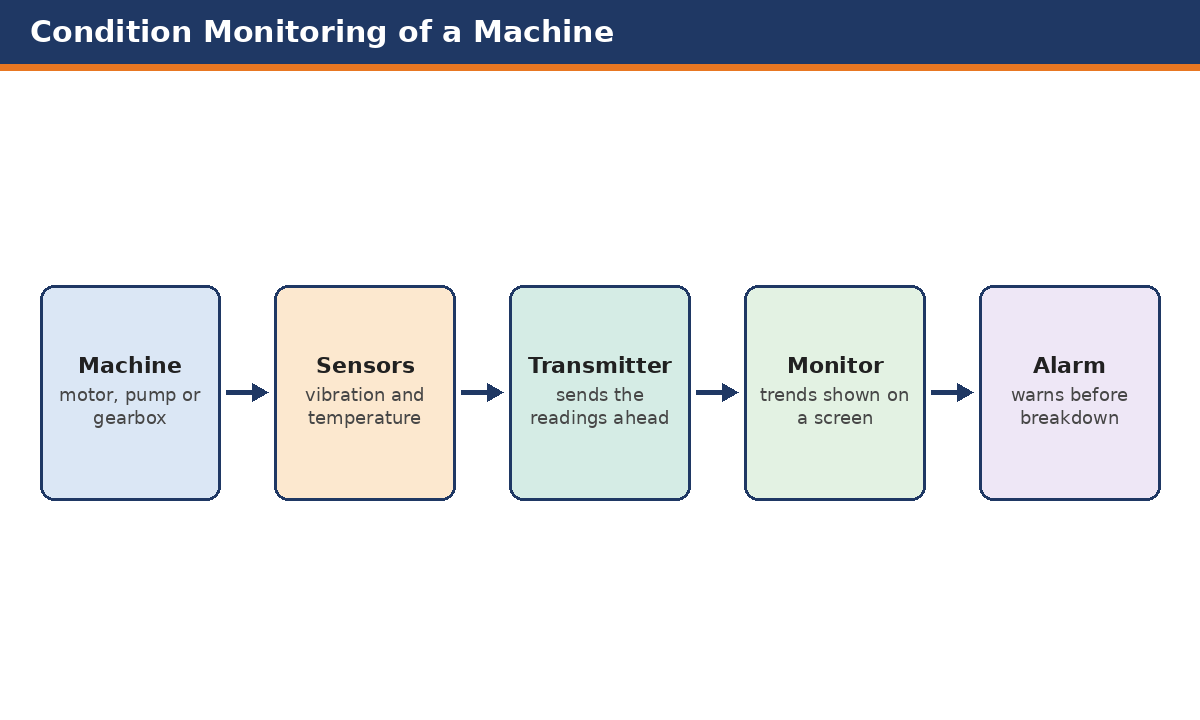
Instruments किसी संयंत्र की इंद्रियाँ हैं — वे temperature, pressure, flow और vibration को महसूस करते हैं, और machine के खराब होने से पहले चेतावनी देते हैं। Industrial Instrumentation and Condition Monitoring आपको condition monitoring और control के लिए instrumentation equipment का उपयोग करना सिखाता है। यह Program Elective-1, Option 2 है: आप यह विषय या Industrial Automation and Control चुनते हैं।
पाँचों units हैं: instrumentation की बुनियादी बातें, transducers, non-electrical quantities का मापन, signal conditioning, और data acquisition तथा condition monitoring। Non-electrical quantities के मापन और data acquisition का weightage सबसे ज़्यादा है — प्रत्येक 25%। यह practicum विषय है (L 1 – P 4) जिसमें 11 practicals हैं और 5 संदर्भ पुस्तकें हैं। एक ईमानदार नोट: PDF में Unit V का तीसरा practical सिर्फ “3.” नंबर के रूप में छपा है, बिना किसी text के — उसकी सामग्री पढ़ी नहीं जा सकी और उसे यहाँ शामिल नहीं किया गया है।
Subject 4.4.2 (Program Elective-1, Practicum) • Total 100 Marks • 3 Credits • L 1 – P 4 • Choose this OR Industrial Automation and Control • 4th सेमेस्टर — Electrical Engineering • सत्र 2026–27
Note: In the PDF, the third practical of Unit – V is printed as a bare number “3.” with no text — its content could not be read and is not included here.
आप क्या पढ़ेंगे
Unit – I: Fundamentals of instrumentation (02 Periods, 15%)
Basic purpose of instrumentation; Basic block diagram (transduction, signal conditioning, signal presentation) and their function; Construction, working and application of switching devices - Push button, limit switch, float switch, pressure switch, thermostat, electromagnetic relay.
Unit – II: Transducers (02 Periods, 20%)
Comparison between Primary and Secondary, Electrical and Mechanical, Analog and Digital, Active and Passive; Advantages of electric transducers; Required characteristics of transducers; Construction and working principle of resistive transducer - Potentiometer, variac and strain gauges; Gauge factor, Types of strain gauges; Construction and principle of Inductive transducers - L.V.D.T. and R.V.D.T, their applications; Construction, principle and applications of transducers – Piezo-Electric transducer, photoconductive cells, photo voltaic cells.
Unit – III: Measurement of Non-Electrical Quantities (05 Periods, 25%)
Temperature measurement - RTD, Thermistor and Thermocouple, radiation pyrometer; Pressure measurement – bourdon tube, bellow diaphragm and strain gauge, Combination of transducer - diaphragm and inductive transducer, Bourdon tube and LVDT, bellow and LVDT, diaphragm capacitance and bridge Circuit; Speed Measurement by contacting and non-Contact Type - DC tachometer, photo-electric tachometer, toothed rotor tachometer Generator - magnetic pickup and Stroboscope; Vibration measurement by accelerometer - LVDT accelerometer, Structure Piezo electric type; Flow measurement by electromagnetic and Turbine Flow meter; Liquid level measurement by resistive, inductive, capacitive gamma rays and Ultrasonic methods; Thickness measurement by resistive, inductive, capacitive, ultrasonic and nuclear methods.
Unit – IV: Signal Conditioning (02 Periods, 15%)
Basic Concept of signal conditioning System; Pin configuration of IC 741; Ideal OP-AMP and Practical of OP-AMP; Different Parameters of op-amp: Input offset voltage, Input offset current, Input bias current, Differential input resistance, CMRR, voltage gain, output voltage, slew rate, gain bandwidth, Output, short circuit current; Use of op-amp as inverting, non-inverting mode, adder, subtractor, and Working of Differential amplifier and instrumentation amplifier.
Unit – V: Data Acquisition System and Condition Monitoring (03 Periods, 25%)
DAS - Block diagram and description; Difference between Single Channel and Multi-Channel DAS; Data conversion - Construction and Working of Analog to digital conversion - successive approximation method, ramp type method; Digital to Analog conversion - Construction and Working of binary weighted resistance method; Telemetry system and its type - Electrical telemetering system; Digital display device - operation and its application of seven segment display, dot matrix display and concept of 3½, 4½ digits, LED and LCD applications; Definition of condition monitoring, Insulation deterioration Mechanism - factors affecting occurrence and rate of deterioration, types of stresses responsible for deterioration; Different tests on transformer, their purpose, and the necessary condition of machine; Tests on Circuit breaker, purpose and required condition of machine; Tests on CT, purpose, item to be tested and required condition of machine.
प्रैक्टिकल कार्य
- Unit I — Identify different switches used in instrumentation system.
- Unit II — Measure linear displacement by L.V.D.T.
- Unit II — Measure the strain with the help of strain gauge.
- Unit III — Measure temperature by PT-100, thermistor, thermocouple along with simple resistance bridge.
- Unit III — Use Thermocouple to control the temperature of a furnace/machine.
- Unit III — Measure pressure using pressure sensor kit.
और भी हैं — 11 प्रैक्टिकल्स की पूरी सूची PDF के अंदर है।
पूरा सिलेबस
आधिकारिक सिलेबस से पूरी परीक्षा योजना, प्रैक्टिकल्स की पूरी सूची और संदर्भ पुस्तकें। यूनिट-वार विषय ऊपर "आप क्या पढ़ेंगे" वाले भाग में हैं।
परीक्षा योजना
| कोड | पेपर | प्रकार | L – P | क्रेडिट | आंतरिक | बाह्य | कुल |
|---|---|---|---|---|---|---|---|
| 4.4 | Program Elective -1: Industrial Instrumentation and Condition Monitoring | Practicum | 1 – 4 | 3 | 60 | 40 (3 hrs) | 100 |
| Industrial Instrumentation and Condition Monitoring Total | 3 | 60 | 40 | 100 | |||
यूनिट्स एक नज़र में
| यूनिट | विषय | पीरियड | अंकों का हिस्सा |
|---|---|---|---|
| I | Fundamentals of instrumentation | 02 | 15% |
| II | Transducers | 02 | 20% |
| III | Measurement of Non-Electrical Quantities | 05 | 25% |
| IV | Signal Conditioning | 02 | 15% |
| V | Data Acquisition System and Condition Monitoring | 03 | 25% |
प्रैक्टिकल्स की पूरी सूची
यह आधिकारिक सिलेबस से प्रैक्टिकल्स की पूरी सूची है।
- Unit I — Identify different switches used in instrumentation system.
- Unit II — Measure linear displacement by L.V.D.T.
- Unit II — Measure the strain with the help of strain gauge.
- Unit III — Measure temperature by PT-100, thermistor, thermocouple along with simple resistance bridge.
- Unit III — Use Thermocouple to control the temperature of a furnace/machine.
- Unit III — Measure pressure using pressure sensor kit.
- Unit III — Measure angular speed using stroboscope and tachometer.
- Unit III — Measure the flow using flow meter.
- Unit IV — Use op-amp as inverter, non-inverting mode, adder, differentiator and integrator.
- Unit V — Convert digital data into analog data by using analog to digital converters and analog data into digital data by digital to analog converter.
- Unit V — Prepare a Report on various tools and equipment used for condition monitoring of electrical machines.
संदर्भ पुस्तकें
सिलेबस में दी गई सूची के अनुसार:
- Sawhney, A.K. Electric and Electronic Measurement and instrumentation, Dhanpat Rai and Co. Author, Nineteenth revised edition 2011 reprint, 2014, ISBN: 10: 8177001000
- Rangan, C.S. G.R. Sharma and V.S. V. Mani, Instrumentation devices and system, Pen ram International Publishing India Pvt. Ltd. Fifth edition, ISBN: 10: 0074633503
- Mehta, V.K. Electronics and instrumentation, Third edition - S. Chand and company Pvt Ltd Reprint, 2010, ISBN: 81-219-2729-3
- Singh, S.K. Industrial instrumentation and control, Tata McGraw-Hill, 1987. ISBN: 007451914X, 9780074519141
- J.G. Joshi, Electronic Measurement and Instrumentation, Khanna Publishing House, New Delhi, ISBN: 978-93-86173-621
अक्सर पूछे जाने वाले प्रश्न
चौथा सेमेस्टर में Industrial Instrumentation and Condition Monitoring कितने अंकों का है?
कुल 100 अंक, 3 क्रेडिट। Practicum विषय (L 1 – 4): आंतरिक 60, बाह्य 40 (3 hrs)।
Industrial Instrumentation and Condition Monitoring में सबसे ज़्यादा भार वाली unit कौन सी है?
Measurement of Non-Electrical Quantities, 25% (05 पीरियड)।
Industrial Instrumentation and Condition Monitoring में कितने practicals हैं?
11 practicals — पूरी सूची ऊपर पूरा सिलेबस वाले भाग में है, और PDF में भी है।
Industrial Instrumentation and Condition Monitoring के लिए कौन सी किताबें पढ़नी चाहिए?
आधिकारिक सिलेबस में 5 संदर्भ पुस्तकें सूचीबद्ध हैं — पूरी सूची ऊपर पूरा सिलेबस वाले भाग में है।
Industrial Instrumentation and Condition Monitoring सिलेबस PDF कैसे डाउनलोड करूँ?
PDF मुफ़्त डाउनलोड के लिए है — नीचे Download वाले भाग में दिए गए लिंक का उपयोग करें। यह KAMALDNP द्वारा आधिकारिक BTEUP सिलेबस से तैयार किया गया है।
मुझे Industrial Instrumentation चुनना चाहिए या Industrial Automation?
दोनों Program Elective-1 (4.4) के दो विकल्प हैं — आप इनमें से एक चुनते हैं। Instrumentation transducers, temperature, pressure, flow और vibration के मापन, signal conditioning और condition monitoring के बारे में है; Automation PLCs, ladder programming, drives और SCADA के बारे में है। देखें कि आपका polytechnic कौन सा विकल्प पढ़ाता है।
संबंधित सिलेबस पोस्ट
- BTEUP Electrical 4thवाँ सेमेस्टर सिलेबस 2026-27
- Electrical Engineering पूरा सिलेबस 2026-27
- Electric Power Transmission and Distribution — BTEUP Electrical 4thवाँ सेमेस्टर सिलेबस 2026-27
- Electric Machine-2 — BTEUP Electrical 4thवाँ सेमेस्टर सिलेबस 2026-27
- Fundamentals of Power Electronics — BTEUP Electrical 4thवाँ सेमेस्टर सिलेबस 2026-27
Industrial Instrumentation and Condition Monitoring सिलेबस PDF डाउनलोड करें
नीचे Industrial Instrumentation and Condition Monitoring का पूरा सिलेबस PDF डाउनलोड करें — KAMALDNP द्वारा तैयार, जिसमें topics की पूरी सूची, practicals और संदर्भ पुस्तकें हैं।
Industrial Instrumentation and Condition Monitoring सिलेबस PDF डाउनलोड करें
स्रोत: BTEUP द्वितीय वर्ष Electrical Engineering curriculum (folder2627)। फ़ाइल के कवर पर "YEAR 2025-2026" छपा है, लेकिन स्वीकृति पंक्ति "UPDATED AND APPROVED BY BOARD OF TECHNICAL EDUCATION U.P. LUCKNOW IN C.D.C MEETING HELD ON 16.07.2026" हर पृष्ठ पर (95 बार) है, और उस स्वीकृति के आधार पर इसे यहाँ 2026-27 सिलेबस माना गया है। विषय-सूचियाँ आधिकारिक सिलेबस के अनुसार हैं; छोटे स्पष्टीकरण लेखक के अपने सरल हिंदी सारांश हैं, सिलेबस का मूल पाठ नहीं। अपने पॉलिटेक्निक में किसी भी स्थानीय बदलाव की पुष्टि अवश्य करें।




Comments (0)
Share your question or experience about this syllabus. Your comment will appear after review.
No comments yet — be the first to share your thoughts!