

Information Security — What This Subject Is About
To learn how to evaluate and enhance the information security of IT infrastructure and organisations. By the end you should be able to: understand the security needs and issues of IT infrastructure, and apply basic skills in security audit of networks, operating systems and application software.
Subject 5.4.1 (Practicum) • Total 100 Marks • 5 Credits • L 3 – P 4 • Choose this OR Advance Computer Networks • 5th Semester — Computer Science & Engineering • Session 2026–27
What You Will Study
Unit 1 — Introduction to Information Security (8 Periods, 20%)
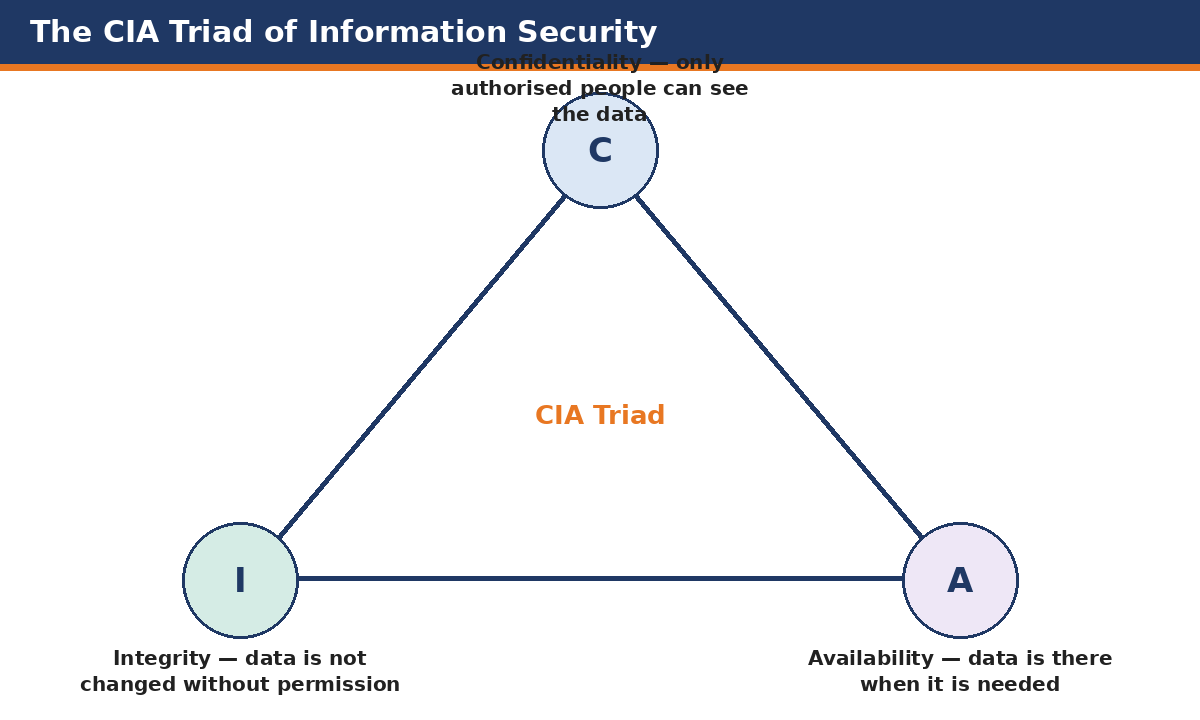
Introduction to information security; various aspects of information security (PAIN); security features of operating systems — authentication, logs, audit features, file system protection, user privileges, RAID options, anti-virus software, etc.
Why security matters, and the protections already built into operating systems — passwords, logs, permissions and anti-virus.
Unit 2 — Security Weaknesses in Networks (10 Periods, 22%)
Understanding security weaknesses in popular networking protocols — IP, TCP, UDP, RIP, OSPF, HTTP, SMTP, etc.; security weaknesses in common networking devices — hub, switch, router, WiFi; security solutions to mitigate security risk of networking protocols (IPSec, HTTPS, etc.) and devices (VLAN, VPN, ingress filtering, etc.).
Where networks are weak — in their protocols and their boxes — and the standard fixes that protect them.
Unit 3 — Cryptography and Secure Development (8 Periods, 20%)
Basics of cryptography; PKI; security considerations while developing software.
Secret writing done properly: encryption, public-key infrastructure (how secure websites prove who they are), and writing software that does not open holes for attackers.
Unit 4 — Network Security Products (8 Periods, 20%)
Network security products — firewall, IDS/IPS, VPN concentrator, content screening gateways, etc.
The security appliances that guard a network: firewalls, intrusion detection/prevention systems, VPN concentrators and content filters.
Unit 5 — Security Standards, Audit and Policy (8 Periods, 18%)
Introduction to security standards — ISO 27001, Indian IT Act, IPR laws; security audit procedures; developing security policies; disaster recovery; business continuity planning.
The rules of the profession: international standards, Indian law, how to audit a system, how to write a security policy, and how an organisation recovers after a disaster.
Practical Work
- Study the security provided within the Windows operating system.
- Recover the password of Windows machines using a password recovery utility (John the Ripper) or any other utility.
- Trace the origin of an email using an email trace tool.
- Use of keylogger and anti-keylogger to secure your system.
- Encrypt and decrypt a message using simple transposition — permutation (CrypTool).
- Encrypt and decrypt a message using Caesar Cipher with variable key (CrypTool); encrypt and decrypt a message using a 3×3 Hill Cipher (CrypTool).
The complete list of 8 practicals is in the Complete Syllabus section below — and in the PDF.
Complete Syllabus
The full examination scheme, the complete practicals list and the reference books from the official syllabus. The unit-wise topics are in the "What You Will Study" section above.
Examination Scheme
| Code | Paper | Type | L – P | Credits | Internal | External | Total |
|---|---|---|---|---|---|---|---|
| 5.4 | Program Elective-3: Information Security | Practicum | 3 – 4 | 5 | 40 | Theory 60 (3 hrs) | 100 |
| Information Security Total | 5 | 40 | 60 | 100 | |||
Units at a Glance
| Unit | Topic | Periods | Marks Share |
|---|---|---|---|
| 1 | Introduction to Information Security | 8 | 20% |
| 2 | Security Weaknesses in Networks | 10 | 22% |
| 3 | Cryptography and Secure Development | 8 | 20% |
| 4 | Network Security Products | 8 | 20% |
| 5 | Security Standards, Audit and Policy | 8 | 18% |
Complete Practicals List
This is the complete list of practicals from the official syllabus.
- Study the security provided within the Windows operating system.
- Recover the password of Windows machines using a password recovery utility (John the Ripper) or any other utility.
- Trace the origin of an email using an email trace tool.
- Use of keylogger and anti-keylogger to secure your system.
- Encrypt and decrypt a message using simple transposition — permutation (CrypTool).
- Encrypt and decrypt a message using Caesar Cipher with variable key (CrypTool); encrypt and decrypt a message using a 3×3 Hill Cipher (CrypTool).
- Create a digital signature document using CrypTool.
- Send and receive a secret message using steganography techniques using Steghide.
Reference Books
As listed in the syllabus:
- Information Security and Cyber Laws — Sarika Gupta, Khanna Publishing House
- RFCs of the protocols listed in the content (ietf.org)
- Various Acts, Laws and Standards (IT Act, ISO 27001 Standard, IPR and Copyright Laws, etc.)
- Security guideline documents of operating systems (OS manuals, man pages, etc.)
- cert-in.org.in
- sans.org
Frequently Asked Questions
How many marks is Information Security worth?
100 marks, 5 credits. It is a practicum subject (3 lecture + 4 practical hours a week): internal 40, external theory 60.
Is Information Security compulsory?
No. It is Program Elective-3, option 1 — you choose it OR Advance Computer Networks.
Which units carry the most weightage in Information Security?
Security Weaknesses in Networks, 22% (10 periods). Introduction, Cryptography and Network Security Products are 20% each; Security Standards, Audit and Policy is 18%.
What practical work is there in Information Security?
Windows security, password recovery with John the Ripper, email tracing, keylogger and anti-keylogger, CrypTool ciphers, digital signatures and Steghide steganography. The complete list is in the Complete Syllabus section above.
How can I download the Information Security syllabus PDF?
The PDF is free to download — use the download link in the Download section below. It is prepared by KAMALDNP from the official BTEUP syllabus.
Related Syllabus Posts
- BTEUP CSE 5th Semester Syllabus 2026-27
- BTEUP CSE Complete Syllabus 2026-27 — 1st, 3rd & 5th Semester (All Subjects)
- Advance Computer Networks — BTEUP CSE 5th Semester Syllabus 2026-27
- Computer Network — BTEUP CSE 3rd Semester Syllabus 2026-27
- Object Oriented Programming Using Java — BTEUP CSE 5th Semester Syllabus 2026-27
Notes, Question Bank & Practice Sets — Information Security
The syllabus PDF on this page stays 100% FREE — no login, no payment, always. The study material below is a paid KAMALDNP product: buy once for just ₹10 and you get both the Hindi and English PDFs. Every PDF is generated with your name and enrolment number and is password-locked, so it remains personal to you. After purchase, the PDF is also sent to your email, and it is always available for download on the My Downloads page.
Short Notes (English + Hindi) — ₹10
Unit-wise short revision notes prepared from the official BTEUP 2026-27 syllabus of this subject.
Buy / Download — My DownloadsQuestion Bank (English + Hindi) — ₹10
One original practice (model) paper with a model-answer outline. This is a KAMALDNP practice paper — NOT a BTEUP board paper, and no question in it is promised to appear in your exam.
Buy / Download — My DownloadsPractice Sets (English + Hindi) — ₹10
10 Practice Sets — practice/guess sets only (no verified previous-year board papers available for this subject yet)
Buy / Download — My DownloadsAlready purchased? You will find the Download button on the same My Downloads page — you will not be charged again.
Download the Information Security Syllabus PDF
Download the complete Information Security syllabus PDF below — prepared by KAMALDNP, with the full topic list, practicals and reference books.
Download the Information Security Syllabus PDF
Source: BTEUP 3rd Year curriculum (folder2627), approved in C.D.C. meeting held on 16.07.2026. Topic lists follow the official syllabus; short explanations are the author's own plain-English summaries, not syllabus text. Please confirm with your own polytechnic for any local changes.

Comments (0)
Share your question or experience about this syllabus. Your comment will appear after review.
No comments yet — be the first to share your thoughts!