Microwave and Radar — What This Subject Is About
To enhance the technical skills of diploma engineers in the operation, maintenance and troubleshooting of microwave and RADAR-based telecommunication systems — microwave communication being the backbone of terrestrial communication and fundamental to mobile communication systems.
Subject 5.2.2 — Program Elective-1, Option 2 (Theory) • Total 100 Marks • 3 Credits • L 3 – P 0 • Choose this OR Control System & PLC OR Digital Communication Systems • 5th Semester — Electronics Engineering • Session 2026–27
What You Will Study
Unit 1 — Fundamentals of Microwave Communication (4 Periods, 10%)
History, Microwave frequency spectrum, band designations and applications of microwave in various fields, Simple block diagram of microwave transmitter, receiver and microwave link repeater. Types of propagation- Ground wave, Sky Wave and Space Wave. Introduction to Transmission Lines, their types and applications.
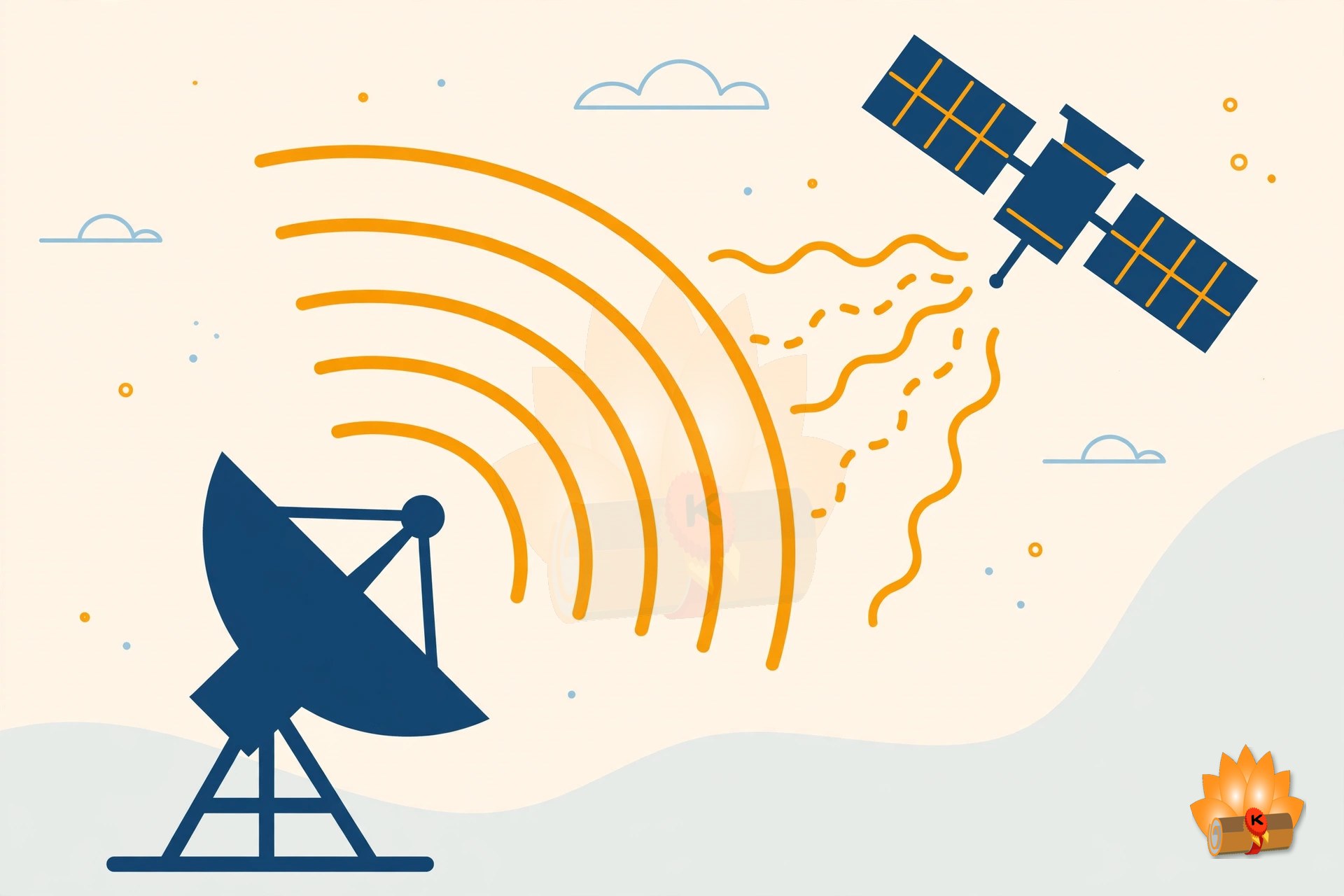
Microwaves: their frequency bands and uses, how signals propagate (ground, sky and space waves), and the basic transmitter-receiver link.
Unit 2 — Introduction to Microwave Devices (14 Periods, 33%)
Microwave Passive Devices: Directional Coupler, Power Divider, Attenuator, Resonator. Microwave vacuum tube devices: Construction working, specifications and applications of two cavity Klystron amplifier, Reflex Klystron, Magnetron and Helix TWT. Compare the performance of Klystron, Magnetron and TWT. Microwave semiconductor devices: Construction, working, specifications, characteristics and applications of Gunn diode. IMPATT diode. Tunnel diode, PIN diode
The devices that generate and handle microwaves: passive components, vacuum tubes (klystron, magnetron, travelling-wave tube) and semiconductor devices (Gunn, IMPATT, tunnel and PIN diodes).
Unit 3 — Wave Guides (8 Periods, 19%)
Types of Waveguides, and Propagation of waves in rectangular and circular waveguides and their applications. Advantages and disadvantages of rectangular and circular wave guides. Modes of wave guide; Propagation constant of a rectangular wave guide, cut off wavelength, guide wavelength and their relationship with free space wavelength (no mathematical derivation). Impossibility of TEM mode in a wave guide. Comparison of wave guide with Transmission line and comparison of rectangular waveguide with circular waveguide.
Waveguides — hollow pipes that carry microwaves: their modes, cut-off wavelength, and why the TEM mode cannot exist inside one.
Unit 4 — Radar Systems (8 Periods, 19%)
Introduction to RADAR Fundamentals: Basic block diagram of RADAR system, RADAR performance factors: RADAR range equation, factors influencing range, effect of noise. Types of RADAR Systems: Basic pulse RADAR system: Block diagram and description, applications. Doppler Effect, CW Doppler RADAR: Block diagram, operation and application. FM CW RADAR: Block diagram. Operation and application. MTI: Block diagram, operation concept of blind speed, application. Automatic target detection RADAR, SONAR system: Working principle and applications.
Radar: how it detects targets and measures range, pulse radar, Doppler radar, FM-CW radar, moving-target indication, and sonar.
Unit 5 — Satellite Communication (8 Periods, 19%)
Introduction. Advantages & disadvantages of satellite system. Frequency bands, uplink & downlink frequencies. Kepler's First Law. Kepler's Second Law. Kepler 's Third Law. Definitions of Terms for Earth-Orbiting Satellites. Orbital Elements. Apogee and Perigee Heights. Orbit Perturbations, Effects of a non-spherical earth. Atmospheric drag. Satellite angles, satellite repeaters. Station keeping. attitude control. satellite positioning. LEO, MEO, GEO satellite overview. Satellite communication system. Transponders. Crosslink, Satellite frequency allocation and frequency reuse. Block diagram of satellite earth station.
Satellites: Kepler's laws, orbits (LEO, MEO, GEO), transponders, frequency reuse, and the earth station that talks to them.
Complete Syllabus
The full examination scheme, the complete practicals list and the reference books from the official syllabus. The unit-wise topics are in the "What You Will Study" section above.
Examination Scheme
| Code | Paper | Type | L – P | Credits | Internal | External | Total |
|---|---|---|---|---|---|---|---|
| 5.2.2 | Program Elective-1: Microwave and Radar | Theory | 3 – 0 | 3 | Theory 40 | Theory 60 (3 hrs) | 100 |
| Microwave and Radar Total | 3 | 40 | 60 | 100 | |||
Units at a Glance
| Unit | Topic | Periods | Marks Share |
|---|---|---|---|
| 1 | Fundamentals of Microwave Communication | 4 | 10% |
| 2 | Introduction to Microwave Devices | 14 | 33% |
| 3 | Wave Guides | 8 | 19% |
| 4 | Radar Systems | 8 | 19% |
| 5 | Satellite Communication | 8 | 19% |
Reference Books
As listed in the syllabus:
- RADAR systems and radio aids to navigation Sen, A. K. and Bhattacharya, A. B. Mercury Learning information. PVT.LTD. New Delhi, 2017.
- Microwave Engineering, Das, Annapurna and Das, S. K. Mc Graw Hill, New Delhi (3rd edition)
- Microwave Engineering, Gupta, Sanjeev, Khanna publication 2015 New Delhi
- Microwave and RADAR Engineering, Gautam, A. K., S.K. Kataria Publication New Delhi.
- Microwave and RADAR Engineering, Kulkarni, M. Umesh Publications, New Delhi, 2009.
Frequently Asked Questions
How many marks is Microwave and Radar worth in the 5th semester?
Program Elective-1: Microwave and Radar (5.2.2) is 100 marks. Total: 100 marks, 3 credits. The full scheme table is in the Complete Syllabus section above.
Which units carry the most weightage in Microwave and Radar?
Introduction to Microwave Devices, 33% each. The full unit-wise weightage table is in the Complete Syllabus section above.
Which books should I refer to for Microwave and Radar?
The syllabus lists RADAR systems and radio aids to navigation Sen, A. K. and Bhattacharya, A. B. Mercury Learning information. PVT.LTD. New Delhi, 2017., and Microwave Engineering, Das, Annapurna and Das, S. K. Mc Graw Hill, New Delhi (3rd edition), among others. The full list is in the Complete Syllabus section above.
Is Microwave and Radar a theory subject or a practical subject?
It is assessed as theory — see the examination scheme in the Complete Syllabus section above.
How can I download the Microwave and Radar syllabus PDF?
The PDF is free to download — use the download link in the Download section below. It is prepared by KAMALDNP Academy from the official BTEUP syllabus.
Related Syllabus Posts
- BTEUP Electronics 5th Semester Syllabus 2026-27
- BTEUP Electronics Complete Syllabus 2026-27 — 3rd, 4th, 5th & 6th Semester (All Subjects)
- Optical Fiber Communication — BTEUP Electronics 5th Semester Syllabus 2026-27
- Control System & PLC — BTEUP Electronics 5th Semester Syllabus 2026-27
- Digital Communication Systems — BTEUP Electronics 5th Semester Syllabus 2026-27
Download the Microwave and Radar Syllabus PDF
Download the complete Microwave and Radar syllabus PDF below — prepared by KAMALDNP Academy, with the full topic list, practicals and reference books.
Download the Microwave and Radar Syllabus PDF
Source: BTEUP 3rd Year curriculum (folder2627), approved in C.D.C. meeting held on 16.07.2026. Topic lists follow the official syllabus; short explanations are the author's own plain-English summaries, not syllabus text. Please confirm with your own polytechnic for any local changes.




Comments (0)
Share your question or experience about this syllabus. Your comment will appear after review.
No comments yet — be the first to share your thoughts!