
Optical Fiber Communication — यह विषय किस बारे में है
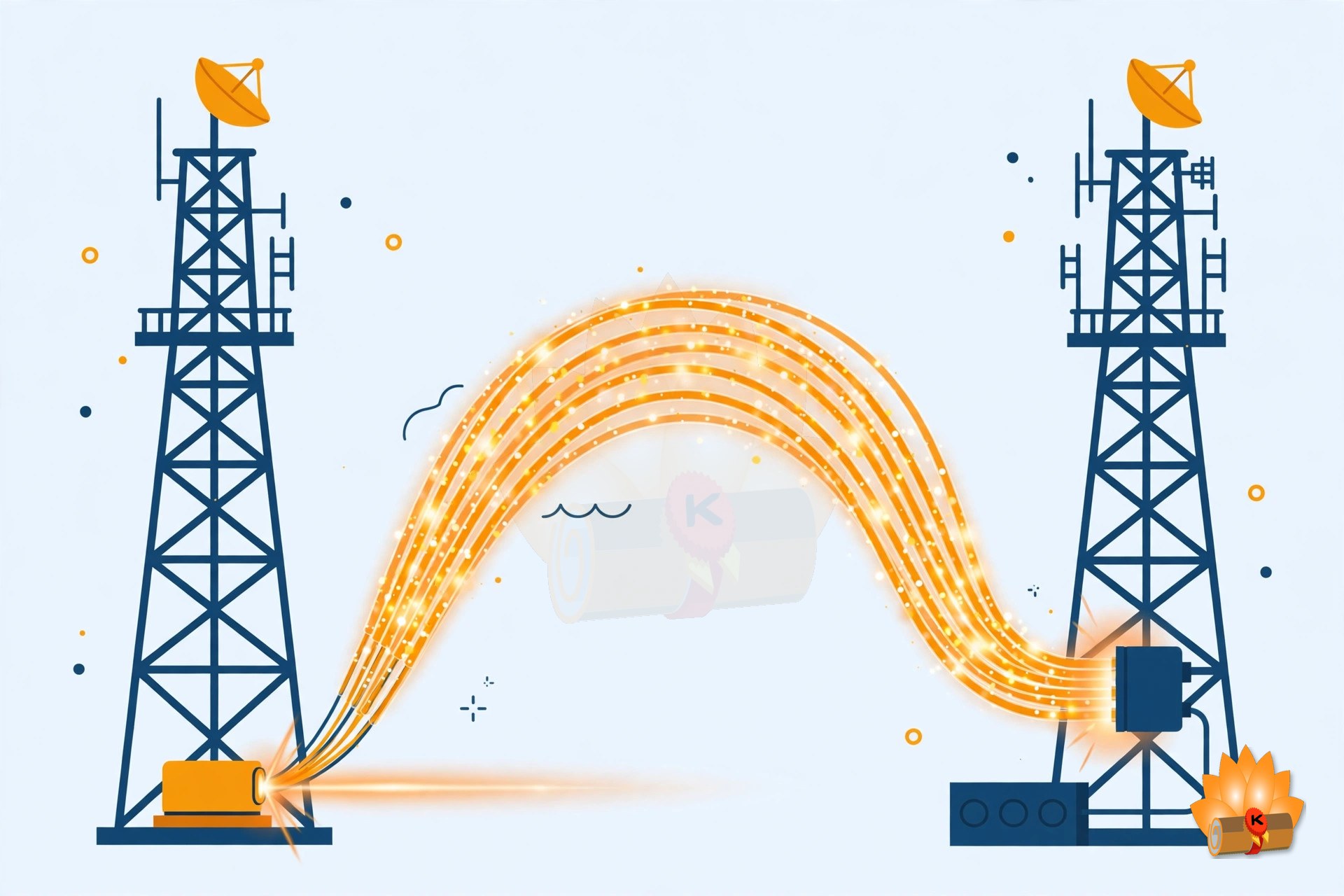
Optical Fiber Communication — light से data भेजने की technology, जो high-speed internet और long-distance communication की रीढ़ है।
To understand and apply the principles of optical communication systems — fibre optic technology being the most economical and efficient medium for wired communication, with lower costs than copper, improved transmission quality and reduced maintenance.
Subject 5.1 (Theory) + 5.5 (Lab) • Total 200 Marks • 7 Credits • पाँचवाँ सेमेस्टर — Electronics Engineering • सत्र 2026–27
About this document: Optical Fiber Communication appears twice in the 5th semester — as a theory paper (5.1) and as a lab (5.5). Both are covered here, completely, in the official order.
आप क्या पढ़ेंगे
यूनिट 1 — Introduction (8 पीरियड, 16%)
Various wired communication mediums – copper wire and optical fiber cable. Electromagnetic spectrum, optical band and its range, Optical windows. General Block diagram of optical Fiber communication system. Advantages, disadvantages and application of Fiber Optic communication.
Why fibre beats copper: the optical band, the parts of a fibre-optic link, and its advantages, disadvantages and applications.
यूनिट 2 — Optical Fiber (12 पीरियड, 21%)
Nature of light, its properties, Definition and concept of Reflection, refraction dispersion, diffraction, absorption, Total internal reflection (TIR) and scattering of light ray. Propagation of light in optical fiber, Ray model, Theoretical approach to Wave model, Snell’s law, definition and concept of Critical angle, numerical aperture, acceptance angle and acceptance cone - (Numerical on above concepts).
The optics behind fibre: total internal reflection, critical angle, numerical aperture and acceptance cone — with numerical problems.
यूनिट 3 — Fiber Materials, Connectors, Coupler, Splicer and Losses (12 पीरियड, 21%)
Fiber materials, Structure of fiber, Dimension of fiber. Optical fiber classification based on Modes and index profile, Modes of light propagation in fiber. Optical fiber connections: joints and Couplers-Fiber alignment and joint loss, fiber splicing techniques (Mechanical, fusion). fiber connectors, Losses and signal degradation in optical fiber.
What fibre is made of, how it is classified by mode and index profile, how fibres are joined and spliced, and where signal is lost.
यूनिट 4 — Optical Sources and Detectors (12 पीरियड, 21%)
Optical sources: LED, LASER, construction and working, Characteristics, specifications & Comparison. Optical detectors: PIN diode, Avalanche photo diode- construction, working, Characteristics, specifications & Comparison.
The light sources (LED and laser) and the detectors (PIN and avalanche photodiodes) at the two ends of a fibre link, compared side by side.
यूनिट 5 — Optical Amplifiers and Its Type (12 पीरियड, 21%)
Optical Amplifiers: Types of optical amplifiers, semiconductor & fiber optical amplifiers, principle of operation of SOA, types of SOA. EDFA, Raman amplifiers. Comparison of SOA, EDFA and Raman Amplifiers.
Amplifiers that boost light without converting it to electricity: semiconductor, erbium-doped fibre (EDFA) and Raman amplifiers.
प्रैक्टिकल कार्य
- To identify and use various components and tools used in optical fiber communication.
- To view and draw the structure of an optical fiber and cable.
- To observe the Total Internal Reflection (TIR) and Light transmission.
- To calculate NA of given optical fiber.
- To set up fiber optic analog link.
- To set up fiber optic digital link.
और भी बहुत कुछ — 15 practicals की पूरी सूची PDF के अंदर है।
पूरा सिलेबस
आधिकारिक सिलेबस से पूरी परीक्षा योजना, practicals की पूरी सूची और संदर्भ पुस्तकें। यूनिट के अनुसार topics ऊपर "आप क्या पढ़ेंगे" वाले हिस्से में दिए गए हैं।
परीक्षा योजना
| Code | Paper | Type | L – P | Credits | Internal | External | Total |
|---|---|---|---|---|---|---|---|
| 5.1 | Optical Fiber Communication | Theory | 4 – 0 | 4 | Theory 40 | Theory 60 (3 hrs) | 100 |
| 5.5 | Optical Fiber Communication (Lab) | Practical | 0 – 6 | 3 | Practical 60 | Practical 40 (3 hrs) | 100 |
| Optical Fiber Communication Total | 7 | 100 | 100 | 200 | |||
एक नज़र में यूनिट्स
| यूनिट | विषय | पीरियड | अंकों का हिस्सा |
|---|---|---|---|
| 1 | Introduction | 8 | 16% |
| 2 | Optical Fiber | 12 | 21% |
| 3 | Fiber Materials, Connectors, Coupler, Splicer and Losses | 12 | 21% |
| 4 | Optical Sources and Detectors | 12 | 21% |
| 5 | Optical Amplifiers and Its Type | 12 | 21% |
प्रैक्टिकल्स की पूरी सूची
यह आधिकारिक सिलेबस से practicals की पूरी सूची है।
- To identify and use various components and tools used in optical fiber communication.
- To view and draw the structure of an optical fiber and cable.
- To observe the Total Internal Reflection (TIR) and Light transmission.
- To calculate NA of given optical fiber.
- To set up fiber optic analog link.
- To set up fiber optic digital link.
- Identify various layers & parts of an optical fiber cable.
- Measure bending losses of the given fiber optic cable.
- Plot the characteristics of optical source & detector.
- To connect a fiber with connector at both ends.
- To observe and measure the splice or connector loss.
- To splice the available optical fiber.
- To measure attenuation in optical fiber.
- To do power budgeting of an optical fiber link.
- To determine the position of fault in optical fiber link.
संदर्भ पुस्तकें
सिलेबस में दिए अनुसार:
- Fiber Optic Communication Keiser, Gerd McGraw Hill New Delhi.
- Optical Fiber communications principles & Practices Senior, John M. Pearson Education Ltd., New Delhi.
- Govind P. Agrawal, “Fiber Optic Communication Systems”, John Wiley, 3rd Edition, 2004.
अक्सर पूछे जाने वाले प्रश्न
पाँचवाँ सेमेस्टर में Optical Fiber Communication कितने अंकों का है?
Optical Fiber Communication (5.1) 100 अंक; Optical Fiber Communication (Lab) (5.5) 100 अंक। कुल: 200 अंक, 7 क्रेडिट। पूरी योजना ऊपर "पूरा सिलेबस" वाले हिस्से में है।
Optical Fiber Communication में किन यूनिट्स का weightage सबसे ज़्यादा है?
Optical Sources and Detectors और Optical Fiber और Optical Amplifiers and Its Type और Fiber Materials, Connectors, Coupler, Splicer and Losses, 21% प्रत्येक। यूनिट के अनुसार weightage की पूरी तालिका ऊपर "पूरा सिलेबस" वाले हिस्से में है।
Optical Fiber Communication में क्या प्रैक्टिकल कार्य है?
15 practicals/experiments, जिनमें शामिल हैं: To identify and use various components and tools used in optical fiber communication.; To view and draw the structure of an optical fiber and cable.; To observe the Total Internal Reflection (TIR) and Light transmission.। पूरी सूची ऊपर "पूरा सिलेबस" वाले हिस्से में है।
Optical Fiber Communication के लिए किन किताबों को देखें?
सिलेबस में Fiber Optic Communication Keiser, Gerd McGraw Hill New Delhi. और Optical Fiber communications principles & Practices Senior, John M. Pearson Education Ltd., New Delhi., सहित अन्य किताबें दी गई हैं। पूरी सूची ऊपर "पूरा सिलेबस" वाले हिस्से में है।
क्या Optical Fiber Communication theory विषय है या practical विषय?
इसका मूल्यांकन Practical और Theory के रूप में होता है — परीक्षा योजना ऊपर "पूरा सिलेबस" वाले हिस्से में देखें।
Optical Fiber Communication सिलेबस PDF कैसे डाउनलोड करें?
PDF मुफ़्त में डाउनलोड के लिए उपलब्ध है — नीचे Download वाले हिस्से में दिए गए download link का उपयोग करें। यह KAMALDNP द्वारा आधिकारिक BTEUP सिलेबस से तैयार किया गया है।
संबंधित सिलेबस पोस्ट
- BTEUP Electronics पाँचवाँ सेमेस्टर सिलेबस 2026-27
- BTEUP Electronics पूरा सिलेबस 2026-27 — तीसरा, चौथा, पाँचवाँ और छठा सेमेस्टर (सभी विषय)
- Control System & PLC — BTEUP Electronics पाँचवाँ सेमेस्टर सिलेबस 2026-27
- Microwave and Radar — BTEUP Electronics पाँचवाँ सेमेस्टर सिलेबस 2026-27
- Digital Communication Systems — BTEUP Electronics पाँचवाँ सेमेस्टर सिलेबस 2026-27
Optical Fiber Communication सिलेबस PDF डाउनलोड करें
नीचे पूरा Optical Fiber Communication सिलेबस PDF डाउनलोड करें — KAMALDNP द्वारा तैयार, जिसमें topics की पूरी सूची, practicals और संदर्भ पुस्तकें हैं।
Optical Fiber Communication सिलेबस PDF डाउनलोड करें
स्रोत: BTEUP 3rd Year curriculum (folder2627), approved in C.D.C. meeting held on 16.07.2026। Topic सूचियाँ आधिकारिक सिलेबस के अनुसार हैं; छोटे सारांश लेखक के अपने सरल शब्दों में लिखे गए हैं, सिलेबस का मूल पाठ नहीं हैं। कृपया अपने पॉलिटेक्निक से किसी भी स्थानीय बदलाव की पुष्टि कर लें।


Comments (0)
Share your question or experience about this syllabus. Your comment will appear after review.
No comments yet — be the first to share your thoughts!