
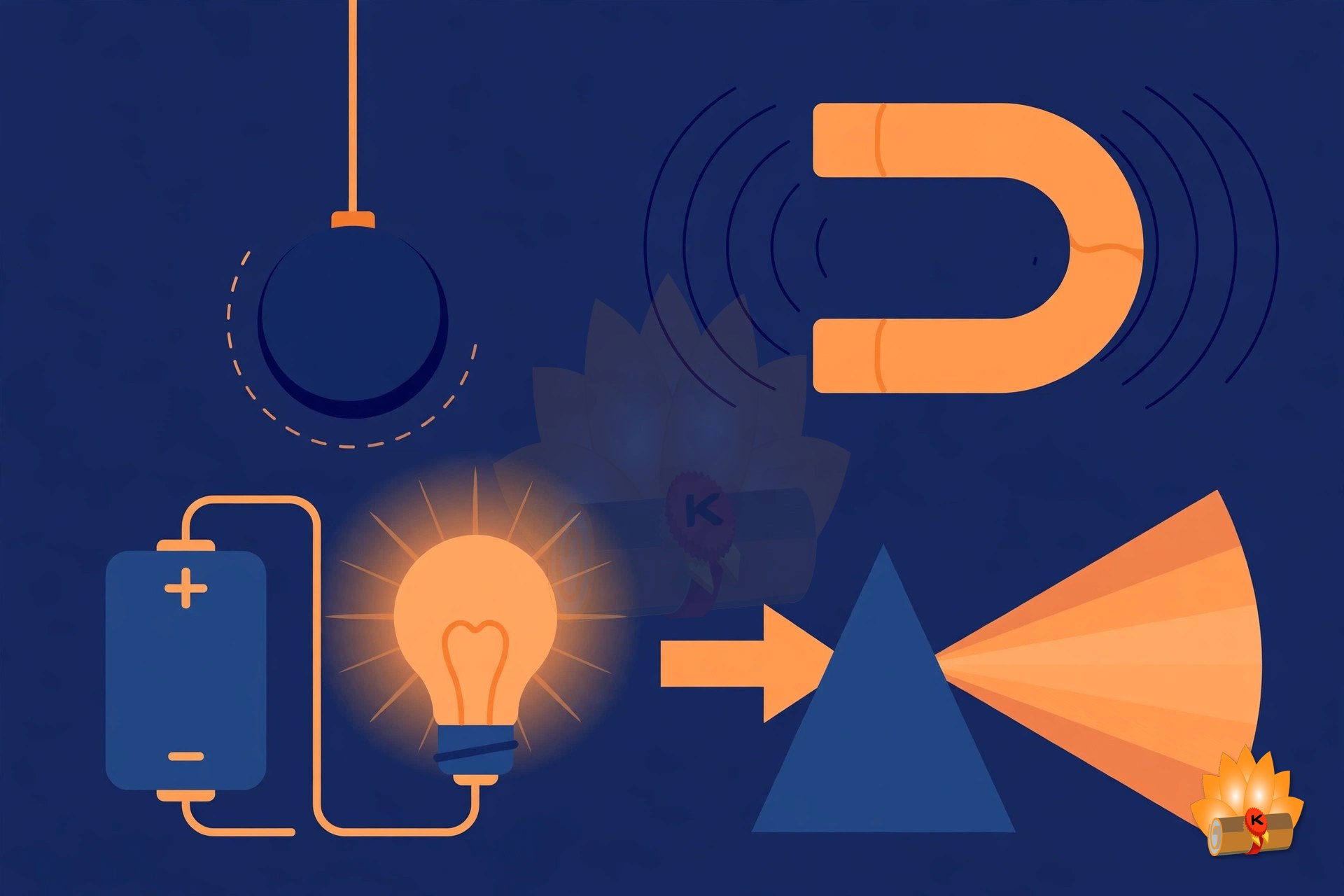
Physics — What This Subject Is About
To build a working understanding of the physical world — motion, force, energy, light, sound and electricity — through concepts and simple experiments.
Common Curriculum • 1st Semester • All 41 Engineering Branches • 1st Semester (First Year — Common Curriculum) • Session 2026–27
About this document: The first year of a BTEUP diploma runs on one common curriculum for 41 engineering branches, so this subject is the same whether you are in Computer Science, Mechanical, Civil or Electrical. The subject areas below are from the official 1st-year curriculum (folder2627, NEP-2020). The scheme — 1st semester 18 credits and 900 marks, 2nd semester 22 credits and 1050 marks — is given in the Examination Scheme section below.
Examination Scheme — 1st & 2nd Semester (Official, Verified 2026-27)
The scheme below is from the official 1st-year curriculum (folder2627), corrected and approved by the Board of Technical Education, U.P. Lucknow in the C.D.C. meeting held on 16.07.2026. Each period is 60 minutes, each session is 16 weeks, with at least 14 effective teaching weeks.
1st Semester — 18 Credits, 900 Marks
| Sr. No. | Subject | L–T–P | Credits | Internal | External | Total Marks |
|---|---|---|---|---|---|---|
| 1.1 | Mathematics-I | 2–1–0 | 3 | Th 40 | Th 60 | 100 |
| 1.2 | Applied Physics-I | 3–0–2 | 4 | Th 40 + Pr 60 | Th 60 + Pr 40 | 200 |
| 1.3 | Applied Chemistry OR Introduction to IT and AI | 3–0–2 / 2–0–4 | 4 | Th 40 + Pr 60 | Th 60 + Pr 40 | 200 |
| 1.4 | Communication Skills in English OR Fundamentals of Electrical & Electronics Engineering | 3–0–2 | 4 | Th 40 + Pr 60 | Th 60 + Pr 40 | 200 |
| 1.5 | Engineering Graphics OR Engineering Workshop Practice | 0–0–4 | 2 | Graphics: Pr 40 / Workshop: Pr 60 | Graphics: Th 60 / Workshop: Pr 40 | 100 |
| 1.6 | Sports & Yoga | 0–0–2 | 1 | Pr 50 | — | 50 |
| — | Student Centred Activities (SCA) | 0–0–10 | — | Pr 50 | — | 50 |
| 1st Semester Total | 18 | — | — | 900 | ||
2nd Semester — 22 Credits, 1050 Marks
| Sr. No. | Subject | L–T–P | Credits | Internal | External | Total Marks |
|---|---|---|---|---|---|---|
| 2.1 | Mathematics-II | 3–1–0 | 4 | Th 40 | Th 60 | 100 |
| 2.2 | Applied Physics-II | 3–0–2 | 4 | Th 40 + Pr 60 | Th 60 + Pr 40 | 200 |
| 2.3 | Introduction to IT and AI OR Applied Chemistry | 2–0–4 / 3–0–2 | 4 | Th 40 + Pr 60 | Th 60 + Pr 40 | 200 |
| 2.4 | Fundamentals of Electrical & Electronics Engineering OR Communication Skills in English | 3–0–2 | 4 | Th 40 + Pr 60 | Th 60 + Pr 40 | 200 |
| 2.5 | Engineering Mechanics | 2–1–2 | 4 | Th 40 + Pr 60 | Th 60 + Pr 40 | 200 |
| 2.6 | Engineering Workshop Practice OR Engineering Graphics | 0–0–4 | 2 | Workshop: Pr 60 / Graphics: Pr 40 | Workshop: Pr 40 / Graphics: Th 60 | 100 |
| 2.7 | (Q) Environmental Sciences | 3–0–0 | — (Audit) | — | Th 60* | — |
| — | Student Centred Activities (SCA) | 0–0–4 | — | Pr 50 | — | 50 |
| 2nd Semester Total | 22 | — | — | 1050 | ||
About the OR choices: at Sr. No. 1.3, 1.4 and 1.5 the institute chooses which alternative runs in the 1st semester; the other alternative then runs in the 2nd semester (1.3 ↔ 2.3, 1.4 ↔ 2.4, 1.5 ↔ 2.6). An alternative once selected in the 1st semester is not selected again in the 2nd semester.
No paper codes: the official 1st-year curriculum gives no paper codes — subjects are numbered 1.1–1.6 in the 1st semester and 2.1–2.7 in the 2nd semester only.
Qualifying subject: Environmental Sciences (2.7, Q) is an audit subject — you must appear and pass, but its 60 external marks are not counted for percentage or division. A 4-week summer internship (Internship–I) is organised after the 2nd-semester examination and is evaluated in the 3rd semester.
What You Will Study
Mechanics
Laws of motion; force, work, energy and power; friction; circular motion.
Why things move the way they do — the foundation of machines and structures.
Electricity & Magnetism
Electric charge, current and voltage; Ohm's law; magnetic effects of current.
The physics behind every circuit you will meet in electronics and networks.
Optics & Waves
Reflection and refraction; lenses; wave motion and sound.
How light and sound behave — used in instruments, communication and displays.
Modern Physics
Atomic structure; semiconductors in brief; lasers and their uses.
A first look at the physics inside chips and modern devices.
How This Helps You Later
Physics and electronics form the base of Computer Networks and IoT. Weak physics in the first year makes networks harder in the 2nd year.
Complete Syllabus
The four areas in the "What You Will Study" section above — Mechanics, Electricity & Magnetism, Optics & Waves, Modern Physics — are the complete subject content as per the official 1st-year common curriculum (folder2627, NEP-2020), which is the same for all 41 engineering branches. The scheme — 1st semester 18 credits and 900 marks, 2nd semester 22 credits and 1050 marks — is given in the Examination Scheme section above, from the official 1st-year curriculum approved in the C.D.C. meeting held on 16.07.2026. There are no paper codes in the official curriculum; subjects are numbered 1.1–1.6 and 2.1–2.7 only.
Frequently Asked Questions
Is Physics the same for all branches?
Yes. The first year of a BTEUP diploma runs on one common curriculum for 41 engineering branches, so this subject is the same whether you are in Computer Science, Mechanical, Civil or Electrical.
How many marks is Physics worth?
Applied Physics-I (1.2) carries 200 marks (4 credits, L3 P2) in the 1st semester, and Applied Physics-II (2.2) carries 200 marks (4 credits, L3 P2) in the 2nd semester — see the Examination Scheme section above.
What does Physics cover?
Four areas: Mechanics, Electricity & Magnetism, Optics & Waves and Modern Physics.
How does Physics help later?
Physics and electronics form the base of Computer Networks and IoT. Weak physics in the first year makes networks harder in the 2nd year.
How can I download the Physics syllabus PDF?
The PDF is free to download — use the download link in the Download section below. It is prepared by KAMALDNP from the official BTEUP syllabus.
Related Syllabus Posts
- BTEUP CSE Complete Syllabus 2026-27 — 1st, 3rd & 5th Semester (All Subjects)
- Mathematics — BTEUP 1st Semester Syllabus 2026-27
- Chemistry — BTEUP 1st Semester Syllabus 2026-27
- Electrical & Electronics Fundamentals — BTEUP 1st Semester Syllabus 2026-27
Notes, Question Bank & Practice Sets — Applied Physics-I
The syllabus PDF on this page stays 100% FREE — no login, no payment, always. The study material below is a paid KAMALDNP product: buy once for just ₹10 and you get both the Hindi and English PDFs. Every PDF is generated with your name and enrolment number and is password-locked, so it remains personal to you. After purchase, the PDF is also sent to your email, and it is always available for download on the My Downloads page.
Short Notes (English + Hindi) — ₹10
Unit-wise short revision notes prepared from the official BTEUP 2026-27 syllabus of this subject.
Buy / Download — My DownloadsQuestion Bank (English + Hindi) — ₹10
One original practice (model) paper with a model-answer outline. This is a KAMALDNP practice paper — NOT a BTEUP board paper, and no question in it is promised to appear in your exam.
Buy / Download — My DownloadsPractice Sets (English + Hindi) — ₹10
10 Practice Sets — practice/guess sets only (no verified previous-year board papers available for this subject yet)
Buy / Download — My DownloadsAlready purchased? You will find the Download button on the same My Downloads page — you will not be charged again.
Download the Physics Syllabus PDF
Download the complete Physics syllabus PDF below — prepared by KAMALDNP, with the full topic list.
Download the Physics Syllabus PDF
Source: BTEUP 1st Year common curriculum (folder2627), NEP-2020 aligned — scheme and subject areas verified from the official 1st-year curriculum, approved in the C.D.C. meeting held on 16.07.2026. Topic lists follow the official syllabus; short explanations are the author's own plain-English summaries, not syllabus text. Please confirm with your own polytechnic for any local changes.
Comments (0)
Share your question or experience about this syllabus. Your comment will appear after review.
No comments yet — be the first to share your thoughts!