
Project & Student Centred Activities — यह विषय किस बारे में है
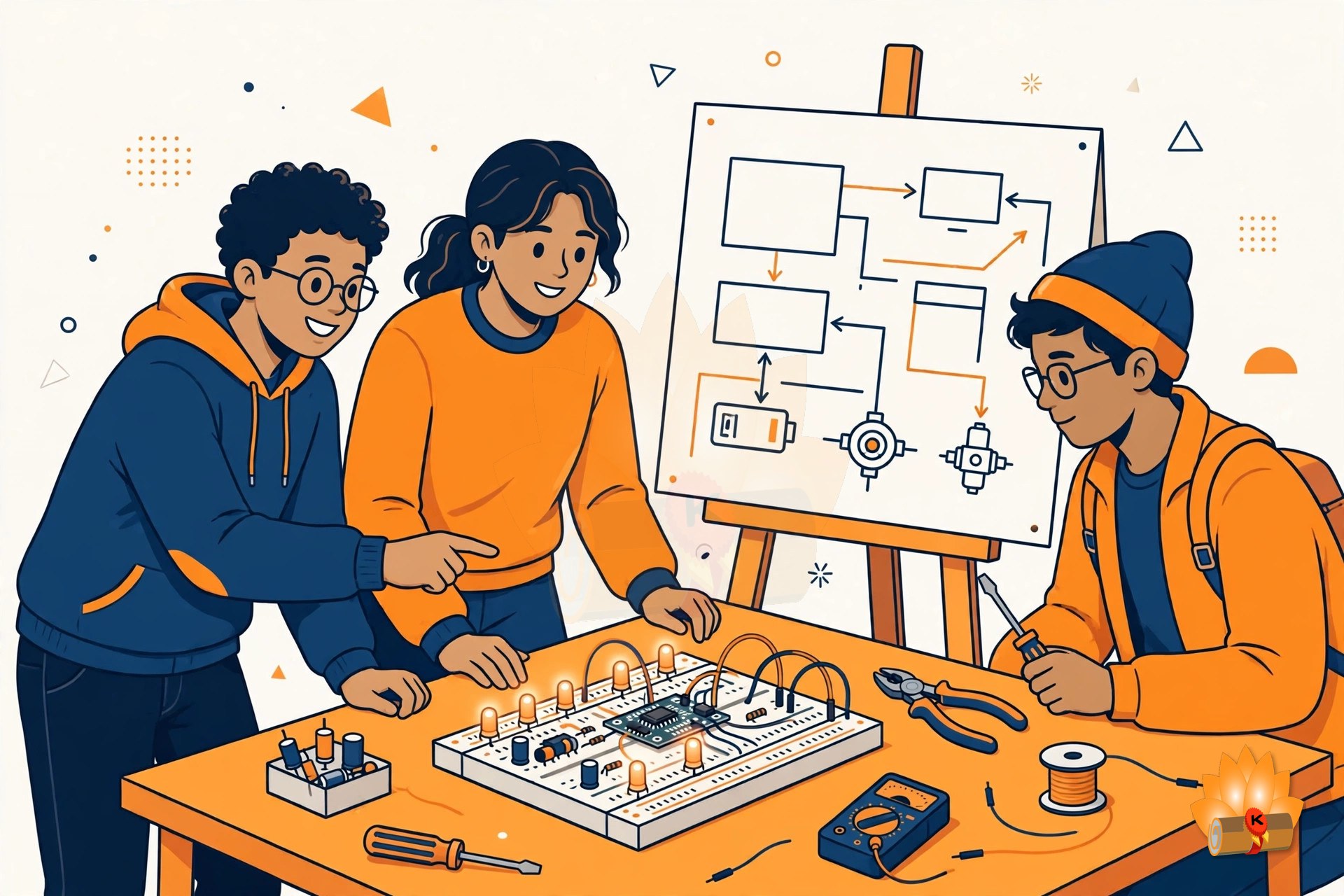
Project & SCA — final-year project, जिसमें पूरे diploma की सीख को एक असली product या system में बदलना होता है।
Subject 6.4 (Project) 400 Marks • SCA 50 Marks • Total 450 Marks • Normal Pathway • छठा सेमेस्टर — Electronics Engineering • सत्र 2026–27
Note: No detailed project syllabus (objectives, content, evaluation break-up) is given in the PDF — only the scheme-table entry below. The Industrial Pathway is an alternative to this normal pathway; see the extra section.
पूरा सिलेबस
आधिकारिक सिलेबस से पूरी परीक्षा योजना, practicals की पूरी सूची और संदर्भ पुस्तकें। यूनिट के अनुसार topics ऊपर "आप क्या पढ़ेंगे" वाले हिस्से में दिए गए हैं।
परीक्षा योजना
| Code | Paper | Type | L – P | Credits | Internal | External | Total |
|---|---|---|---|---|---|---|---|
| 6.4 | Project | Project | 4 – 16 | 12 | Practical 240 | Practical 160 | 400 |
| — | Student Centred Activities (SCA) | Activity | 0 – 6 | — | 50 | — | 50 |
| Project + SCA Total | 12 | 290 | 160 | 450 | |||
संदर्भ पुस्तकें
इस विषय के लिए आधिकारिक सिलेबस में reference books नहीं दी गई हैं।
Industrial Pathway — the alternative to the Normal Pathway (6th Semester)
Instead of the normal pathway, a student may take the Industrial Pathway (one-semester industrial training/internship). Its scheme is: 6.1 Entrepreneurship and Start-Up (Online Mode) — 2 credits, external theory 100 (3 hrs), total 100; 6.2 Industrial Hands-on Practice — 12 credits, internal 150* (faculty mentor) + external 200** (industry), total 350; 6.3 Industrial Project — 4 credits, internal 50* + external 50**, total 100; 6.4 Seminar (in-house) — 2 credits, internal 100, total 100. Pathway total: 20 credits, 650 marks. Notes from the PDF: (1) the industrial training tenure should not be less than 4 months; (2) “Entrepreneurship and Start-Up” is mandatory in the industrial training option, taught in contact mode by the student’s polytechnic institute, and after completing the online course the student must appear for a separate exam conducted by the Board of Technical Education, Lucknow; (3) the student must attend a seminar at his/her polytechnic institute after training to earn 2 credits; (4) a monthly progress report attested by the industrial authority must be submitted during training; (5) the industrial unit must evaluate the student using the format provided by the polytechnic, in both credits and marks; (7) *Evaluation by faculty mentor — the institute deputes one faculty member for mentoring at least 20–30 students; mentors monitor, guide and counsel, and may make surprise visits to check the student’s presence; (8) **Evaluation by industry — the industry assesses attendance, discipline and punctuality, familiarity of tools and material, engineering skills, application of knowledge and problem-solving skills, comprehension and observation, professional ethics, safety and environmental consciousness, communication skills, supervisory skills and general conduct; (9) evaluation through seminar presentation/viva-voce at the institute before an expert committee. (Caution: the scheme-table numbers 6.2/6.3/6.4 mean different subjects in the two pathways — Normal: 6.2 Elective (Pathway), 6.3 Elective (Specialisation), 6.4 Project; Industrial: 6.2 Industrial Hands-on Practice, 6.3 Industrial Project, 6.4 Seminar.)
Student Centred Activities (SCA) — 50 Marks
A provision for overall personality development, including co-curricular activities such as extension lectures, games, hobby clubs (for example photography, painting and singing), seminars, declamation contests, educational field visits, NCC, NSS, library work, cultural activities and self-study. Maximum marks 50, distributed as: (i) 15 marks for general behaviour and discipline (by HODs in consultation with all teachers of the department); (ii) 10 marks for attendance — 75–80% = 6 marks, 80–85% = 8 marks, above 85% = 10 marks; (iii) 25 marks maximum in an even semester for Sports/NCC/Cultural/Co-curricular/NSS activities — State/National level participation, participation in two of the above activities, or Inter-Polytechnic level participation.
अक्सर पूछे जाने वाले प्रश्न
छठा सेमेस्टर में Project & Student Centred Activities कितने अंकों का है?
Project (6.4) 400 अंक; Student Centred Activities (SCA) (—) 50 अंक। कुल: 450 अंक, 12 क्रेडिट। पूरी योजना ऊपर "पूरा सिलेबस" वाले हिस्से में है।
Project & Student Centred Activities के लिए किन किताबों को देखें?
इस विषय के लिए आधिकारिक सिलेबस में reference books नहीं दी गई हैं।
क्या final-year Project का विस्तृत सिलेबस है?
नहीं — आधिकारिक सिलेबस में Project का कोई विस्तृत content नहीं है (कोई objectives, units, books या evaluation break-up नहीं), केवल scheme-table entry है: L 4 – P 16, 12 क्रेडिट, 240 आंतरिक + 160 बाह्य = 400 अंक।
क्या Project & Student Centred Activities theory विषय है या practical विषय?
इसका मूल्यांकन Activity और Project के रूप में होता है — परीक्षा योजना ऊपर "पूरा सिलेबस" वाले हिस्से में देखें।
Project & Student Centred Activities सिलेबस PDF कैसे डाउनलोड करें?
PDF मुफ़्त में डाउनलोड के लिए उपलब्ध है — नीचे Download वाले हिस्से में दिए गए download link का उपयोग करें। यह KAMALDNP द्वारा आधिकारिक BTEUP सिलेबस से तैयार किया गया है।
संबंधित सिलेबस पोस्ट
- BTEUP Electronics छठा सेमेस्टर सिलेबस 2026-27
- BTEUP Electronics पूरा सिलेबस 2026-27 — तीसरा, चौथा, पाँचवाँ और छठा सेमेस्टर (सभी विषय)
- Entrepreneurship and Start-Up — BTEUP Electronics छठा सेमेस्टर सिलेबस 2026-27
- Managerial Economics — BTEUP Electronics छठा सेमेस्टर सिलेबस 2026-27
- Finance Fundamentals — BTEUP Electronics छठा सेमेस्टर सिलेबस 2026-27
Project & Student Centred Activities सिलेबस PDF डाउनलोड करें
नीचे पूरा Project & Student Centred Activities सिलेबस PDF डाउनलोड करें — KAMALDNP द्वारा तैयार, जिसमें topics की पूरी सूची, practicals और संदर्भ पुस्तकें हैं।
Project & Student Centred Activities सिलेबस PDF डाउनलोड करें
स्रोत: BTEUP 3rd Year curriculum (folder2627), approved in C.D.C. meeting held on 16.07.2026। Topic सूचियाँ आधिकारिक सिलेबस के अनुसार हैं; छोटे सारांश लेखक के अपने सरल शब्दों में लिखे गए हैं, सिलेबस का मूल पाठ नहीं हैं। कृपया अपने पॉलिटेक्निक से किसी भी स्थानीय बदलाव की पुष्टि कर लें।
Comments (0)
Share your question or experience about this syllabus. Your comment will appear after review.
No comments yet — be the first to share your thoughts!