
Construction Materials — What This Subject Is About
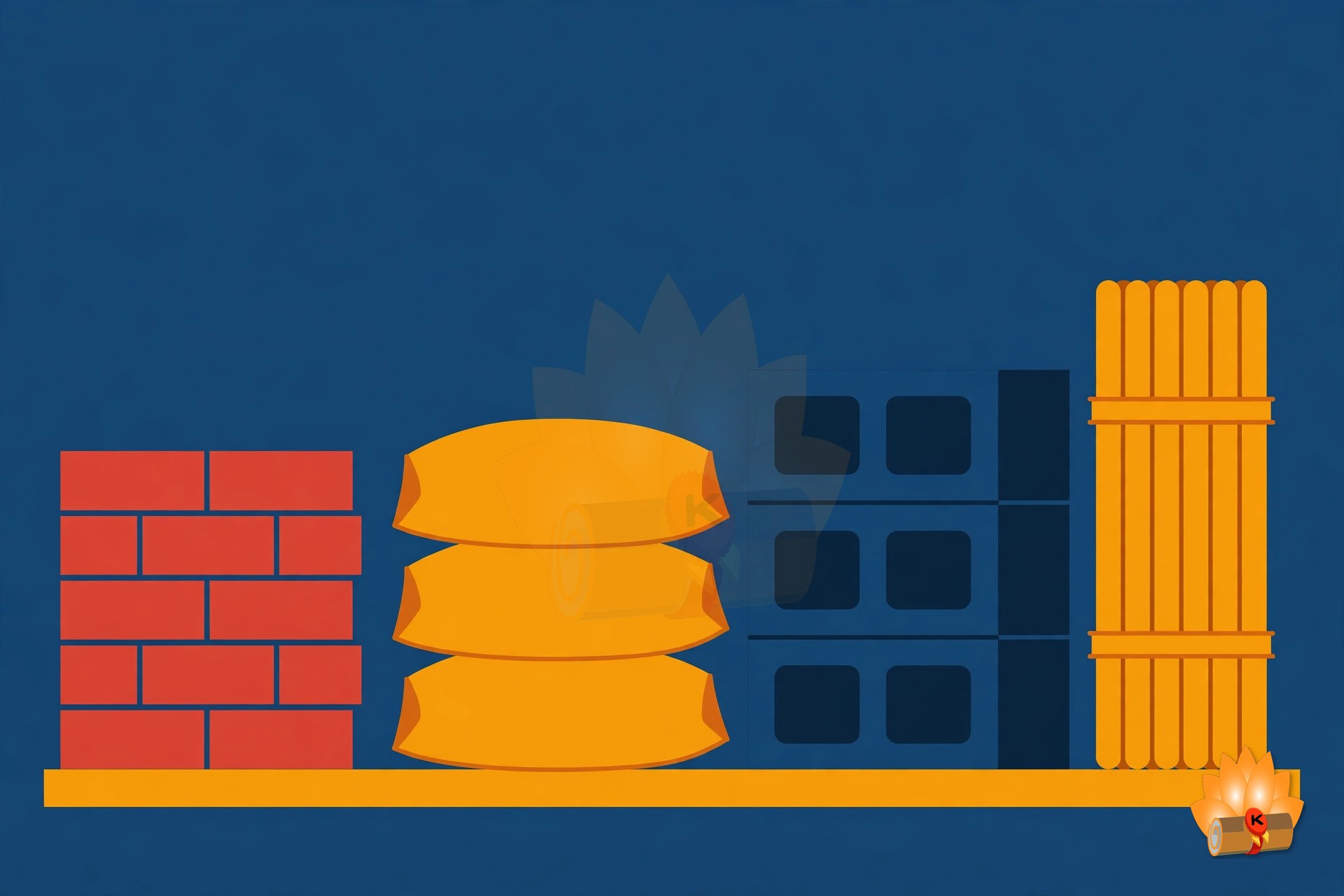
Every building you see is made of materials someone chose — stone, brick, cement, timber, steel, glass — and choosing the wrong one can crack a wall, leak a roof or waste a fortune. Construction Materials is the subject that teaches you what each material is, how it behaves, and where it belongs. It is the first subject of the 3rd semester, and almost everything you study later — building construction, concrete technology, even estimating — builds on it.
The subject covers five groups of materials in 28 periods: natural materials like stone, timber and lime; artificial materials like bricks, cement and glass; special materials for waterproofing and insulation; and processed materials like plaster of Paris, paints and industrial waste. The lab work is hands-on from the start — identifying aggregates, testing bricks, slaking lime and building 3D models of brick bonds.
Subject 3.1 (Practicum/Theory) • Total 100 Marks • 3 Credits • L 2 – P 2 • 3rd Semester — Civil Engineering • Session 2026–27
Note: The 3rd-semester scheme totals imply this subject's 40 internal marks sit under Practical assessment (the extracted table's column alignment is garbled — see NOTES). The lab work listed here is part of subject 3.1 itself.
What You Will Study
Unit 1 — Overview of Construction Materials (4 Periods, 15%)
Scope of construction materials in Building Construction, Transportation Engineering, Environmental Engineering, Irrigation Engineering (applications only); selection of materials for different civil engineering structures on the basis of strength, durability, eco-friendly nature and economy; broad classification of materials — Natural, Artificial, special, finishing and recycled.
Why materials matter — where they are used in buildings, roads and irrigation works, and how to choose a material by strength, durability, eco-friendliness and cost.
Unit 2 — Natural Construction Materials (6 Periods, 20%)
Requirements of good building stone; general characteristics of stone; quarrying and dressing methods and tools for stone; classification of rocks — geological, physical and chemical classification; structure of timber, general properties and uses of good timber, different methods of seasoning for preservation of timber, defects in timber, use of bamboo in construction; asphalt, bitumen and tar used in construction, properties and uses; types of lime, properties of lime and uses, slaking of lime; properties of sand and uses; classification of aggregate according to size.
The materials nature gives us — stone, timber, bamboo, lime, sand and aggregates — how they are quarried, seasoned and tested, and what makes a good one.
Unit 3 — Artificial Construction Materials (8 Periods, 30%)
Constituents of brick earth; conventional/traditional bricks, modular and standard bricks; special bricks — fly ash bricks; characteristics of good brick, field tests on bricks, classification of burnt clay bricks and their suitability; manufacturing process of burnt clay brick, fly ash bricks, aerated concrete blocks (AAC); flooring tiles — types, uses; manufacturing process of cement — dry and wet (only flow chart), types of cement and its uses, field tests on cement; pre-cast concrete blocks — hollow, solid, pavement blocks — and their uses; plywood, particle board, veneers, laminated board and their uses; types of glass — soda lime glass, lead glass, borosilicate glass, toughened glass, reinforced glass, fibre glass — and their uses; ferrous and non-ferrous metals and their uses.
The materials factories make — bricks, cement, tiles, concrete blocks, plywood and glass — how they are manufactured and how to tell a good brick or a good cement from a bad one.
Unit 4 — Special Construction Materials (4 Periods, 15%)
Types of material and suitability in construction works of: water proofing, termite proofing; thermal and sound insulating materials; fibres and its types — jute, glass, plastic, asbestos fibres (only uses).
The specialist materials — waterproofing, termite proofing, thermal and sound insulation, and fibres — and where each one is used.
Unit 5 — Processed Construction Materials (6 Periods, 20%)
Constituents and uses of POP (Plaster of Paris), POP finishing boards, sizes and uses; gypsum and gypsum based material; paints — whitewash, cement paint, distempers, oil paints and varnishes — with their uses (situations where used); industrial waste materials — fly ash, blast furnace slag, granite and marble polishing waste — and their uses; agro waste materials — rice husk, bagasse, coir fibres — and their uses; special processed construction materials — geo-synthetic, ferrocrete, artificial timber, artificial sand — and their uses.
The finished and recycled materials — plaster of Paris, gypsum, paints and varnishes, industrial and agro waste, and new materials like geo-synthetics and artificial sand.
Practical Work
- Identify various sizes of available coarse aggregates from sample of 10 kg in laboratory and prepare report (60, 40, 20, 10 mm).
- Identify the available construction materials in the laboratory on the basis of their sources.
- Prepare the lime putty by mixing lime (1 kg) with water in appropriate proportion and prepare report on slaking of lime.
- Select first class, second class and third-class bricks from the stake of bricks and prepare report on the basis of its properties.
- Measure dimensions of 10 bricks and find average dimension and weight. Perform field tests — dropping, striking and scratching by nail — and correlate the results obtained.
- Identify different types of flooring tiles such as vitrified tiles, ceramic tiles, glazed tiles, mosaic tiles, anti-skid tiles, chequered tiles, paving blocks and prepare report about the specifications.
And more — the complete list of 12 practicals is inside the PDF.
Complete Syllabus
The full examination scheme, the complete practicals list and the reference books from the official syllabus. The unit-wise topics are in the “What You Will Study” section above.
Examination Scheme
| Code | Paper | Type | L – P | Credits | Internal | External | Total |
|---|---|---|---|---|---|---|---|
| 3.1 | Construction Materials | Practicum/Theory | 2 – 2 | 3 | 40 | Theory 60 (3 hrs) | 100 |
| Construction Materials Total | 3 | 40 | 60 | 100 | |||
Units at a Glance
| Unit | Topic | Periods | Marks Share |
|---|---|---|---|
| 1 | Overview of Construction Materials | 4 | 15% |
| 2 | Natural Construction Materials | 6 | 20% |
| 3 | Artificial Construction Materials | 8 | 30% |
| 4 | Special Construction Materials | 4 | 15% |
| 5 | Processed Construction Materials | 6 | 20% |
Complete Practicals List
This is the complete list of practicals from the official syllabus.
- Identify various sizes of available coarse aggregates from sample of 10 kg in laboratory and prepare report (60, 40, 20, 10 mm).
- Identify the available construction materials in the laboratory on the basis of their sources.
- Prepare the lime putty by mixing lime (1 kg) with water in appropriate proportion and prepare report on slaking of lime.
- Select first class, second class and third-class bricks from the stake of bricks and prepare report on the basis of its properties.
- Measure dimensions of 10 bricks and find average dimension and weight. Perform field tests — dropping, striking and scratching by nail — and correlate the results obtained.
- Identify different types of flooring tiles such as vitrified tiles, ceramic tiles, glazed tiles, mosaic tiles, anti-skid tiles, chequered tiles, paving blocks and prepare report about the specifications.
- Apply the relevant termite chemical on given damaged sample of timber.
- Identify the type of glasses from the given samples.
- To determine the compressing strength of bricks, CLC and AAC blocks.
- To determine the water absorption of bricks and efflorescence of bricks.
- Construct a brick masonary 3D models of Flemish / English bonds.
- Construct a 3D models on sustainable construction practices.
Reference Books
As listed in the syllabus:
- Ghose, D. N., Construction Materials, Tata McGraw Hill, New Delhi.
- S.K. Sharma, Civil Engineering Construction Materials, Khanna Publishing House, Delhi.
- Varghese, P.C., Building Materials, PHI learning, New Delhi.
- Rangwala, S.C., Engineering Materials, Charator publisher, Ahemdabad.
- Somayaji, Shan, Civil Engineering Materials, Pearson education, New Delhi.
- D.V.Gupta, Vikram Singh, Construction Materials, Asian Publishers, Muzaffarnagar, ISBN no. 978-93-5502-020-8.
- Rajput, R.K, Engineering Materials, S. Chand and Co., New Delhi.
- Sood H., Laboratory Manual on Testing of Engineering Materials, New Age Publishers, New Delhi.
- Sharma C. P., Engineering Materials, PHI Learning, New Delhi.
- Duggal, S. K, Building Materials, New International, New Delhi.
Frequently Asked Questions
How many marks is Construction Materials worth in the 3rd semester?
100 marks in total and 3 credits. Construction Materials: 100 marks (internal 40, external Theory 60 (3 hrs)).
Which units carry the most weightage in Construction Materials?
Artificial Construction Materials (30%, 8 periods) — the highest weightage in the subject. The complete unit-wise weightage table is in the Complete Syllabus section above.
What practical work is there in Construction Materials?
12 experiments, including Identify various sizes of available coarse aggregates from sample of 10 kg in laboratory and prepare report (60, 40, 20, 10 mm).; Identify the available construction materials in the laboratory on the basis of their sources.; Prepare the lime putty by mixing lime (1 kg) with water in appropriate proportion and prepare report on slaking of lime.. The complete list is in the Complete Syllabus section above.
Which books should I refer to for Construction Materials?
The syllabus lists 10 books, including Ghose, D. N., Construction Materials, Tata McGraw Hill, New Delhi. and S.K. Sharma, Civil Engineering Construction Materials, Khanna Publishing House, Delhi., among others. The full list is in the Complete Syllabus section above.
Is Construction Materials a theory subject or a practical subject?
Construction Materials is practicum/theory (L–P 2 – 2).
How can I download the Construction Materials syllabus PDF?
The PDF is free to download — use the download link in the Download section below. It is prepared by KAMALDNP Academy from the official BTEUP syllabus.
Related Syllabus Posts
- BTEUP Civil 3rd Semester Syllabus 2026-27
- BTEUP Civil Engineering Complete Syllabus 2026-27 — All Years, All Semesters
- Basic Surveying — BTEUP Civil 3rd Semester Syllabus 2026-27
- Mechanics of Material — BTEUP Civil 3rd Semester Syllabus 2026-27
- Building Construction — BTEUP Civil 3rd Semester Syllabus 2026-27
- Building Planning and Drawings — BTEUP Civil 3rd Semester Syllabus 2026-27
Download the Construction Materials Syllabus PDF
Download the complete Construction Materials syllabus PDF below — prepared by KAMALDNP Academy, with the full topic list, practicals and reference books.
Download the Construction Materials Syllabus PDF
Source: BTEUP 2nd Year curriculum (IIMT mirror of the official curriculum), approved in C.D.C. meeting held on 16.07.2026. Topic lists follow the official syllabus; short explanations are the author's own plain-English summaries, not syllabus text. Please confirm with your own polytechnic for any local changes.

Comments (0)
Share your question or experience about this syllabus. Your comment will appear after review.
No comments yet — be the first to share your thoughts!