
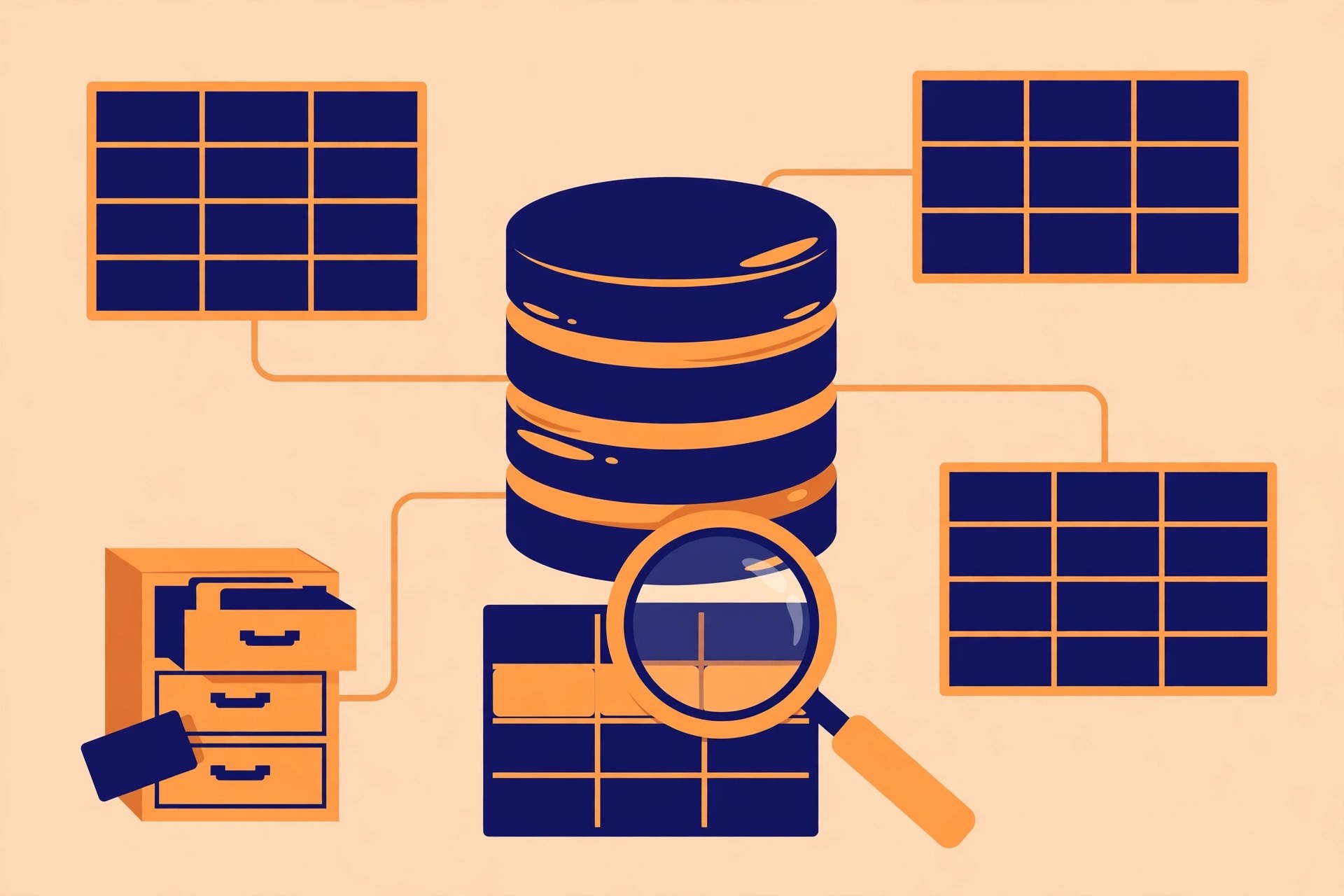
Database Management System — What This Subject Is About
To cover the development of database-driven applications using modern database management software — including conceptual modelling, relational database design and database query languages. By the end you should be able to: describe DBMS fundamentals, installation and working; understand keys and data models; understand the relational model and relational algebra; design a relational database; and apply SQL commands to create, insert, retrieve, update and delete data.
Subject 3.2 (Theory) + 3.6 (Lab) • Total 200 Marks • 5 Credits • 3rd Semester — Computer Science & Engineering • Session 2026–27
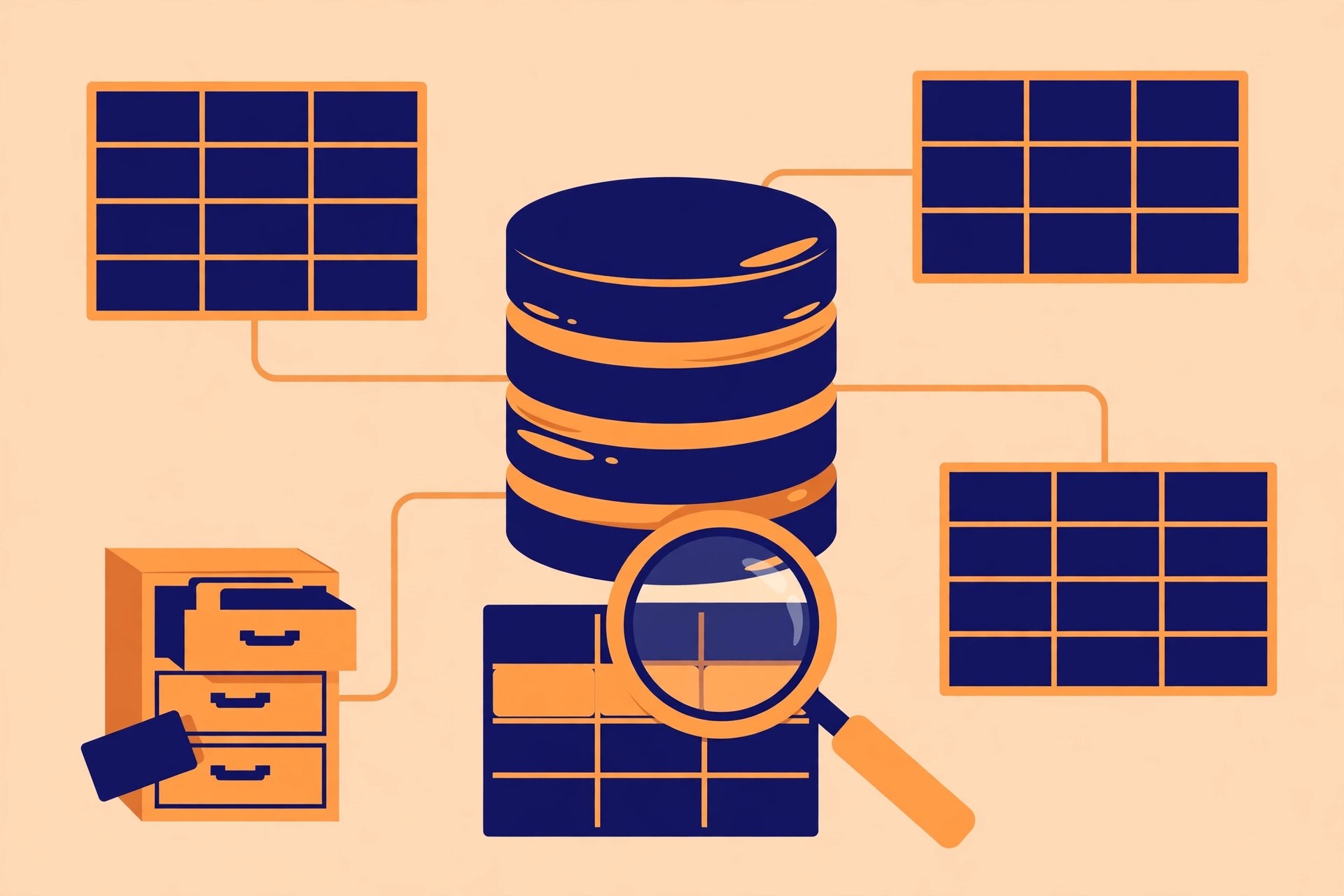
What You Will Study
Unit 1 — Introduction (6 Periods, 10%)
Database system concepts and architecture; components of DBMS; table structure; schema definition; three views of data (external view, conceptual view, internal view).
What a database system is, what parts it has, and the three ways of looking at the same data — what the user sees, how it is designed, and how it is actually stored.
Unit 2 — Data Model and Keys (8 Periods, 25%)
Data model definition; network model, hierarchical model, E-R model; advantages and disadvantages of each data model; concept of keys (primary, candidate, super, foreign); constraints; strong entity set and weak entity set.
Different ways to model data, how tables are linked through keys, and the rules (constraints) that keep data correct.
Unit 3 — Relational Model (10 Periods, 25%)
The relational data model and relational database constraints; ER/EER to relational model mapping; relational algebra and relational calculus; basic operations (union, intersection, difference, Cartesian product); additional operations (projection, selection, division, rename, join).
The maths behind tables: how to combine, filter and join tables to get exactly the data you want — this is the theory behind every SQL query.
Unit 4 — Relational Database Design (10 Periods, 25%)
Functional dependencies and normalisation for relational databases; types of normalisation (1NF, 2NF, 3NF, multivalued dependencies and BCNF, fourth normal form, fifth normal form).
How to design tables so data is not repeated unnecessarily and cannot become inconsistent — the rules that turn a messy table into a clean database.
Unit 5 — SQL / MySQL (8 Periods, 15%)
MySQL data types; data definition commands; data manipulation commands; data retrieval commands; types of operators — arithmetic, comparison and logical operators.
The actual SQL language: creating tables, inserting and changing data, and asking questions of the database.
Practical Work
- Install and configure a database system (MySQL through XAMPP Server, MySQL, PostgreSQL, or SQLite).
- Design an ER model for a Library Management System.
- Study the different properties present in an ER model.
- Creating a database and a table; specifying relational data types, constraints and indexes.
- Table and record handling: INSERT, SELECT with INSERT, DELETE, UPDATE, TRUNCATE, DROP and ALTER statements.
- Retrieving data: SELECT, WHERE clause, logical operators, IN, BETWEEN, LIKE, ORDER BY, GROUP BY and HAVING clauses, aggregate functions, and combining tables using JOINS.
The complete list of 10 practicals is in the Complete Syllabus section below — and in the PDF.
Complete Syllabus
The full examination scheme, the complete practicals list and the reference books from the official syllabus. The unit-wise topics are in the "What You Will Study" section above.
Examination Scheme
| Code | Paper | Type | L – P | Credits | Internal | External | Total |
|---|---|---|---|---|---|---|---|
| 3.2 | Database Management System | Theory | 3 – 0 | 3 | Theory 40 | Theory 60 (3 hrs) | 100 |
| 3.6 | Database Management System (Lab) | Practical | 0 – 4 | 2 | Practical 60 | Practical 40 (3 hrs) | 100 |
| DBMS Total | 5 | 100 | 100 | 200 | |||
Units at a Glance
| Unit | Topic | Periods | Marks Share |
|---|---|---|---|
| 1 | Introduction | 6 | 10% |
| 2 | Data Model and Keys | 8 | 25% |
| 3 | Relational Model | 10 | 25% |
| 4 | Relational Database Design | 10 | 25% |
| 5 | SQL / MySQL | 8 | 15% |
Complete Practicals List
This is the complete list of practicals from the official syllabus.
- Install and configure a database system (MySQL through XAMPP Server, MySQL, PostgreSQL, or SQLite).
- Design an ER model for a Library Management System.
- Study the different properties present in an ER model.
- Creating a database and a table; specifying relational data types, constraints and indexes.
- Table and record handling: INSERT, SELECT with INSERT, DELETE, UPDATE, TRUNCATE, DROP and ALTER statements.
- Retrieving data: SELECT, WHERE clause, logical operators, IN, BETWEEN, LIKE, ORDER BY, GROUP BY and HAVING clauses, aggregate functions, and combining tables using JOINS.
- Case study 1: SQL — Library Management System (books, members, authors, publishers).
- Case study 2: SQL — Employee Database (department, salary, joining date queries).
- Case study 3: SQL — Bookstore Inventory (genre, price and stock queries).
- Case study 4: SQL — Student Grades Database (grade-wise retrieval, averages, updates and deletions).
Reference Books
As listed in the syllabus:
- Fundamentals of Database Systems — Elmasri & Navathe, Pearson Education
- Database Management Systems — Raghu Ramakrishnan & Johannes Gehrke, Tata McGraw-Hill
- Database System Concepts — Silberschatz, Korth & Sudarshan, McGraw-Hill
- Introduction to Database Systems — C. J. Date, Pearson Education
- Introduction to SQL — Rick F. van der Lans, Pearson Education
Frequently Asked Questions
How many marks is DBMS worth in the 3rd semester?
200 marks in total: the theory paper 3.2 is 100 marks (internal 40 + external 60) and the lab 3.6 is 100 marks (practical 60 + external 40). Together they carry 5 credits.
Which units carry the most weightage in DBMS?
Data Model and Keys, Relational Model and Relational Database Design, 25% each. Introduction is 10% and SQL/MySQL is 15%.
What do you do in the DBMS lab?
MySQL through XAMPP: an ER model for a library system, creating tables with constraints and indexes, INSERT/SELECT/UPDATE/DELETE, WHERE/JOIN/GROUP BY/aggregates, plus four SQL case studies (library, employee, bookstore and student grades).
What is normalisation in DBMS?
Unit 4 covers functional dependencies and normalisation — 1NF, 2NF, 3NF, BCNF, fourth and fifth normal forms — the rules that turn a messy table into a clean database.
Which books should I refer to for DBMS?
The syllabus lists Elmasri and Navathe’s Fundamentals of Database Systems, Ramakrishnan and Gehrke’s Database Management Systems, and Silberschatz, Korth and Sudarshan’s Database System Concepts, among others. The full list is in the Complete Syllabus section above.
How can I download the Database Management System syllabus PDF?
The PDF is free to download — use the download link in the Download section below. It is prepared by KAMALDNP from the official BTEUP syllabus.
Related Syllabus Posts
- BTEUP CSE 3rd Semester Syllabus 2026-27
- BTEUP CSE Complete Syllabus 2026-27 — 1st, 3rd & 5th Semester (All Subjects)
- Operating Systems — BTEUP CSE 3rd Semester Syllabus 2026-27
- Web Technologies — BTEUP CSE 3rd Semester Syllabus 2026-27
- Object Oriented Programming Using Java — BTEUP CSE 5th Semester Syllabus 2026-27
Free PDF Download — DBMS Video Lectures (Topic-wise YouTube Links)
For every topic of this DBMS syllabus, we searched YouTube and kept only the lectures that actually teach that topic — 49 verified video lectures in one free PDF. Every link in the PDF is clickable: tap a title or a link and the video opens on YouTube. This PDF is completely FREE — no login, no payment.
Download Free PDF (English)Download Free PDF (Hindi)
Notes, Question Bank & Practice Sets — Database Management System
The syllabus PDF on this page stays 100% FREE — no login, no payment, always. The study material below is a paid KAMALDNP product: buy once for just ₹10 and you get both the Hindi and English PDFs. Every PDF is generated with your name and enrolment number and is password-locked, so it remains personal to you. After purchase, the PDF is also sent to your email, and it is always available for download on the My Downloads page.
Short Notes (English + Hindi) — ₹10
Unit-wise short revision notes prepared from the official BTEUP 2026-27 syllabus of this subject.
Buy / Download — My DownloadsQuestion Bank (English + Hindi) — ₹10
One original practice (model) paper with a model-answer outline. This is a KAMALDNP practice paper — NOT a BTEUP board paper, and no question in it is promised to appear in your exam.
Buy / Download — My DownloadsPractice Sets (English + Hindi) — ₹10
10 Practice Sets — practice/guess sets only (no verified previous-year board papers available for this subject yet)
Buy / Download — My DownloadsAlready purchased? You will find the Download button on the same My Downloads page — you will not be charged again.
Download the Database Management System Syllabus PDF
Download the complete Database Management System syllabus PDF below — prepared by KAMALDNP, with the full topic list, practicals and reference books.
Download the Database Management System Syllabus PDF
Source: BTEUP 2nd Year curriculum (folder2627), approved in C.D.C. meeting held on 16.07.2026. Topic lists follow the official syllabus; short explanations are the author's own plain-English summaries, not syllabus text. Please confirm with your own polytechnic for any local changes.


Comments (0)
Share your question or experience about this syllabus. Your comment will appear after review.
No comments yet — be the first to share your thoughts!