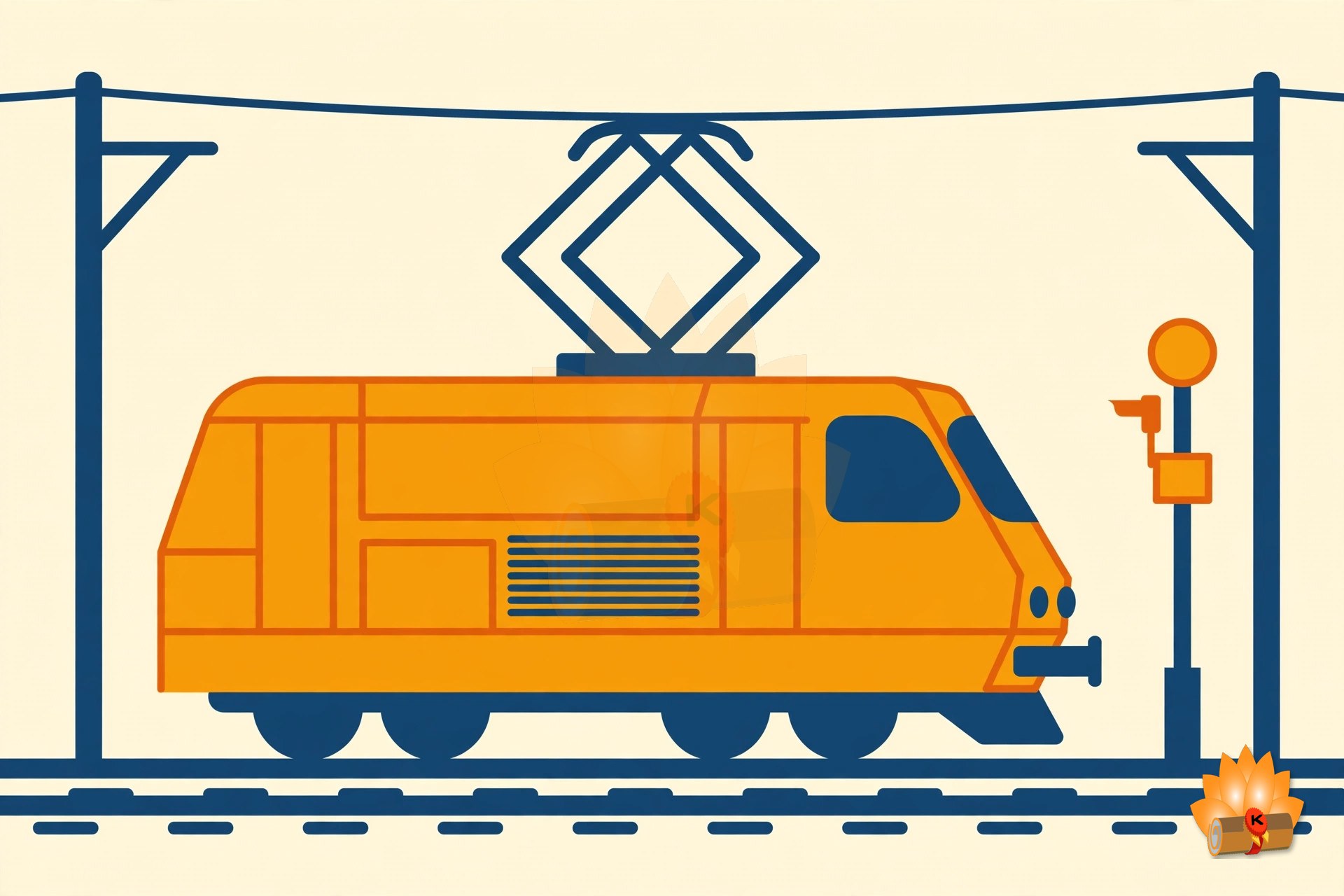
Electric Traction — What This Subject Is About
Electric Traction is the engineering behind electric trains — how a locomotive draws power, how that power reaches it, and how the train is controlled and kept safe. The subject teaches you to maintain electric traction systems, and it is Program Elective-3, Option 2: you choose either this subject or Solar Power Technologies.
It is the only subject in the 5th semester with six units: Basics of Traction, Power Supply Arrangements, Overhead Equipment, Electric Locomotive, Traction Motors and Train Lighting, and Signalling and Supervisory Control. The weightage is evenly spread — no unit is above 19% — so every part of the system matters: the supply, the overhead wires, the locomotive itself, the motors, and the signalling that keeps trains apart.
Subject 5.2.2 (Program Elective-3, Theory) • Total 100 Marks • 3 Credits • L 3 – P 0 • Choose this OR Solar Power Technologies • 5thth Semester — Electrical Engineering • Session 2026–27
What You Will Study
Unit – I: Basics of Traction (06 Periods, 14%)
General description of Electrical Traction system in India; Advantages and Disadvantages of Electric Drive, Diesel Electric Drive, Battery Drive; Problems associated with AC traction System and remedies for it.
Unit – II: Power Supply Arrangements (08 Periods, 19%)
Traction Substation: layout, list of equipment and their functions; Miscellaneous equipment at control post or Switching station; Protection system for traction transformer and 25 kV centenary construction.
Unit – III: Overhead Equipment (07 Periods, 17%)
Different types of overhead equipments; Pentagonal OHE Centenary Construction; OHE Supporting Structure, Cantilever assembly diagram; Overhead system - Trolley collector, Bow collector, Pantograph Collector; Types and construction of pantograph.
Unit – IV: Electric Locomotive (07 Periods, 17%)
Classification and Nomenclature of Electric Locomotive; Block diagram of AC locomotive; Power Circuit of AC Locomotive; Equipment (List and Function only) used in auxiliary circuit of AC Locomotive.
Unit – V: Traction Motors and Train Lighting (08 Periods, 19%)
Desirable characteristics of traction motor; Types of motors used for traction with their characteristics and features; Control of motors used for traction and methods to control; Requirements of braking, types of braking; Electric braking, Regenerative braking; brief idea of train lighting system.
Unit – VI: Signalling and Supervisory Control (06 Periods, 14%)
Requirements of signalling systems; Types of signals, track circuits; Advantages of remote control; Systems of remote control, equipment and network; Metro rail - supply systems, advantages, schemes in India.
Complete Syllabus
The full examination scheme, the complete practicals list and the reference books from the official syllabus. The unit-wise topics are in the "What You Will Study" section above.
Examination Scheme
| Code | Paper | Type | L – P | Credits | Internal | External | Total |
|---|---|---|---|---|---|---|---|
| 5.2 | Program Elective-3: Electric Traction | Theory | 3 – 0 | 3 | 40 | 60 (3 hrs) | 100 |
| Electric Traction Total | 3 | 40 | 60 | 100 | |||
Units at a Glance
| Unit | Topic | Periods | Marks Share |
|---|---|---|---|
| I | Basics of Traction | 06 | 14% |
| II | Power Supply Arrangements | 08 | 19% |
| III | Overhead Equipment | 07 | 17% |
| IV | Electric Locomotive | 07 | 17% |
| V | Traction Motors and Train Lighting | 08 | 19% |
| VI | Signalling and Supervisory Control | 06 | 14% |
Reference Books
As listed in the syllabus:
- G.C. Garg, Utilization of Electric Power & Electric Traction, Khanna Book Publishing Co., New Delhi (ISBN: 978-93-86173-355) Revised Ed. 2018
- Gupta J.B., S.K. Kataria and Son, Utilization of Electric power and traction
- Partab H., Dhanpat Rai and Co, Art and Science of Utilization of Electrical Energy
- Partab H., Dhanpat Rai and Co, Modern Electric Traction
- Suryanarayana N.V., New Age International Publishers, Reprint 2010
- Open Shaw Taylor, Orient Longman ltd., Utilisation of electrical energy
- Dr. T. D. Bisht, Ashish Sahoo, Pooja Yadav, Electric Traction, Asian Publishers, Muzaffarnagar, ISBN No. 978-93-91541-68-2
Frequently Asked Questions
How many marks is Electric Traction worth in the 5th semester?
100 marks, 3 credits. It is a theory subject (L 3 – 0): internal 40, external 60 (3 hrs).
Which unit carries the most weightage in Electric Traction?
Power Supply Arrangements, 19% (08 periods).
Is there any practical work in Electric Traction?
No — the official syllabus lists no practicals for this subject.
Which books should I read for Electric Traction?
7 reference books are listed in the official syllabus — the full list is in the Complete Syllabus section above.
How can I download the Electric Traction syllabus PDF?
The PDF is free to download — use the download link in the Download section below. It is prepared by KAMALDNP Academy from the official BTEUP syllabus.
Should I choose Electric Traction or Solar Power Technologies?
Both are the two options of Program Elective-3 (5.2) — you choose one. Electric Traction covers traction basics, power supply arrangements, overhead equipment, electric locomotives, traction motors and train lighting, and signalling and supervisory control. Check with your polytechnic which option it offers.
Related Syllabus Posts
- BTEUP Electrical 5th Semester Syllabus 2026-27
- BTEUP Electrical Complete Syllabus 2026-27 — 5th & 6th Semester (All Subjects)
- Switch Gear and Protection — BTEUP Electrical 5th Semester Syllabus 2026-27
- Solar Power Technologies — BTEUP Electrical 5th Semester Syllabus 2026-27
- Energy Conservation and Audit — BTEUP Electrical 5th Semester Syllabus 2026-27
Download the Electric Traction Syllabus PDF
Download the complete Electric Traction syllabus PDF below — prepared by KAMALDNP Academy, with the full topic list, practicals and reference books.
Download the Electric Traction Syllabus PDF
Source: BTEUP 3rd Year Electrical Engineering curriculum (folder2627), approved in C.D.C. meeting held on 16.07.2026. Topic lists follow the official syllabus; short explanations are the author's own plain-English summaries, not syllabus text. Please confirm with your own polytechnic for any local changes.

Comments (0)
Share your question or experience about this syllabus. Your comment will appear after review.
No comments yet — be the first to share your thoughts!