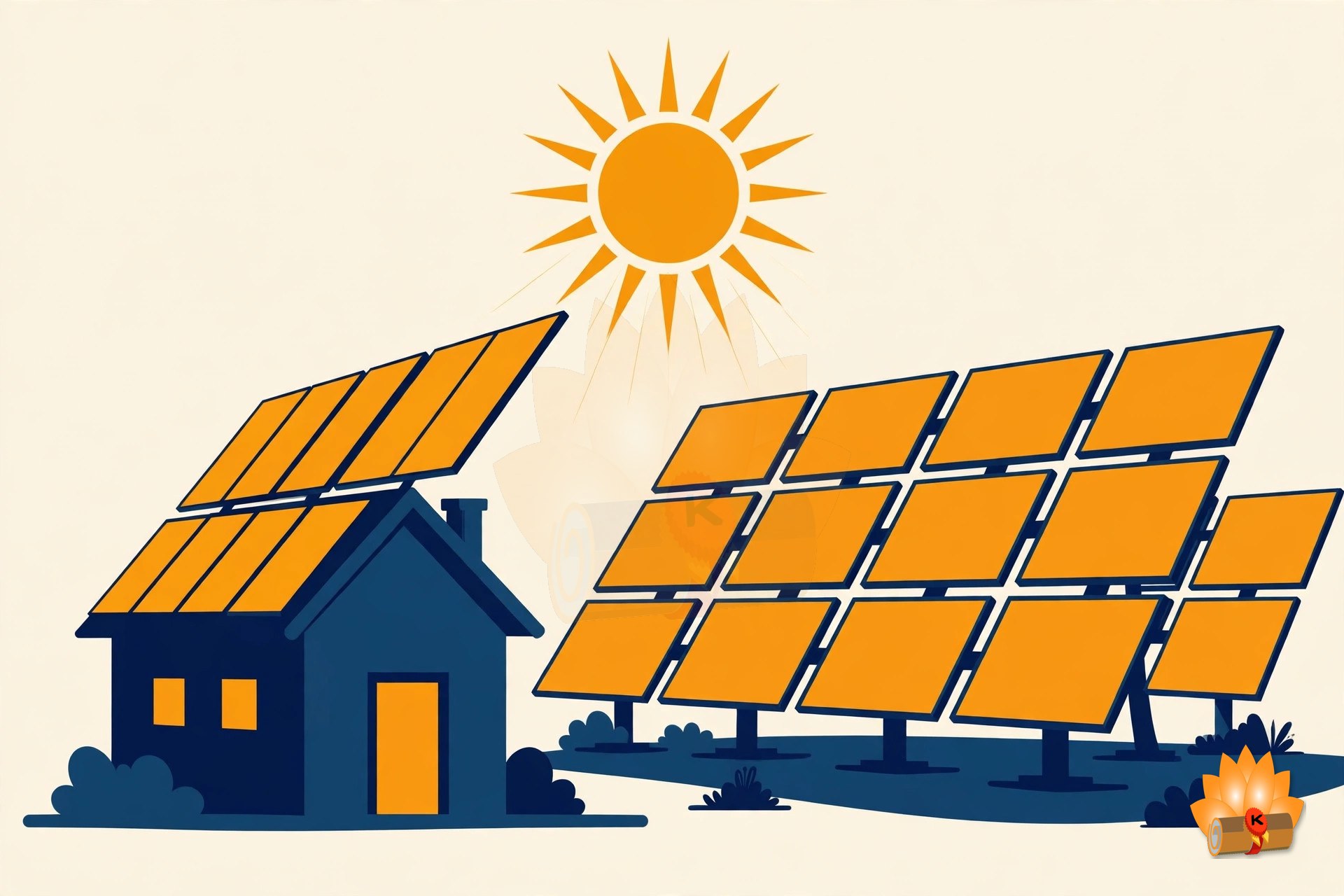
Solar Power Technologies — What This Subject Is About
Solar power is no longer a side topic in electrical engineering — it is one of the main ways India now generates electricity. Solar Power Technologies teaches you to maintain the efficient operation of various types of solar power technologies, from the sun's energy itself to complete power plants. This is Program Elective-3, Option 1: you choose either this subject or Electric Traction.
The five units cover solar energy first, then concentrated solar power (CSP), then solar PV panels and their installation, solar PV electronics, and finally off-grid and grid-tied systems. The two heaviest units — Solar PV Panel and Installation, and Solar PV Electronics — carry 25% each, so half the weightage is on the PV side: how panels are put up, wired and run, and the electronics that turn their DC output into usable power.
Subject 5.2.1 (Program Elective-3, Theory) • Total 100 Marks • 3 Credits • L 3 – P 0 • Choose this OR Electric Traction • 5thth Semester — Electrical Engineering • Session 2026–27
Note: In the PDF the recommended-books list ends with a blank entry numbered “6.” — no sixth book is named, so it is not included here.
What You Will Study
Unit – I: Solar Energy (06 Periods, 14%)
Solar Map of India: Global solar power radiation; Different types of Solar water heaters: working and installation; Solar Heating systems, Different types of Solar cookers, Solar lighting.
Unit – II: Concentrated Solar Power (CSP) (08 Periods, 18%)
Concentrated Solar Power (CSP) plants or solar thermal electric systems; Parabolic Trough: working and specifications; Parabolic Dish: Construction, working and specifications; Power Tower, Fresnel Reflectors: Construction, working and specifications; Solar Stirling engines.
Unit – III: Solar PV Panel and Installation (10 Periods, 25%)
Types construction, working, Typical specifications of solar cells; Solar PV working principle: Series and parallel connections of solar modules; Solar Photovoltaic (PV) system: components layout and working; Solar modules, arrays and their standard specifications; Roof top and streetlight solar PV systems; Solar water pumping application.
Unit – IV: Solar PV Electronics (10 Periods, 25%)
Solar Charge controllers: working and specifications, switchgear and cables; Batteries: Different types for solar PV systems, Solar Inverters: working; Signal conditioning systems: working, Solar Power tracking: construction, working, I-V, P-V characteristics.
Unit – V: Solar PV Off-grid and Grid Tied Systems (08 Periods, 18%)
Solar off grid systems: Layout; Solar Grid tied (on grid) systems: Working principle of grid-tied dc-ac inverter, grid synchronization and active power export; Net metering: main features and working.
Complete Syllabus
The full examination scheme, the complete practicals list and the reference books from the official syllabus. The unit-wise topics are in the "What You Will Study" section above.
Examination Scheme
| Code | Paper | Type | L – P | Credits | Internal | External | Total |
|---|---|---|---|---|---|---|---|
| 5.2 | Program Elective-3: Solar Power Technologies | Theory | 3 – 0 | 3 | 40 | 60 (3 hrs) | 100 |
| Solar Power Technologies Total | 3 | 40 | 60 | 100 | |||
Units at a Glance
| Unit | Topic | Periods | Marks Share |
|---|---|---|---|
| I | Solar Energy | 06 | 14% |
| II | Concentrated Solar Power (CSP) | 08 | 18% |
| III | Solar PV Panel and Installation | 10 | 25% |
| IV | Solar PV Electronics | 10 | 25% |
| V | Solar PV Off-grid and Grid Tied Systems | 08 | 18% |
Reference Books
As listed in the syllabus:
- Solanki, Chetan Singh, - Solar Photovoltaics: Fundamentals, Technologies and Applications, PHI Learning, New Delhi, ISBN: 9788120351110
- Kothari, D.P. et al: Renewable Energy Sources and Emerging Technologies, PHI
- David M. Buchla, Thomas E. Kissell, Thomas L. Floyd, - Renewable Energy Systems, Pearson Education New Delhi, ISBN: 9789332586826
- Rachel, Sthuthi, Earnest, Joshua; - Wind Power Technologies, PHI Learning
- O.P. Gupta, Energy Technology, Khanna Publishing House, ISBN: 978-93-86173-683
Frequently Asked Questions
How many marks is Solar Power Technologies worth in the 5th semester?
100 marks, 3 credits. It is a theory subject (L 3 – 0): internal 40, external 60 (3 hrs).
Which unit carries the most weightage in Solar Power Technologies?
Solar PV Panel and Installation, 25% (10 periods).
Is there any practical work in Solar Power Technologies?
No — the official syllabus lists no practicals for this subject.
Which books should I read for Solar Power Technologies?
5 reference books are listed in the official syllabus — the full list is in the Complete Syllabus section above.
How can I download the Solar Power Technologies syllabus PDF?
The PDF is free to download — use the download link in the Download section below. It is prepared by KAMALDNP Academy from the official BTEUP syllabus.
Should I choose Solar Power Technologies or Electric Traction?
Both are the two options of Program Elective-3 (5.2) — you choose one. Solar Power Technologies covers solar energy, CSP, PV panels and installation, PV electronics and off-grid/grid-tied systems. Check with your polytechnic which option it offers.
Related Syllabus Posts
- BTEUP Electrical 5th Semester Syllabus 2026-27
- BTEUP Electrical Complete Syllabus 2026-27 — 5th & 6th Semester (All Subjects)
- Switch Gear and Protection — BTEUP Electrical 5th Semester Syllabus 2026-27
- Electric Traction — BTEUP Electrical 5th Semester Syllabus 2026-27
- Energy Conservation and Audit — BTEUP Electrical 5th Semester Syllabus 2026-27
Download the Solar Power Technologies Syllabus PDF
Download the complete Solar Power Technologies syllabus PDF below — prepared by KAMALDNP Academy, with the full topic list, practicals and reference books.
Download the Solar Power Technologies Syllabus PDF
Source: BTEUP 3rd Year Electrical Engineering curriculum (folder2627), approved in C.D.C. meeting held on 16.07.2026. Topic lists follow the official syllabus; short explanations are the author's own plain-English summaries, not syllabus text. Please confirm with your own polytechnic for any local changes.



Comments (0)
Share your question or experience about this syllabus. Your comment will appear after review.
No comments yet — be the first to share your thoughts!