
Open Elective-3 — What This Subject Is About
Open Elective-3 is the 6th semester's qualifying elective — 2 credits, 50 internal marks — and it is different from every other subject in the semester: you must appear for the examination and pass it, but the marks are NOT counted in your percentage or division. You choose ONE of two options: 6.4.1 Disaster Management or 6.4.2 Renewable Energy Technologies. Or, instead of either, you can take an Advance Skill Development certification course of not less than 20 hours, offline or online, from the elective list in the syllabus, conducted by agencies of repute.
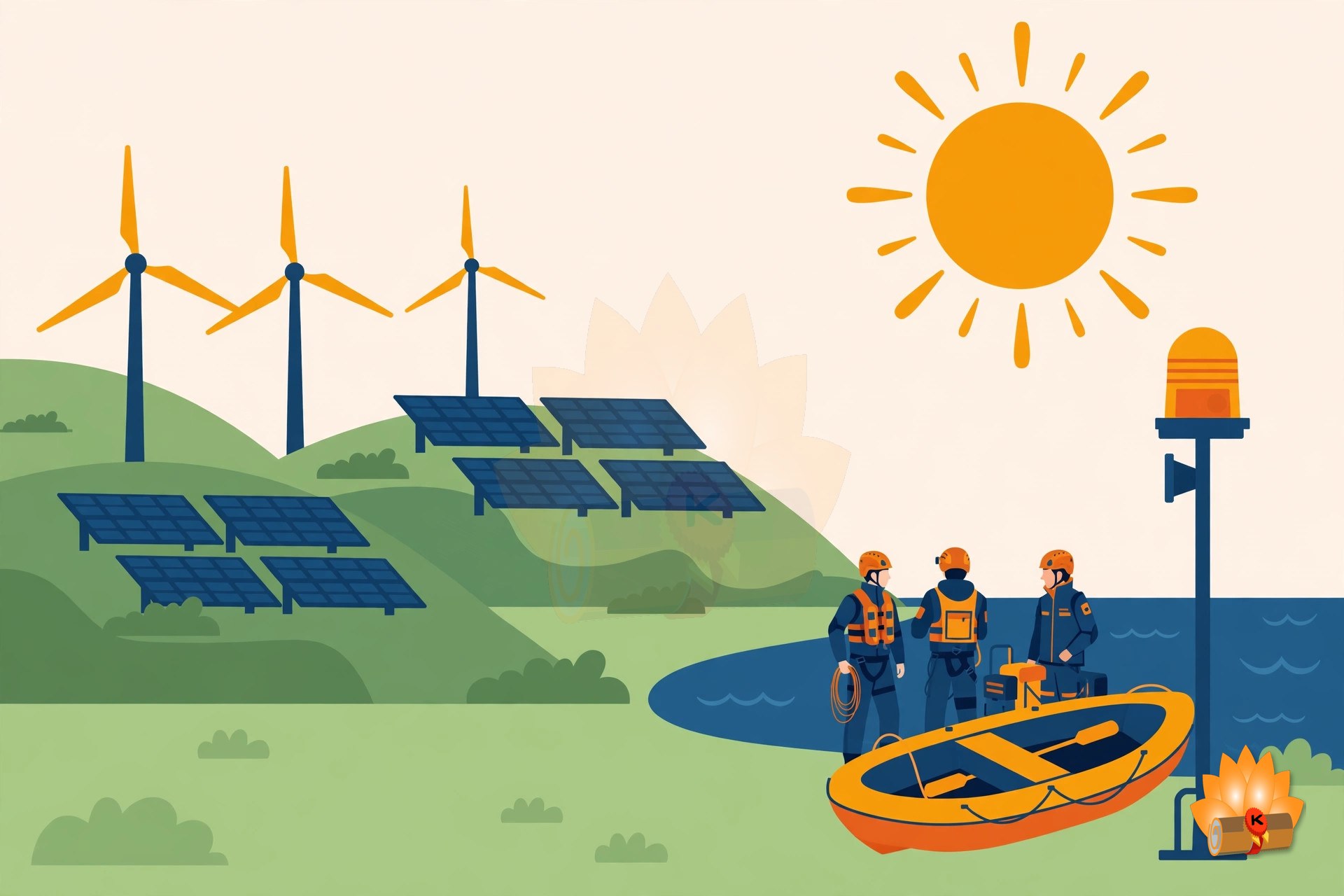
Both options are short — 42 periods for Disaster Management — and both are about the world outside the computer lab: how disasters are understood and managed, and how energy comes from the sun, wind, biomass and water. This post covers both options completely, in the official order.
Subject 6.4 (Q) (Open Elective-3) • 50 Marks Internal Only • 2 Credits • L 2 • Qualifying — marks NOT counted in percentage / division • Choose ONE of 6.4.1 / 6.4.2 OR Advance Skill Development • 6th Semester — Computer Science & Engineering • Session 2026–27
About this document: Open Elective-3 is a qualifying (Q) theory elective worth 2 credits. Students choose ONE of the two options below — 6.4.1 Disaster Management or 6.4.2 Renewable Energy Technologies — or take an Advance Skill Development certification course instead (duration not less than 20 hours, offline/online, chosen from the elective list provided in the syllabus and conducted by agencies of repute). It is compulsory to appear and to pass the examination, but the 50 internal marks will not be included for percentage and division of obtained marks. Both options are covered here, completely, in the official order.
6.4.1 — Disaster Management
Disaster management aims to reduce, or avoid the potential losses from hazards, assure prompt and appropriate assistance to victims of disaster, and achieve rapid and effective recovery.
Course Outcomes
- CO 1: Understanding disaster and hazards.
- CO 2: Understanding types, consequences and control of disasters.
- CO 3: Understanding Disaster Management Cycle.
- CO 4: Understanding Disaster Management Acts in India.
- CO 5: Understanding application of technology for Managing the disasters.
Units — 6.4.1 Disaster Management
Unit I — Understanding Disaster (6 Periods, 17%)
Understanding the concepts and definitions of Disaster, Hazard, Vulnerability, Risk, Capacity, Disaster and Development, and disaster management.
What a disaster, a hazard, vulnerability and risk actually mean — and what disaster management is.
Unit II — Types, Trends, Causes, Consequences and Control of Disasters (10 Periods, 22%)
Geological Disasters (earthquakes, landslides, tsunami, mining); Hydro-Meteorological Disasters (floods, cyclones, lightning, thunder-storms, hail storms, avalanches, droughts, cold and heat waves); Biological Disasters (epidemics, pest attacks, forest fire); Technological Disasters (chemical, industrial, radiological, nuclear) and Manmade Disasters (building collapse, rural and urban fire, road and rail accidents, nuclear, radiological, chemicals and biological disasters); Global Disaster Trends — Emerging Risks of Disasters — Climate Change and Urban Disasters.
The kinds of disasters — earthquakes, floods, cyclones, epidemics, industrial accidents — and how they are controlled.
Unit III — Disaster Management Cycle and Framework (10 Periods, 22%)
Disaster Management Cycle — Paradigm Shift in Disaster Management. Pre-Disaster — Risk Assessment and Analysis, Risk Mapping, zonation and Micro zonation, Prevention and Mitigation of Disasters, Early Warning System; Preparedness, Capacity Development; Awareness. During Disaster — Evacuation — Disaster Communication — Search and Rescue — Emergency Operation Centre — Incident Command System — Relief and Rehabilitation. Post-disaster — Damage and Needs Assessment, Restoration of Critical Infrastructure — Early Recovery — Reconstruction and Redevelopment; IDNDR, Yokohama Strategy, Hyogo Framework of Action.
The disaster management cycle: before, during and after a disaster, from early warning to reconstruction.
Unit IV — Disaster Management in India (10 Periods, 22%)
Disaster Profile of India — Mega Disasters of India and Lessons Learnt. Disaster Management Act 2005 — Institutional and Financial Mechanism, National Policy on Disaster Management, National Guidelines and Plans on Disaster Management; Role of Government (local, state and national), Non-Government and Inter Governmental Agencies.
How India manages disasters — the Disaster Management Act 2005, national policy, and who does what.
Unit V — Applications of Science and Technology for Disaster Management (6 Periods, 17%)
Geo-informatics in Disaster Management (RS, GIS, GPS and RS). Disaster Communication System (Early Warning and Its Dissemination). Land Use Planning and Development Regulations, Disaster Safe Designs and Constructions, Structural and Non-Structural Mitigation of Disasters; S&T Institutions for Disaster Management in India.
How science and technology help — satellites, GIS, GPS, communication systems and disaster-safe design.
6.4.2 — Renewable Energy Technologies
Course Outcomes
- CO 1: Understanding basics of Renewable Energy.
- CO 2: Understanding Solar Energy.
- CO 3: Understanding Wind Energy.
- CO 4: Understanding Bio Energy.
- CO 5: Understanding Tidal, Wave, Hydro Thermal Energy.
The source lists no period counts or marks distribution for this option, and no course objectives — only course outcomes. Unit heads below therefore carry no periods or weightage.
Units — 6.4.2 Renewable Energy Technologies
Unit I — Introduction
World Energy Use; Reserves of Energy Resources; Environmental Aspects of Energy Utilisation; Renewable Energy Scenario in India and around the World; Potentials; Achievements / Applications; Economics of renewable energy systems.
How the world uses energy, what reserves remain, and where renewable energy stands in India and the world.
Unit II — Solar Energy
Solar Radiation; Measurements of Solar Radiation; Flat Plate and Concentrating Collectors; Solar direct Thermal Applications; Solar thermal Power Generation; Fundamentals of Solar Photo Voltaic Conversion; Solar Cells; Solar PV Power Generation; Solar PV Applications.
Sunlight as energy — solar radiation, collectors, solar thermal power and solar cells.
Unit III — Wind Energy
Wind Data and Energy Estimation; Types of Wind Energy Systems; Performance; Site Selection; Details of Wind Turbine Generator; Safety and Environmental Aspects.
Wind as energy — wind data, types of wind systems, site selection and wind turbine generators.
Unit IV — Bio-Energy
Biomass direct combustion; Biomass gasifiers; Biogas plants; Digesters; Ethanol production; Bio diesel; Cogeneration; Biomass Applications.
Energy from biomass — direct combustion, gasifiers, biogas plants, ethanol and biodiesel.
Unit V — Other Renewable Energy Sources
Tidal energy; Wave Energy; Open and Closed OTEC Cycles; Small Hydro-Geothermal Energy; Hydrogen and Storage; Fuel Cell Systems; Hybrid Systems.
The other sources — tidal and wave energy, small hydro, geothermal, hydrogen, fuel cells and hybrid systems.
Practical Work
No practicals are listed in the official syllabus for this subject — it is a theory subject (lectures only).
Complete Syllabus
The full examination scheme and the reference books from the official syllabus. The unit-wise topics are in the “What You Will Study” section above.
Examination Scheme
| Code | Paper | Type | L – P | Credits | Internal | External | Total |
|---|---|---|---|---|---|---|---|
| 6.4 | Open Elective-3 (choose ONE of 6.4.1 / 6.4.2) OR Advance Skill Development | Theory | 2 – 0 | 2 | 50 | — | — (Q) |
| Open Elective-3 Total | 2 | 50 | — | — (Q) | |||
6.4.1 — Disaster Management
Units at a Glance
| Unit | Topic | Periods | Marks Share |
|---|---|---|---|
| I | Understanding Disaster | 6 | 17% |
| II | Types, Trends, Causes, Consequences and Control of Disasters | 10 | 22% |
| III | Disaster Management Cycle and Framework | 10 | 22% |
| IV | Disaster Management in India | 10 | 22% |
| V | Applications of Science and Technology for Disaster Management | 6 | 17% |
Reference Books
As listed in the syllabus:
- Publications of National Disaster Management Authority (NDMA) on Various Templates and Guidelines for Disaster Management.
- Bhandani, R. K., An overview on natural & man-made disasters and their reduction, CSIR, New Delhi.
- Srivastava, H. N., and Gupta G. D., Management of Natural Disasters in developing countries, Daya Publishers, Delhi.
- Alexander, David, Natural Disasters, Kluwer Academic London.
- Ghosh, G. K., Disaster Management, A P H Publishing Corporation.
- Murthy, D. B. N., Disaster Management: Text & Case Studies, Deep & Deep Pvt. Ltd.
6.4.2 — Renewable Energy Technologies
The official syllabus gives no period counts or marks distribution table for this option — only course outcomes. The units are listed without periods or weightage.
Reference Books
As listed in the syllabus:
- O.P. Gupta, Energy Technology, Khanna Publishing House, Delhi (ed. 2018).
- Renewable Energy Sources, Twidell, J.W. & Weir, A., EFN Spon Ltd., UK, 2006.
- Solar Energy, Sukhatme. S.P., Tata McGraw Hill Publishing Company Ltd., New Delhi, 1997.
- Renewable Energy, Power for a Sustainable Future, Godfrey Boyle, Oxford University Press, U.K., 1996.
- Fundamental of Renewable Energy Sources, GN Tiwari and MK Ghoshal, Narosa, New Delhi, 2007.
- Renewable Energy and Environment — A Policy Analysis for India, NH Ravindranath, UK Rao, B Natarajan, P Monga, Tata McGraw Hill.
- Energy and The Environment, RA Ristinen and J J Kraushaar, Second Edition, John Willey & Sons, New York, 2006.
- Renewable Energy Resources, JW Twidell and AD Weir, ELBS, 2006.
Frequently Asked Questions
How many marks is Open Elective-3 worth in the 6th semester?
50 marks internal (qualifying). You must appear and pass the examination, but the marks are not included in your percentage or division. The subject carries 2 credits.
Do the Open Elective-3 marks count in my result?
No. Open Elective-3 is qualifying (Q): you must appear and pass the examination, but the 50 internal marks are not included for percentage and division of obtained marks. The subject carries 2 credits.
What can I take instead of Disaster Management or Renewable Energy Technologies?
An Advance Skill Development certification course, of duration not less than 20 hours, offline or online, chosen from the elective list provided in the syllabus and conducted by agencies of repute. The detailed contents of that certification course are not given in the PDF.
Which units carry the most weightage in Disaster Management (6.4.1)?
Units II (Types, Trends, Causes, Consequences and Control of Disasters), III (Disaster Management Cycle and Framework) and IV (Disaster Management in India) carry 22% each — the highest weightage in the option. Units I and V carry 17% each.
Why are there no period counts or marks for Renewable Energy Technologies (6.4.2)?
The official syllabus itself gives no period counts per unit, no marks distribution table and no course objectives for this option — only course outcomes. The units are listed here without periods or weightage, exactly as the source gives them, rather than inventing numbers.
How can I download the Open Elective-3 syllabus PDF?
The PDF is free to download — use the download link in the Download section below. It is prepared by KAMALDNP Academy from the official BTEUP syllabus.
Related Syllabus Posts
- BTEUP CSE 6th Semester Syllabus 2026-27
- BTEUP CSE 5th Semester Syllabus 2026-27
- BTEUP CSE Complete Syllabus 2026-27 — All Years, All Semesters
- Program Elective-4 — BTEUP CSE 6th Semester Syllabus 2026-27
- Entrepreneurship and Start-ups — BTEUP CSE 6th Semester Syllabus 2026-27
- In House Project — BTEUP CSE 6th Semester Syllabus 2026-27
Download the Open Elective-3 Syllabus PDF
Download the complete Open Elective-3 syllabus PDF below — prepared by KAMALDNP Academy, with the full topic list and reference books.
Download the Open Elective-3 Syllabus PDF
Source: BTEUP 3rd Year curriculum (folder2627), approved in C.D.C. meeting held on 16.07.2026. Topic lists follow the official syllabus; short explanations are the author's own plain-English summaries, not syllabus text. Please confirm with your own polytechnic for any local changes.

Comments (0)
Share your question or experience about this syllabus. Your comment will appear after review.
No comments yet — be the first to share your thoughts!