Switch Gear and Protection — What This Subject Is About
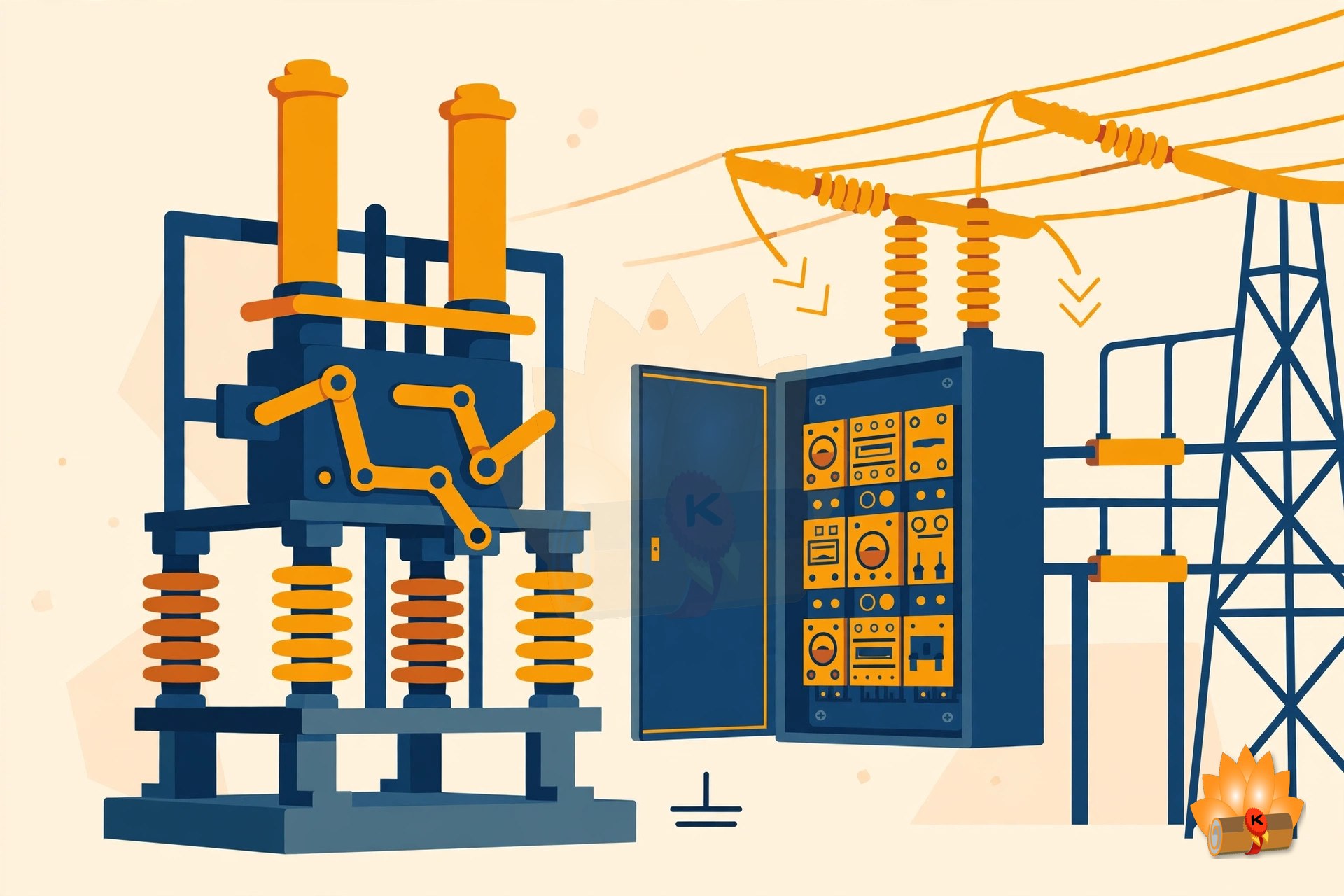
Every power system needs a guard. When a fault occurs — a short circuit, an overload, a lightning strike — something must detect it in a fraction of a second and disconnect only the faulty part, so the rest of the system keeps running. That is what Switch Gear and Protection is about. The subject teaches you to maintain the switchgear and protection schemes used in electrical power systems: the circuit breakers and isolators that interrupt current, and the protective relays that decide when to trip them.
The five units move from the basics of protection to the equipment itself. You start with the fundamental quality requirements of protection, then study circuit interruption devices and isolators, then protective relays — the heaviest unit at 23% — and finally the protection of alternators, transformers and motors, and of busbars and transmission lines, including the concept of neutral grounding. It is a theory subject (L 3 – T 1 – P 0), so there is no separate practical list — the learning is in understanding how each scheme works and where it is applied.
Subject 5.1 (Theory) • Total 100 Marks • 4 Credits • L 3 – T 1 – P 0 • 5thth Semester — Electrical Engineering • Session 2026–27
What You Will Study
Unit – I: Basics of Protection & Fundamental quality requirements (10 Periods, 17%)
Necessity, purpose and functions of protective switchgear; Characteristics of a protection system, Normal and abnormal conditions; Types of faults, their causes and effects; Protection zones and backup protection, Need of current limiting reactors and their arrangements.
Unit – II: Circuit Interruption Devices Isolators (11 Periods, 20%)
Vertical break, Horizontal break and Pantograph type; HRC fuses – Construction, working, characteristics and applications; Arc formation process, methods of arc extinction (High resistance and Low resistance), Arc voltage, Recovery voltage, Re-striking voltage, RRRV; HT circuit breakers (Sulphur-hexa Fluoride (SF6), Vacuum circuit breaker) - Working, construction; L.T. circuit breaker (Air circuit breakers (ACB), Miniature circuit breakers (MCB)) - Working and applications; Selection of LT and HT circuit breakers (ratings); Gas insulated switchgear.
Unit – III: Protective Relays (13 Periods, 23%)
Basic relay terminology - Protective relay, Relay time, Breaker time, Fault Clearing time, Pick-up, reset value, current setting, plug setting multiplier, Time setting multiplier, burden, reach; Protective relays: Classification, principle of working, construction and operation of – Electromagnetic, Induction type relays; Block diagram and working of Static relays; Overcurrent relay - Time current characteristics, principle of operation of - Non directional Over Current relay, Induction type Directional Power Relay, Directional Induction type Over Current relay; Introduction to Microprocessor based over current relays; Distance relaying - Principle, operation and classification of distance relays; Differential relay - operation of current balance and voltage balance differential relays.
Unit – IV: Protection of Alternator, Transformer and Motors (11 Periods, 20%)
Alternator Protection: Faults, Differential protection, Over current, earth fault, overheating protection; Transformer Protection: Faults, Differential, over current, earth fault, over heating protection, Limitations of differential protection; Buchholz relay: Construction, operation; Motor Protection: Short circuit protection, Overload protection (through thermal Relay), Single phase preventer.
Unit – V: Protection of Busbar, Transmission Line and Concept of Neutral Grounding (11 Periods, 20%)
Faults on Bus bar and Transmission Lines; Bus bar protection: Differential and Fault bus protection; Transmission line protection: Over current, Distance and Pilot wire protection; Grounding (equipment and system), Ungrounded Neutral system, Need of neutral grounded, Methods of Neutral Grounding.
Complete Syllabus
The full examination scheme, the complete practicals list and the reference books from the official syllabus. The unit-wise topics are in the "What You Will Study" section above.
Examination Scheme
| Code | Paper | Type | L – P | Credits | Internal | External | Total |
|---|---|---|---|---|---|---|---|
| 5.1 | Switch Gear and Protection | Theory | 3 – 0 | 4 | 40 | 60 (3 hrs) | 100 |
| Switch Gear and Protection Total | 4 | 40 | 60 | 100 | |||
Units at a Glance
| Unit | Topic | Periods | Marks Share |
|---|---|---|---|
| I | Basics of Protection & Fundamental quality requirements | 10 | 17% |
| II | Circuit Interruption Devices Isolators | 11 | 20% |
| III | Protective Relays | 13 | 23% |
| IV | Protection of Alternator, Transformer and Motors | 11 | 20% |
| V | Protection of Busbar, Transmission Line and Concept of Neutral Grounding | 11 | 20% |
Reference Books
As listed in the syllabus:
- Mehta V. K; Rohit Mehta, Principles of Power System, S. Chand and Co., New Delhi., ISBN: 978-81-2192-496-2
- Rao, Sunil S., Switchgear and Protection, Khanna Publishers, New Delhi, ISBN: 978-81-7409-232-3
- Singh, R. P., Switchgear and Power System Protection, PHI Learning, New Delhi, ISBN: 978-81-203-3660-5
- Gupta. J. B., Switchgear and Protection, S. K. Kataria and Sons, New Delhi, ISBN: 978-93-5014-372-8
- Veerapan, N., Krishnamurty, S. R., Switchgear and Protection, S. Chand and Co., New Delhi. ISBN: 978-81-2193-212-7
- Ram, Badri; Vishwakarma D. N., Power System Protection and Switchgear, McGraw-Hill, New Delhi. ISBN: 978-07-107774-X
- Dr. T. D. Bisht, Ashish Sahoo, Pooja Yadav, Switch Gear & Protection, Asian Publishers, Muzaffarnagar, ISBN No. 978-93-91541-62-0
Frequently Asked Questions
How many marks is Switch Gear and Protection worth in the 5th semester?
100 marks, 4 credits. It is a theory subject (L 3 – 0): internal 40, external 60 (3 hrs).
Which unit carries the most weightage in Switch Gear and Protection?
Protective Relays, 23% (13 periods).
Is there any practical work in Switch Gear and Protection?
No — the official syllabus lists no practicals for this subject.
Which books should I read for Switch Gear and Protection?
7 reference books are listed in the official syllabus — the full list is in the Complete Syllabus section above.
How can I download the Switch Gear and Protection syllabus PDF?
The PDF is free to download — use the download link in the Download section below. It is prepared by KAMALDNP Academy from the official BTEUP syllabus.
What does Switch Gear and Protection cover?
Five units: Basics of Protection & Fundamental quality requirements (17%), Circuit Interruption Devices Isolators (20%), Protective Relays (23%), Protection of Alternator, Transformer and Motors (20%), and Protection of Busbar, Transmission Line and Concept of Neutral Grounding (20%).
Related Syllabus Posts
- BTEUP Electrical 5th Semester Syllabus 2026-27
- BTEUP Electrical Complete Syllabus 2026-27 — 5th & 6th Semester (All Subjects)
- Solar Power Technologies — BTEUP Electrical 5th Semester Syllabus 2026-27
- Electric Traction — BTEUP Electrical 5th Semester Syllabus 2026-27
- Energy Conservation and Audit — BTEUP Electrical 5th Semester Syllabus 2026-27
Download the Switch Gear and Protection Syllabus PDF
Download the complete Switch Gear and Protection syllabus PDF below — prepared by KAMALDNP Academy, with the full topic list, practicals and reference books.
Download the Switch Gear and Protection Syllabus PDF
Source: BTEUP 3rd Year Electrical Engineering curriculum (folder2627), approved in C.D.C. meeting held on 16.07.2026. Topic lists follow the official syllabus; short explanations are the author's own plain-English summaries, not syllabus text. Please confirm with your own polytechnic for any local changes.




Comments (0)
Share your question or experience about this syllabus. Your comment will appear after review.
No comments yet — be the first to share your thoughts!