
Program Elective-4 — यह विषय किस बारे में है
Program Elective-4 छठे सेमेस्टर की specialisation का चुनाव है — एक theory elective, 100 अंक और 4 क्रेडिट, और आप वह दिशा चुनते हैं जो आपको सही लगे। Option 6.1.1 है Fundamentals of Artificial Intelligence: machines कैसे search करती हैं, plan बनाती हैं, reason करती हैं और games खेलती हैं। Option 6.1.2 है Data Science and Machine Learning: raw data को कैसे clean किया जाता है, explore किया जाता है और predictions में बदला जाता है। आप दोनों में से ONE चुनते हैं, और आपकी परीक्षा सिर्फ़ उसी option में होती है जिसे आपने चुना है।
दोनों options का weight बराबर है — 42 periods, 100 अंक, 4 क्रेडिट — इसलिए चुनाव अंकों का नहीं, रुचि और career का है। Artificial Intelligence आपको suit करता है अगर आपको algorithms, logic और problem-solving पसंद है; Data Science and Machine Learning आपको suit करता है अगर आपको data, statistics और examples से सीखने वाले models बनाना पसंद है। यह post दोनों options को पूरी तरह, आधिकारिक क्रम में cover करती है।
विषय 6.1 (Program Elective-4) • कुल 100 अंक • 4 क्रेडिट • L 4 • में से एक चुनें 6.1.1 / 6.1.2 • छठा सेमेस्टर — Computer Science & Engineering • सत्र 2026–27
इस दस्तावेज़ के बारे में: Program Elective-4 एक theory elective है, 4 क्रेडिट और 100 अंक। Students नीचे दिए गए दो options में से ONE चुनते हैं — 6.1.1 Fundamentals of Artificial Intelligence या 6.1.2 Data Science and Machine Learning — और उनकी परीक्षा सिर्फ़ उसी option में होती है जिसे वे चुनते हैं। दोनों options यहाँ पूरी तरह, आधिकारिक क्रम में दिए गए हैं।
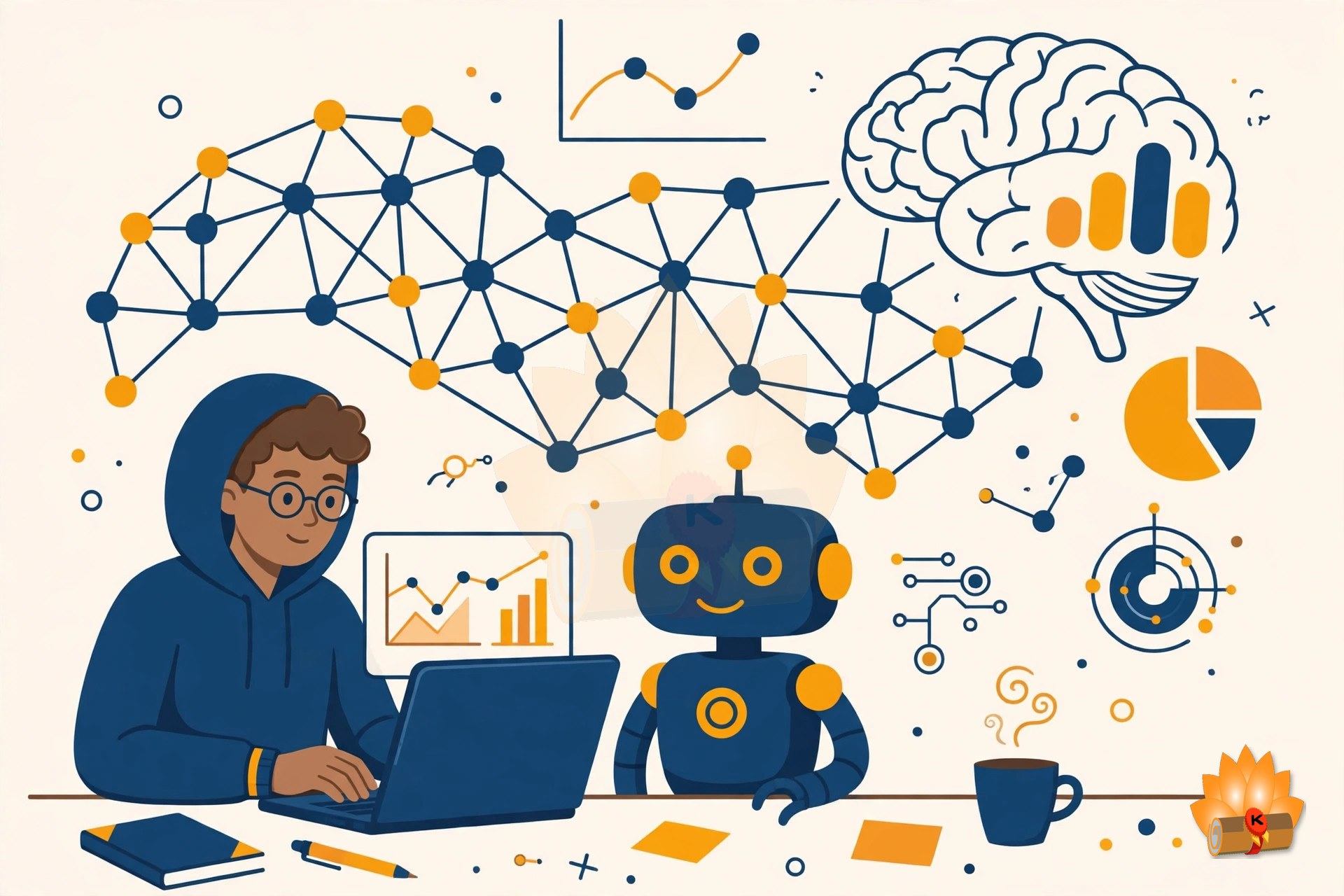
6.1.1 — Fundamentals of Artificial Intelligence
Identify problems where artificial intelligence techniques are applicable; apply selected basic AI techniques; judge applicability of more advanced techniques; participate in the design of systems that act intelligently and learn from experience.
Course Outcomes
- CO1: Understanding the basic concepts of Artificial Intelligence.
- CO2: Describing different AI searching algorithms.
- CO3: Applying various optimization techniques to real world problems.
- CO4: Capable of implementing autonomous planning under constraints in simulated or real environment.
- CO5: Applying different AI logics to solve various problems.
यूनिट्स — 6.1.1 Fundamentals of Artificial Intelligence
Unit 1 — Introduction (8 Periods, 20%)
Overview and Historical Perspective, Turing test, Physical Symbol Systems and the scope of Symbolic AI, Agents.
AI क्या है, यह idea कैसे शुरू हुआ, Turing test, और एक intelligent agent क्या करता है।
Unit 2 — Searching (8 Periods, 20%)
Heuristic Search: Best First Search, Hill Climbing, Beam Search, Tabu Search. Randomized Search: Simulated Annealing, Genetic Algorithms, Ant Colony Optimization.
Computer जवाब कैसे खोजता है — सब कुछ blindly check करने के बजाय smart तरीके से रास्ते आज़माना।
Unit 3 — Finding Optimal Paths, Problem Decomposition and Game Playing (10 Periods, 20%)
Finding Optimal Paths: Branch and Bound, A*, IDA*, Divide and Conquer approaches, Beam Stack Search. Problem Decomposition: Goal Trees, AO*, Rule Based Systems, Rete Net. Game Playing: Minimax Algorithm, Alpha-Beta Algorithm, SSS*.
सबसे अच्छा रास्ता खोजना, बड़ी समस्याओं को छोटे हिस्सों में बाँटना, और computers chess जैसे games कैसे खेलते हैं।
Unit 4 — Planning and Constraint Satisfaction (8 Periods, 20%)
Domains, Forward and Backward Search, Goal Stack Planning, Plan Space Planning, Graphplan, Constraint Propagation.
Computer step by step plan कैसे बनाता है और काम करते समय rules और limits को कैसे संभालता है।
Unit 5 — Logic and Inferences (8 Periods, 20%)
Propositional Logic, First Order Logic, Soundness and Completeness, Forward and Backward chaining.
Reasoning के पीछे का logic — machine तथ्यों और rules से निष्कर्ष कैसे निकालती है।
6.1.2 — Data Science and Machine Learning
This course will introduce the concepts of data warehouse and data mining, which gives a complete description about the principles, used, architectures, applications, design and implementation of data mining and data warehousing concepts.
Course Outcomes
- CO 1: Understand the basics of Data Science.
- CO 2: Visualize and Analyze Data.
- CO 3: Understand concept of Exploratory Data Analysis.
- CO 4: Understand and develop Machine Learning Algorithms.
- CO 5: Implement Mining Process on Social Network Graph.
यूनिट्स — 6.1.2 Data Science and Machine Learning
Unit 1 — Introduction of Data Science and Machine Learning (10 Periods, 22%)
Fundamentals of Artificial Intelligence, need and applications of Data Science, Data Mining, data preparation, Machine Learning, Types and Applications of Machine Learning.
Data science और machine learning क्या हैं, और वे कहाँ इस्तेमाल होते हैं।
Unit 2 — Data Preprocessing, Analysis and Visualization (6 Periods, 16%)
Data Pre-processing: Pre-processing Techniques — Mean Removal, Scaling, Normalization, Binarization, One Hot Encoding, Label encoding. Data Analyses: Loading and summarizing the dataset. Data Visualization: Univariate Plots, Multivariate Plots, Training Data, Test Data, Performance Measures.
Raw data को clean करना, उसे समझना, और charts बनाना जो बताते हैं कि उसका मतलब क्या है।
Unit 3 — Statistical Inference & Exploratory Data Analysis and the Data Science Process (10 Periods, 22%)
Populations and samples, Types of Statistical modelling, Types of probability distributions, Parametric and Non-Parametric Methods, Distance Metrics. Basic tools (plots, graphs and summary statistics) of EDA, Philosophy of EDA, The Data Science Process.
Statistics, plots और summaries से data को explore करना, और data science की step-by-step process।
Unit 4 — Machine Learning Algorithms (8 Periods, 20%)
Introduction to Supervised Learning Algorithms — Decision Tree, Linear Regression, k Nearest Neighbours (k-NN), SVM — and Introduction to Unsupervised Learning Algorithms — K-means Clustering, Mean Shift Algorithm, Dimensionality Reduction Techniques, Introduction to Neural Networks.
Machine learning के मुख्य तरीके — decision trees, regression, nearest neighbours, SVM, clustering और neural networks।
Unit 5 — Mining Social-Network Graphs, Data Science and Ethical Issues (8 Periods, 20%)
Social networks as graphs, Clustering of graphs, Direct discovery of communities in graphs, Partitioning of graphs, Neighbourhood properties in graphs, Discussions on privacy, security, ethics, A look back at Data Science, Next-generation data scientists.
Social networks को graphs के रूप में कैसे study किया जाता है, और data science से जुड़े privacy, security और ethics के सवाल।
प्रैक्टिकल कार्य
इस विषय के लिए आधिकारिक सिलेबस में कोई practicals नहीं दिए गए हैं — यह theory विषय है (सिर्फ़ lectures)।
पूरा सिलेबस
आधिकारिक सिलेबस से पूरी परीक्षा योजना और संदर्भ पुस्तकें। यूनिट के अनुसार topics ऊपर “आप क्या पढ़ेंगे” वाले हिस्से में दिए गए हैं।
परीक्षा योजना
| कोड | पेपर | प्रकार | L – P | क्रेडिट | आंतरिक | बाह्य | कुल |
|---|---|---|---|---|---|---|---|
| 6.1 | Program Elective-4 (choose ONE of 6.1.1 / 6.1.2) | Theory | 4 – 0 | 4 | Theory 40 | Theory 60 (3 hrs) | 100 |
| Program Elective-4 Total | 4 | 40 | 60 | 100 | |||
6.1.1 — Fundamentals of Artificial Intelligence
एक नज़र में यूनिट्स
| यूनिट | विषय | पीरियड | अंकों का हिस्सा |
|---|---|---|---|
| 1 | Introduction | 8 | 20% |
| 2 | Searching | 8 | 20% |
| 3 | Finding Optimal Paths, Problem Decomposition and Game Playing | 10 | 20% |
| 4 | Planning and Constraint Satisfaction | 8 | 20% |
| 5 | Logic and Inferences | 8 | 20% |
संदर्भ पुस्तकें
सिलेबस में दिए अनुसार:
- Deepak Khemani. A First Course in Artificial Intelligence, McGraw Hill Education (India).
- https://nptel.ac.in/courses/106106126/
- Stefan Edelkamp and Stefan Schroedl. Heuristic Search, Morgan Kaufmann.
- Pamela McCorduck, Machines Who Think: A Personal Inquiry into the History and Prospects of Artificial Intelligence, A K Peters/CRC Press.
- Elaine Rich and Kevin Knight. Artificial Intelligence, Tata McGraw Hill.
- Stuart Russell and Peter Norvig. Artificial Intelligence: A Modern Approach, Prentice Hall.
- M.C. Trivedi, A classical approach to Artificial Intelligence, Khanna Publishing House.
6.1.2 — Data Science and Machine Learning
एक नज़र में यूनिट्स
| यूनिट | विषय | पीरियड | अंकों का हिस्सा |
|---|---|---|---|
| 1 | Introduction of Data Science and Machine Learning | 10 | 22% |
| 2 | Data Preprocessing, Analysis and Visualization | 6 | 16% |
| 3 | Statistical Inference & Exploratory Data Analysis and the Data Science Process | 10 | 22% |
| 4 | Machine Learning Algorithms | 8 | 20% |
| 5 | Mining Social-Network Graphs, Data Science and Ethical Issues | 8 | 20% |
संदर्भ पुस्तकें
सिलेबस में दिए अनुसार:
- Jiawei Han, Micheline Kamber, Jian Pei, Data Mining: Concepts and Techniques, Elsevier.
- Margaret H Dunham, Data Mining Introductory and Advanced Topics, Pearson Education.
- Amitesh Sinha, Data Warehousing, Thomson Learning, India.
- Xingdong Wu, Vipin Kumar, the Top Ten Algorithms in Data Mining, CRC Press, UK.
अक्सर पूछे जाने वाले प्रश्न
Program Elective-4 छठे सेमेस्टर में कितने अंकों का है?
कुल 100 अंक और 4 क्रेडिट। Program Elective-4 (choose ONE of 6.1.1 / 6.1.2): 100 अंक (आंतरिक Theory 40, बाह्य Theory 60 (3 hrs))।
मुझे कौन सा option चुनना चाहिए — Artificial Intelligence या Data Science and Machine Learning?
दोनों के अंक और क्रेडिट बराबर हैं, इसलिए रुचि से चुनें। Artificial Intelligence searching, planning, game playing और logic पर केंद्रित है; Data Science and Machine Learning data preparation, statistics और learning algorithms पर केंद्रित है। अगर आप data, analytics या ML models के साथ काम करना चाहते हैं, तो 6.1.2 लें; अगर आपको algorithms, reasoning और intelligent systems पसंद हैं, तो 6.1.1 लें।
Artificial Intelligence (6.1.1) में किन यूनिट्स का weightage सबसे ज़्यादा है?
हर यूनिट का weightage बराबर है — प्रत्येक 20% — इसलिए किसी को भी छोड़ा नहीं जा सकता। पाँच यूनिट्स हैं: Introduction, Searching, Finding Optimal Paths / Problem Decomposition / Game Playing, Planning and Constraint Satisfaction, और Logic and Inferences।
Data Science and Machine Learning (6.1.2) में किन यूनिट्स का weightage सबसे ज़्यादा है?
Unit 1 (Introduction of Data Science and Machine Learning, 10 पीरियड) और Unit 3 (Statistical Inference & Exploratory Data Analysis and the Data Science Process, 10 पीरियड) का weightage 22% है — इस option में सबसे ज़्यादा। Unit 4 का 20%, और Unit 2 और Unit 5 का 16% और 20% है।
Program Elective-4 के लिए किन किताबों को देखें?
सिलेबस में 11 किताबें दी गई हैं, जिनमें Deepak Khemani. A First Course in Artificial Intelligence, McGraw Hill Education (India). और https://nptel.ac.in/courses/106106126/ सहित अन्य किताबें शामिल हैं। पूरी सूची ऊपर “पूरा सिलेबस” वाले हिस्से में है।
Program Elective-4 सिलेबस PDF कैसे डाउनलोड करें?
PDF मुफ़्त में डाउनलोड के लिए उपलब्ध है — नीचे Download वाले हिस्से में दिए गए download link का उपयोग करें। यह KAMALDNP द्वारा आधिकारिक BTEUP सिलेबस से तैयार किया गया है।
संबंधित सिलेबस पोस्ट
- BTEUP CSE छठा सेमेस्टर सिलेबस 2026-27
- BTEUP CSE पाँचवाँ सेमेस्टर सिलेबस 2026-27
- BTEUP CSE पूरा सिलेबस 2026-27 — सभी वर्ष, सभी सेमेस्टर
- Entrepreneurship and Start-ups — BTEUP CSE छठा सेमेस्टर सिलेबस 2026-27
- In House Project — BTEUP CSE छठा सेमेस्टर सिलेबस 2026-27
- Open Elective-3 — BTEUP CSE छठा सेमेस्टर सिलेबस 2026-27
Program Elective-4 सिलेबस PDF डाउनलोड करें
नीचे पूरा Program Elective-4 सिलेबस PDF डाउनलोड करें — KAMALDNP द्वारा तैयार, जिसमें topics की पूरी सूची और संदर्भ पुस्तकें हैं।
Program Elective-4 सिलेबस PDF डाउनलोड करें
स्रोत: BTEUP तृतीय वर्ष पाठ्यक्रम (folder2627), C.D.C. की 16.07.2026 को हुई बैठक में स्वीकृत। Topic सूचियाँ आधिकारिक सिलेबस के अनुसार हैं; छोटे सारांश लेखक के अपने सरल शब्दों में लिखे गए हैं, सिलेबस का मूल पाठ नहीं हैं। कृपया अपने पॉलिटेक्निक से किसी भी स्थानीय बदलाव की पुष्टि कर लें।

Comments (0)
Share your question or experience about this syllabus. Your comment will appear after review.
No comments yet — be the first to share your thoughts!