Mechatronics — What This Subject Is About
To understand mechatronics — the integration of mechanical, electrical, electronics, computer and control engineering — for designing advanced, reliable and cost-effective electro-mechanical systems, with growing demand for diploma engineers skilled in installing, operating and maintaining these integrated systems in industry.
Subject 5.4.1 — Program Elective-2, Option 1 (Practicum) • Total 100 Marks • 3 Credits • L 1 – P 4 • Choose this OR Signal and Image Processing • 5th Semester — Electronics Engineering • Session 2026–27
Note: No marks-distribution table and no reference-books list are given for this subject in the PDF, so unit weightages and books are not shown.
What You Will Study
Unit 1 — Introduction (3 Periods)
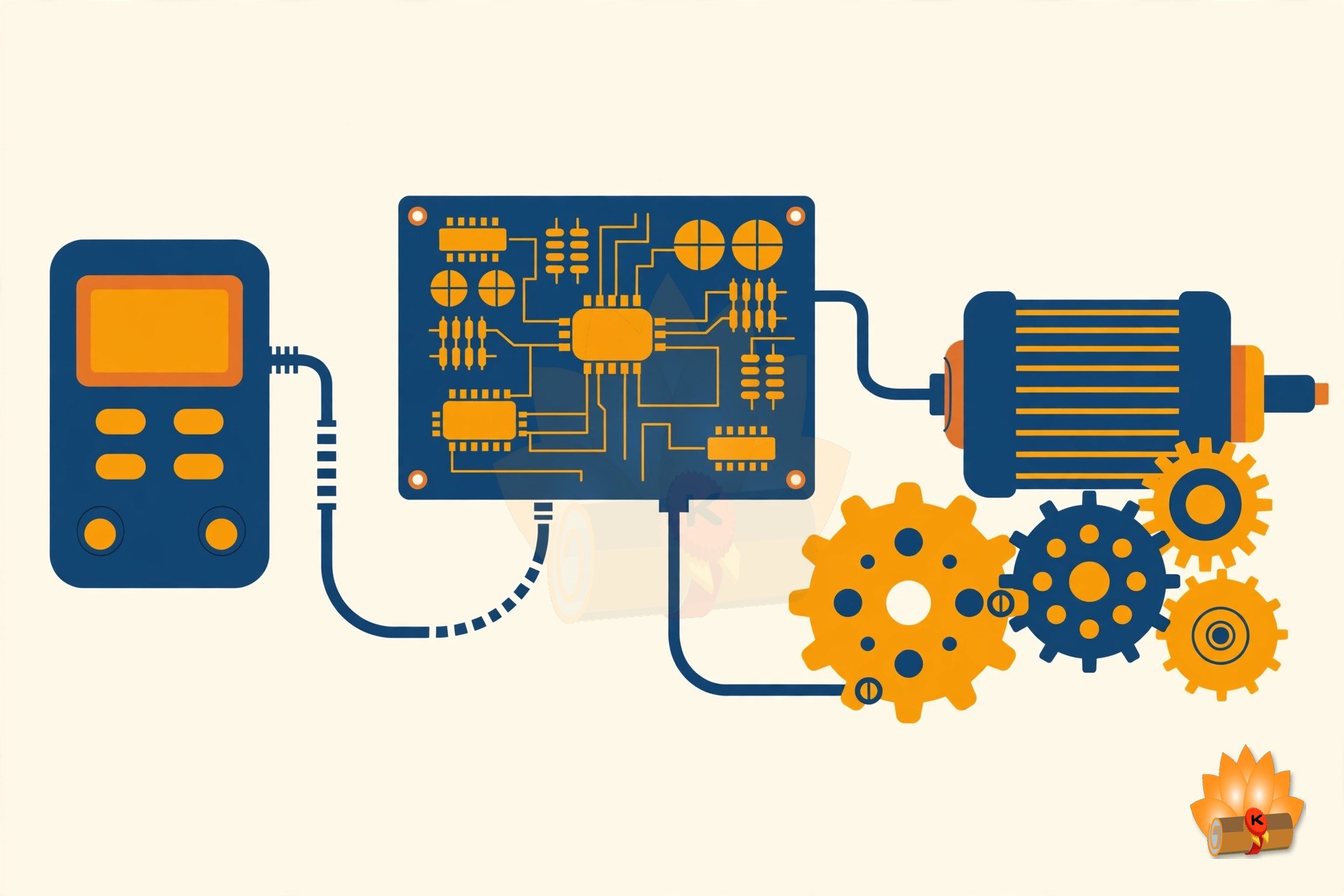
Introduction to Mechatronics: Mechatronics; Importance of Mechatronics; Systems: Measurement systems; Control systems and their types; Closed-loop control System; Automatic water level controller; Sequential controllers-washing machine. Mechatronics system architecture: Sensors, signal conditioners, PLC/Embedded controllers, pneumatic, hydraulic and electrical actuators. Introduction to Real Time Mechatronics System
What mechatronics is, its system architecture (sensors, controllers, actuators), and everyday examples like a water-level controller and a washing machine.
Unit 2 — Sensors & Switches (3 Periods)
Sensors: Principle of operation and application of each. Proximity, Motion Sensors, Pressure sensor, High and low temperature measurement sensors, Light Sensors, Selection of Sensors. Switches: Principle, working and applications of-Limit switches, proximity switches like inductive, capacitive and optical (deflecting and through beam type),
The senses of a mechatronic system: proximity, motion, pressure, temperature and light sensors, and the switches that detect position and presence.
Unit 3 — Electrical & Mechanical System (3 Periods)
Electric actuators, Stepper motor, servo motors, DC motor, DC brushless motors, AC motor (Only diagram). Relays Principle of operation and application, latching, triggering, Types of relays- solid state. Hydraulic systems: Physical components of hydraulic systems. Pneumatic systems: Air compressors, filters and regulators.
The muscles: electric motors (stepper, servo, DC, brushless, AC), relays, and hydraulic and pneumatic systems.
Unit 4 — Signal Conditioners (3 Periods)
Need of isolators, filters, amplifiers, fluid amplifiers, and optical amplifiers mechatronics systems. Computer Aided Control Systems: CNC Machines: various blocks of CNC machine, advantages of CNC, Part programming of CNC machines, G codes and M codes, small application programs, CNC based machine example.
Conditioning sensor signals for use, and CNC machines: their blocks, advantages, and part programming with G and M codes.
Unit 5 — Introduction to SCADA and PLC (2 Periods)
SCADA: Data acquisition system, communication technologies, monitoring and supervisory functions. PLC: Block diagram, programming languages, Applications, Interfacing of PLC to SCADA. Case studies of mechatronics systems: A Microcontroller based pick-and-place robot, Microcontroller based antilock brake system.
SCADA and PLC: supervising and controlling industrial processes, and two case studies — a pick-and-place robot and an antilock brake system.
Note: no marks-distribution table is given for this subject in the official syllabus, so unit weightages are not shown.
Practical Work
- Familiarize students with measurement systems and control systems, including the working principle of closed-loop control systems.
- Design and implement an automatic water level controller system, which uses sensors to control the water flow into a tank.
- Implement a sequential control system, such as a washing machine controller, using a microcontroller or PLC.
- Study the integration of sensors, signal conditioners, actuators, and controllers in a mechatronics system, with a focus on industrial applications.
- Understand the principle of operation and applications of proximity sensors.
- Study how motion sensors detect and respond to movement.
And more — the complete list of 17 practicals is inside the PDF.
Complete Syllabus
The full examination scheme, the complete practicals list and the reference books from the official syllabus. The unit-wise topics are in the "What You Will Study" section above.
Examination Scheme
| Code | Paper | Type | L – P | Credits | Internal | External | Total |
|---|---|---|---|---|---|---|---|
| 5.4.1 | Program Elective-2: Mechatronics | Practicum | 1 – 4 | 3 | Practical 60 | Practical 40 (3 hrs) | 100 |
| Mechatronics Total | 3 | 60 | 40 | 100 | |||
Complete Practicals List
This is the complete list of practicals from the official syllabus.
- Familiarize students with measurement systems and control systems, including the working principle of closed-loop control systems.
- Design and implement an automatic water level controller system, which uses sensors to control the water flow into a tank.
- Implement a sequential control system, such as a washing machine controller, using a microcontroller or PLC.
- Study the integration of sensors, signal conditioners, actuators, and controllers in a mechatronics system, with a focus on industrial applications.
- Understand the principle of operation and applications of proximity sensors.
- Study how motion sensors detect and respond to movement.
- Study the operation and applications of pressure sensors.
- Study the principle and applications of LDR, photodiodes, and phototransistors.
- To understand the working principle and applications of electric actuators.
- To understand the working principle and applications of stepper motors, Servo motor, DC motors, DC brushless motors.
- To understand the principle of operation and applications of relays (including latching, triggering, and solid-state relays).
- To understand the function and need for various isolators, filters, amplifiers, and their applications in mechatronics systems.
- To understand the components, working, and programming of CNC machines and the role of computer-aided control systems in mechatronics.
- To simulate and troubleshoot common CNC machine operations and errors.
- To understand the SCADA system, its components, and its role in data acquisition, communication, and supervisory control.
- To understand the principles of PLC programming, its block diagram, and its application in real-time systems.
- To explore various microcontroller-based mechatronics systems by designing, simulating, and implementing real-world applications.
Reference Books
Reference books are not listed for this subject in the official syllabus.
Frequently Asked Questions
How many marks is Mechatronics worth in the 5th semester?
Program Elective-2: Mechatronics (5.4.1) is 100 marks. Total: 100 marks, 3 credits. The full scheme table is in the Complete Syllabus section above.
Which units carry the most weightage in Mechatronics?
No marks-distribution table is given for this subject in the official syllabus, so unit weightages are not published. The unit-wise topic list and periods are given in the Complete Syllabus section above.
What practical work is there in Mechatronics?
17 practicals/experiments, including: Familiarize students with measurement systems and control systems, including the working principle of closed-loop control systems.; Design and implement an automatic water level controller system, which uses sensors to control the water flow into a tank.; Implement a sequential control system, such as a washing machine controller, using a microcontroller or PLC.. The complete list is in the Complete Syllabus section above.
Which books should I refer to for Mechatronics?
Reference books are not listed for this subject in the official syllabus.
Is Mechatronics a theory subject or a practical subject?
It is assessed as practicum — see the examination scheme in the Complete Syllabus section above.
How can I download the Mechatronics syllabus PDF?
The PDF is free to download — use the download link in the Download section below. It is prepared by KAMALDNP Academy from the official BTEUP syllabus.
Related Syllabus Posts
- BTEUP Electronics 5th Semester Syllabus 2026-27
- BTEUP Electronics Complete Syllabus 2026-27 — 3rd, 4th, 5th & 6th Semester (All Subjects)
- Optical Fiber Communication — BTEUP Electronics 5th Semester Syllabus 2026-27
- Control System & PLC — BTEUP Electronics 5th Semester Syllabus 2026-27
- Microwave and Radar — BTEUP Electronics 5th Semester Syllabus 2026-27
Download the Mechatronics Syllabus PDF
Download the complete Mechatronics syllabus PDF below — prepared by KAMALDNP Academy, with the full topic list, practicals and reference books.
Download the Mechatronics Syllabus PDF
Source: BTEUP 3rd Year curriculum (folder2627), approved in C.D.C. meeting held on 16.07.2026. Topic lists follow the official syllabus; short explanations are the author's own plain-English summaries, not syllabus text. Please confirm with your own polytechnic for any local changes.



Comments (0)
Share your question or experience about this syllabus. Your comment will appear after review.
No comments yet — be the first to share your thoughts!