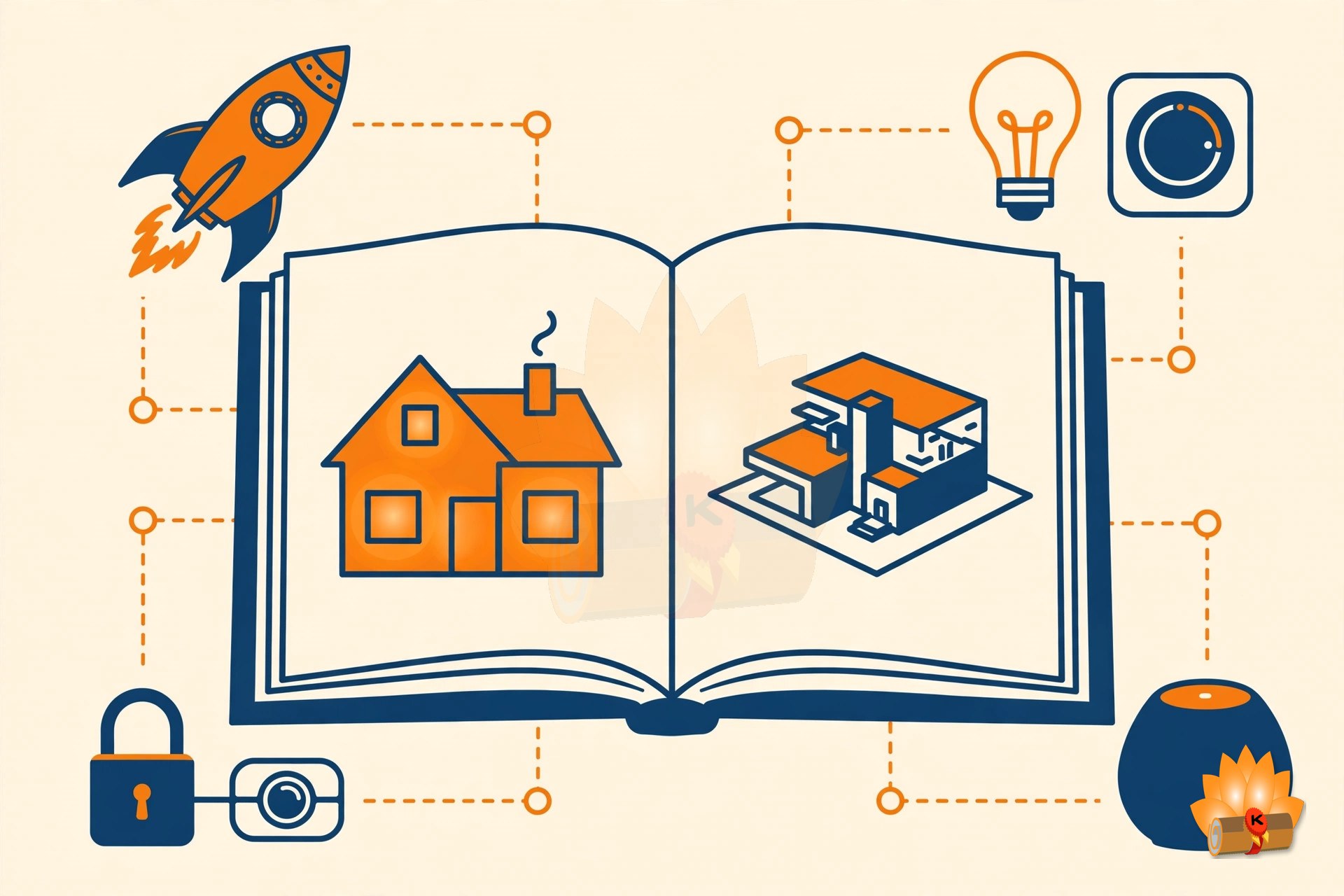
BTEUP Electrical 6वाँ सेमेस्टर सिलेबस 2026-27 — अवलोकन
6th सेमेस्टर आपके diploma का अंतिम सेमेस्टर है, और यह एक ही चीज़ के इर्द-गिर्द बना है: In-House Project — 400 अंक और 12 क्रेडिट, एक ही विषय में सेमेस्टर के आधे से ज़्यादा अंक। इसके साथ, Building Electrification आपको असली buildings की wiring सिखाता है, Entrepreneurship and Start-Ups पूछता है कि क्या आप अपना कुछ बना सकते हैं, और एक Open Elective-3 — Project Management या Internet of Things — सेमेस्टर को पूरा करता है।
Normal pathway में सेमेस्टर का कुल योग 650 अंक और 20 क्रेडिट है। एक Industrial Pathway भी है: In-House Project की जगह आप कम से कम 14 हफ्तों की industrial training करते हैं, और Entrepreneurship and Start-Ups online लिया जाता है। Open Elective-3 (Q) qualifying विषय है — 50 अंक आंतरिक — इसलिए पास होना अनिवार्य है, भले ही अंक आपकी percentage में न गिने जाएँ। यह 2026-27 के लिए अपडेटेड NEP-2020 curriculum है, जो BTEUP द्वारा 16.07.2026 को हुई C.D.C. बैठक में स्वीकृत हुआ।
6thवाँ सेमेस्टर एक नज़र में
| कोड | विषय | प्रकार | क्रेडिट | अंक |
|---|---|---|---|---|
| 6.1 | Building Electrification | Practicum | 4 | 100 |
| 6.2 | Entrepreneurship and Start-Ups | Theory | 2 | 100 |
| 6.3 | In-House Project | Project | 12 | 400 |
| 6.4 | Advance Skill Development (Open Elective-3) (Q) | Theory | 2 | N/A |
| # | Student Centred Activities (SCA) | Activity | — | 50 |
| 6th Semester Total (Normal Pathway) | 20 | 650 | ||
* (Q) का मतलब qualifying है — पास होना अनिवार्य है, लेकिन ये अंक आपकी percentage या division में नहीं जुड़ते।
हर विषय में क्या है
1. Building Electrification
To help students design electrical installation systems in building complexes. (5 units; सबसे भारी: Residential Building Electrification (23%); 11 practicals; 7 संदर्भ पुस्तकें।)
2. Entrepreneurship and Start-Ups
To foster an entrepreneurial mindset by equipping students with the skills to identify business opportunities, formulate comprehensive business plans, understand management functions, and navigate the financial and legal landscapes of starting and sustaining a venture. (6 units; सबसे भारी: Ideas to Start-up (25%); 7 संदर्भ पुस्तकें।)
3. In-House Project
Diploma का सबसे बड़ा विषय: 400 अंक, 12 क्रेडिट (L 4 – P 16)। Curriculum में इसके लिए कोई विस्तृत syllabus भाग नहीं है — कोई units, practicals या किताबें नहीं — इसलिए केवल scheme के आँकड़े दर्ज हैं।
4. Project Management
To help students develop the idea of a project plan — from defining and confirming the project goals and objectives, to identifying tasks and how goals will be achieved. (5 units; सबसे भारी: Capital budgeting process (22%); 5 संदर्भ पुस्तकें।)
5. Internet of Things
To provide foundational knowledge of the Internet of Things — its architecture, components, networking, data handling and real-world applications — enabling students to understand and contribute to IoT systems across domains. (5 units; सबसे भारी: Interfacing by IoT devices (22%); 5 संदर्भ पुस्तकें।)
पूरा सिलेबस
6th सेमेस्टर की पूरी परीक्षा योजना, lecture और practical घंटों तथा आंतरिक और बाह्य अंकों के साथ, उसके बाद हर विषय की unit-wise topics और प्रैक्टिकल्स की पूरी सूची।
परीक्षा योजना — पूरा विवरण
| कोड | पेपर | प्रकार | L – P | क्रेडिट | आंतरिक | बाह्य | कुल |
|---|---|---|---|---|---|---|---|
| 6.1 | Building Electrification | Practicum | 2 – 4 | 4 | 60 | 40 (3 hrs) | 100 |
| 6.2 | Entrepreneurship and Start-Ups | Theory | 2 – 0 | 2 | 40 | 60 (3 hrs) | 100 |
| 6.3 | In-House Project | Project | 4 – 16 | 12 | 240 | 160 | 400 |
| 6.4 | Advance Skill Development (Open Elective-3) (Q) | Theory | 2 – 0 | 2 | 50 | — | N/A |
| # | Student Centred Activities (SCA) | Activity | 0 – 6 | — | 50 | — | 50 |
| 6th Semester Total (Normal Pathway) | 20 | 390 | 260 | 650 | |||
Open Elective-3 (6.4) — Options
Theory courses (choose one): (1) Project Management; (2) Internet of Things. Certification courses (choose one, not less than 20 hrs, offline/online, from agencies of repute): courses conducted by Centre of Excellence (e.g. Tata Technologies — see Annexure 1), Infosys Springboard, TCS iON, other relevant government / international / national organisations or platforms of repute, AICTE-ELIS and Centrally Funded Technical Institutes, C-DAC, NIELIT.
6th Semester — Industrial Pathway (alternative to the normal pathway)
The industrial training tenure should not be less than 14 weeks. The industry must be registered with MSME / Directorate of Industries / Limited Organization / State / Central Government establishments. Monthly progress reports of the intern/trainee should be attested and forwarded by the industrial supervisor during the internship/training. The institute deputes one faculty member as mentor for at least 20–30 students. “Entrepreneurship and Start-up” is also mandatory in industrial internship/training mode, conducted online by the polytechnic; after completing the online course, students must appear for the exam conducted by the Board of Technical Education, Lucknow.
| Code | Subject | Credits | Internal | External | Total |
|---|---|---|---|---|---|
| 6.1 | Entrepreneurship and Start-Ups (Online Mode) | 2 | 100 | — | 100 |
| 6.2 | Industrial Hands-on Practice | 12 | 150 (faculty mentor) | 200 (industry) | 350 |
| 6.3 | Industrial Project | 4 | 50 (faculty mentor) | 50 (industry) | 100 |
| 6.4 | Seminar | 2 | 100 | — | 100 |
| Total | 20 | 650 |
Industrial Hands-on Practice, Industrial Project and seminar are evaluated on the basis of the AICTE Internship Policy: Guidelines and procedures (Chapter 9). The seminar is evaluated through a seminar presentation / viva-voce at the institute, based on the training report, before an expert committee constituted by the concerned department.
Student Centred Activities (SCA) — 50 Marks
Co-curricular activities like extension lectures, games, hobby clubs (e.g. photography), seminars, declamation contests, educational field visits, N.C.C., NSS, library, cultural activities and self-study. Marks distribution: 15 marks general behaviour and discipline; 10 marks attendance (75–80% = 6, 80–85% = 8, above 85% = 10); even-semester activities (25 marks maximum): Sports/NCC/Cultural/Co-curricular/NSS activities (State/National level participation, participation in two of the above activities, Inter-Polytechnic level participation).
Building Electrification
यूनिट्स एक नज़र में
| यूनिट | विषय | पीरियड | अंकों का हिस्सा |
|---|---|---|---|
| I | Wiring Tools and Accessories | 04 | 20% |
| II | Electrical Wires and Underground Cables | 06 | 20% |
| III | Wiring Methods and wiring layout | 06 | 20% |
| IV | Residential Building Electrification | 08 | 23% |
| V | Protective Devices and Earthing for Electrical Installation | 04 | 17% |
- Unit – I: Wiring Tools and Accessories (04 Periods, 20%) — Various tools required for wiring; Application, care & maintenance of tools: Screwdrivers, pliers, Try square, saws, hacksaw, chisel, hammers, mallet, rawal punch, hand drill machine, portable drilling machine, files, plumb bob, line thread, electricians' knife, test lamp, tester; Switch – Their types according to construction such as surface switch, flush switch, and pull switch, rotary switch, knife switch, pendent switch, Main-switch (ICDP, ICTP); Their types according to working such as single pole, double pole, two-way, two-way centre off, intermediate, series parallel switch; Holders - Their types such as bayonet cap lamp holder, pendent holder, batten lamp holder, angle holder, bracket holder, tube light holder, screw type Edison and goliath Edison lamp holder, swivel lamp holder; Socket outlets and plugs - two pin, three-pin, multi pin sockets, two-pin and three-pin plug; Others - Iron connector, adaptor, and ceiling rose, distribution box, neutral link, bus-bar chamber; Wooden/ mica boards, Moulded/ MS Concealed boxes of different sizes; Modular accessories; BIS symbols of various electrical accessories.
- Unit – II: Electrical Wires and Underground Cables (06 Periods, 20%) — Conductors: Wire, cable, bus bar, stranded conductor, cable, armoured cable, flexible cable, solid conductor, PVC wires, CTS wire, LC wire, FR (Fire retardant) wire; Tools used for measurement of wire size, Wire jointing methods; Classification of cables, low tension, high tension, and extra high-tension cables, solid, oil filled and gas filled type; Cable insulation materials – Polyvinyl chloride (PVC), cross linked polythene (XLPE); Selection of suitable cable size and type from standard data; Cable jointing methods; Cable laying methods; Factors determining selection of electric cables.
- Unit – III: Wiring Methods and wiring layout (06 Periods, 20%) — Factors determining the selection of wiring methods; Classification of wiring methods; PVC casing-capping wiring - wiring rules according to IS: 732-2019; Conduit wiring - Types of conduit, types of conduit wiring (Surface/Concealed); Conduit wiring accessories; Comparison of various wiring systems; General BIS rules for domestic installations; Design, working and drawing of following electrical circuits: Simple light and fan circuits, Staircase wiring, Go-down wiring circuit, Bedroom lighting circuit, Corridor lighting circuit, Series parallel circuit, Master switch control circuit, Different lighting circuit using - Intermediate switch, Call bell circuit using bell indicator, Design of wiring circuits according to user's requirement.
- Unit – IV: Residential Building Electrification (08 Periods, 23%) — Domestic Dwellings/Residential Buildings: Reading of Civil Engineering building drawing, Interpretation of electrical installation plan and electrical diagrams, electrical symbols as per IS: 732:2019; Electrical installation for residential building as per NEC 2023; Difference between residential and industrial load, rules/requirements related to lighting load followed in electrical installations, Positioning of equipment; Lighting and power circuits: Light and fan circuit, Power circuit wiring and circuit Schematic diagram according to IS: 2042(Part-I)-1962: multiline and single line representation; Load assessment: Selection of size of conductors, Selection of rating of main switch and protective switch gear; Design and drawing, estimation and costing of a residential installation having maximum 5 KW load; Sequence to be followed for preparing estimate; Calculation of length of wire and other materials, labour cost; Testing of wiring installation as per IS: 732-2019: Insulation resistance - between earth and conductors, between conductors, polarity test of single pole switches; Testing of earth continuity path; Residential building Service Connection - types Underground and overhead; Calculation of Material required for service connection.
- Unit – V: Protective Devices and Earthing for Electrical Installation (04 Periods, 17%) — Miniature circuit Breaker (MCB), Construction, Principle, rating and uses; MCCB - Construction, Principal rating and uses; Earth Leakage Circuit Breaker (ELCB) - Construction, Principle, rating and uses; Residual Current Circuit Breaker (RCCB) - Construction, Principle rating and uses; System and equipment earthing and its requirements, Measurement of earth resistance using earth tester, Methods of reducing earth resistance, Methods of earthing and their procedure - Driven pipe, pipe and plate earthing, modern methods of earthing.
प्रैक्टिकल्स की पूरी सूची
- Unit I — Prepare the chart of electrical accessories with their symbols.
- Unit II — Select the electric wire using measuring and testing instruments for particular applications.
- Unit II — Identify cables of different current ratings.
- Unit III — Prepare wiring installation on a board showing control of one lamp, one fan and one socket from one switch board in PVC surface conduit wiring system.
- Unit III — Control one lamp from two different places using PVC surface conduit wiring system.
- Unit III — Prepare wiring installation on a board. Control one lamp from three different places using PVC surface conduit wiring system.
- Unit IV — Design 2 BHK residential installation scheme and estimate the material required. And draw the details required for installation on A4 size sheet.
- Unit IV — Perform go-down wiring for three blocks using PVC casing capping.
- Unit IV — Test wiring installation using megger.
- Unit V — Measurement of Earth Resistance by using Earth tester.
- Unit V — Dismantling of MCB and identify various parts.
संदर्भ पुस्तकें
- Raina, K.B. and S.K. Bhattacharya, Electrical Design Estimating and Costing, New Age International Ltd., New Delhi, ISBN 978-81-224-0363-3
- Allagappan, N., S. Ekambarram, Electrical Estimating and Costing, New Delhi, ISBN-13: 9780074624784
- Singh, Surjit, Electrical Estimating and Costing, Dhanpat Rai and Co. New Delhi, ISBN: 1234567150995
- Gupta, J B: A Course in Electrical Installation Estimating and Costing, S K Kataria and Sons, New Delhi, ISBN: 978-93-5014-279-0
- Bureau of Indian Standard, IS: 732-2019, Code of practice for electrical wiring installation
- Bureau of Indian Standard, SP 30 National Electrical Code 2023
- Bureau of Indian Standard, SP 72 National Lighting Codes 2010
Entrepreneurship and Start-Ups
यूनिट्स एक नज़र में
| यूनिट | विषय | पीरियड | अंकों का हिस्सा |
|---|---|---|---|
| I | Introduction to Entrepreneurship and Start – Ups | 05 | 15% |
| II | Business Ideas and their implementation | 04 | 15% |
| III | Ideas to Start-up | 08 | 25% |
| IV | Management | 06 | 20% |
| V | Financing and Protection of Ideas | 03 | 10% |
| VI | Succession, Dissolution and Harvesting strategy | 02 | 15% |
- Unit – I: Introduction to Entrepreneurship and Start – Ups (05 Periods, 15%) — Definitions, Classification of Entrepreneur; Traits of an Entrepreneur, Intrapreneurship, Motivation; Types of Business Structures - On the Basis of size and on the basis of ownership; Similarities/differences between entrepreneurs and managers.
- Unit – II: Business Ideas and their implementation (04 Periods, 15%) — Discovering ideas and visualizing the business; Activity map; Business Plan (Case Study).
- Unit – III: Ideas to Start-up (08 Periods, 25%) — Marketing and Accounting - Definition and Importance; Market Analysis – STP (Segmentation, Targeting, Positioning); Competition evaluation and Strategy Development – Vision, Mission, Goal, Objectives; Risk analysis - SWOT Analysis.
- Unit – IV: Management (06 Periods, 20%) — Definition Concept and Functions of Management; Company's Organization Structure - Concept and Classification; Recruitment and Selection - Definition, Training and Development - Importance.
- Unit – V: Financing and Protection of Ideas (03 Periods, 10%) — Financing methods available for Entrepreneurship/ Startups in India (Government Scheme, Banking, NBFCs, SHG and Micro Financing); Intellectual Property Rights - Overview of - Copyrights, Trademark, Geographical Indicators, Patenting and Licenses; Communication of Ideas to potential investors – Investor Pitch.
- Unit – VI: Succession, Dissolution and Harvesting strategy (02 Periods, 15%) — Ways of succession; Types of Dissolution.
संदर्भ पुस्तकें
- The Startup Owner's Manual: The Step-by-Step Guide for Building a Great Company – Steve Blank and Bob Dorf, K & S Ranch, ISBN: 978-0984999392
- Entrepreneurship Development (A New Venture Creation) – Vasant Desai, Himalaya Publishing House
- Entrepreneurship Development – S.S. Khanka, S. Chand & Company Ltd., New Delhi
- Entrepreneurship Development – Gupta and Srinivasan, S. Chand & Company Ltd., New Delhi
- Demand: Creating What People Love Before They Know They Want It – Adrian J. Slywotzky with Karl Weber, Headline Book Publishing, ISBN: 978-0755388974
- The Lean Startup: How Today's Entrepreneurs Use Continuous Innovation to Create Radically Successful Businesses – Eric Ries, Penguin UK, ISBN: 978-0670921607
- The Innovator's Dilemma: The Revolutionary Book That Will Change the Way You Do Business – Clayton M. Christensen, Harvard Business Review Press, ISBN: 978-1422196021
In-House Project
इस विषय के लिए curriculum में कोई विस्तृत syllabus नहीं दिया गया है — केवल scheme के आँकड़े उपलब्ध हैं।
Project Management
यूनिट्स एक नज़र में
| यूनिट | विषय | पीरियड | अंकों का हिस्सा |
|---|---|---|---|
| I | Concept of a project | 04 | 18% |
| II | Capital budgeting process | 06 | 22% |
| III | Financial estimates and projections | 06 | 20% |
| IV | Basic techniques in capital budgeting | 06 | 20% |
| V | Project administration | 06 | 20% |
- UNIT-I: Concept of a project (04 Periods, 18%) — Classification of projects - importance of project management - The project life cycle - establishing project priorities (scope-cost-time) project priority matrix - work break down structure.
- UNIT-II: Capital budgeting process (06 Periods, 22%) — Planning - Analysis - Selection - Financing - Implementation - Review; Generation and screening of project ideas - market and demand analysis - Demand forecasting techniques; Market planning and marketing research process - Technical analysis.
- UNIT-III: Financial estimates and projections (06 Periods, 20%) — Cost of projects - means of financing - estimates of sales and production - cost of production - working capital requirement and its financing - profitability, projected cash flow statement and balance sheet; Break even analysis.
- UNIT-IV: Basic techniques in capital budgeting (06 Periods, 20%) — Non discounting and discounting methods - payback period - Accounting rate of return - net present value - Benefit cost ratio - internal rate of return; Project risk; Social cost benefit analysis and economic rate of return; Non-financial justification of projects.
- UNIT-V: Project administration (06 Periods, 20%) — Progress payments, expenditure planning, project scheduling and network planning, use of Critical Path Method (CPM), schedule of payments and physical progress, time-cost trade off; Concepts and uses of PERT cost as a function of time, Project Evaluation and Review Techniques/cost mechanisms; Determination of least cost duration; Post project evaluation; Introduction to various Project management software.
संदर्भ पुस्तकें
- Project planning, analysis, selection, implementation and review – Prasannachandra – Tata McGraw Hill
- Project Management – the Managerial Process – Clifford F. Gray & Erik W. Larson – McGraw Hill
- Project management - David I Cleland - Mcgraw Hill International Edition, 1999
- Project Management – Gopala krishnan – Mcmillan India Ltd.
- Project Management - Harry - Maylor - Peason Publication
Internet of Things
यूनिट्स एक नज़र में
| यूनिट | विषय | पीरियड | अंकों का हिस्सा |
|---|---|---|---|
| I | Introduction to Internet of Things | 05 | 20% |
| II | Design consideration of IoT | 05 | 20% |
| III | Interfacing by IoT devices | 07 | 22% |
| IV | Data Handling and IoT Platforms | 07 | 22% |
| V | Applications, Projects and Future of IoT | 04 | 16% |
- Unit I - Introduction to Internet of Things (05 periods, 20%) — Basic Definition of “Internet of Things (IoT)”; Evolution and history of IoT; Technological trends enabling IoT: ubiquitous computing, cloud computing, low-cost sensors, wireless communication; IoT architecture overview: perception, network, and application layers; Impact of IoT on society: smart cities, healthcare, agriculture, transportation, and home automation; Challenges in IoT: privacy, security, scalability.
- Unit II - Design consideration of IoT (05 Periods, 20%) — Overview of embedded systems in IoT; Components of an embedded system: microcontroller, sensors, actuators, memory, power supply; Interactions of embedded systems with the physical world; Introduction to Core hardware components and software tools most commonly used in IoT devices.
- Unit III Interfacing by IoT devices (07 Periods, 22%) — Interaction between software and hardware in an IoT device; IoT networking basics: IP addressing, MAC, DNS, DHCP; Basic networking hardware: routers, switches, access points, gateways; Introduction to Structure of the Internet: client-server and peer-to-peer models; Overview of Wireless communication protocols: Wi-Fi, Bluetooth, ZigBee, LoRa, NB-IoT; Brief introduction to Cloud connectivity and MQTT/HTTP protocols.
- Unit IV: Data Handling and IoT Platforms (07 Periods, 22%) — Role of data in IoT: sensing, logging, analysis, and actuation; Data acquisition and storage methods (local and cloud-based); Introduction to data analytics in IoT: basic visualization, dashboards; Overview of popular IoT platforms: ThingSpeak, Blynk, Google Firebase, AWS IoT; Real-time data monitoring and alerts; Security concerns and basic protection mechanisms (encryption, authentication, firewalls).
- Unit V: Applications, Projects and Future of IoT (04 Periods, 16%) — Overview of Application domains: Smart home, Industrial IoT, Healthcare, Smart farming; Mini project ideas: Smart temperature logger, IoT-based light control, Air quality monitor; Social, ethical, and environmental implications of IoT; Career prospects and skills in IoT; Trends and future scope of IoT: AIoT, 5G, Edge Computing.
संदर्भ पुस्तकें
- "Internet of Things" by Jeeva Jose – Beginner-friendly, suitable for diploma students, covers basics to applications
- "Internet of Things: A Hands-On Approach" by Arshdeep Bahga & Vijay Madisetti – Practical approach with architecture, design, and cloud integration
- "Getting Started with the Internet of Things" by Cuno Pfister – Ideal for Arduino beginners with sensor interfacing and networking basics
- "Internet of Things: Architecture and Design Principles" by Raj Kamal – Covers technical architecture, protocols, and design considerations
- "Exploring Raspberry Pi" by Derek Molloy – For advanced learners, focuses on Linux-based IoT development and hardware interfacing
अक्सर पूछे जाने वाले प्रश्न
6th सेमेस्टर में कुल कितने अंक हैं?
Normal pathway में 650 अंक, 20 क्रेडिट। Industrial Pathway में भी कुल 650 अंक और 20 क्रेडिट ही हैं।
Industrial Pathway क्या है?
Normal pathway का एक विकल्प: In-House Project की जगह आप कम से कम 14 हफ्तों की industrial training करते हैं, जो MSME / Directorate of Industries / Limited Organization / State / Central Government establishments के साथ registered industry में होती है। इस pathway में Entrepreneurship and Start-Ups online लिया जाता है, और मासिक progress reports पर industrial supervisor के हस्ताक्षर होने चाहिए।
In-House Project कितना बड़ा है?
400 अंक और 12 क्रेडिट (L 4 – P 16) — एक ही विषय में सेमेस्टर के आधे से ज़्यादा अंक। Curriculum में इसके लिए कोई विस्तृत syllabus नहीं दिया गया है: कोई units, practicals या किताबें सूचीबद्ध नहीं हैं।
क्या Open Elective-3 के अंक मेरी percentage में गिने जाते हैं?
नहीं। Open Elective-3 (Project Management या Internet of Things) (Q) qualifying विषय है: 50 अंक आंतरिक, 2 क्रेडिट। पास होना अनिवार्य है, लेकिन अंक percentage और division में शामिल नहीं किए जाते। तीसरा विकल्प कम से कम 20 घंटे का certification course है।
Open Elective-3 के लिए मुझे कौन सा विषय लेना चाहिए?
Project Management (project plans, capital budgeting, financial estimates) या Internet of Things (IoT architecture, interfacing, data handling और platforms) — या स्वीकृत providers से कम से कम 20 घंटे का certification course। देखें कि आपका polytechnic कौन सा विकल्प पढ़ाता है।
मैं विषय-वार syllabus PDFs कैसे डाउनलोड करूँ?
नीचे Download वाले भाग में दिए गए लिंक का उपयोग करें, या Related Syllabus Posts सूची से कोई भी subject पोस्ट खोलें — हर subject पोस्ट में अपना PDF डाउनलोड है।
संबंधित सिलेबस पोस्ट
- BTEUP Electrical पूरा सिलेबस 2026-27 — 5th और 6th सेमेस्टर (सभी विषय)
- BTEUP Electrical 5thवाँ सेमेस्टर सिलेबस 2026-27
- Building Electrification — BTEUP Electrical 6thवाँ सेमेस्टर सिलेबस 2026-27
- Entrepreneurship and Start-Ups — BTEUP Electrical 6thवाँ सेमेस्टर सिलेबस 2026-27
- In-House Project — BTEUP Electrical 6thवाँ सेमेस्टर सिलेबस 2026-27
- Project Management — BTEUP Electrical 6thवाँ सेमेस्टर सिलेबस 2026-27
6th सेमेस्टर सिलेबस सिलेबस PDF डाउनलोड करें
नीचे 6th सेमेस्टर सिलेबस का पूरा सिलेबस PDF डाउनलोड करें — KAMALDNP Academy द्वारा तैयार, जिसमें विषयों की पूरी सूची, प्रैक्टिकल्स और संदर्भ पुस्तकें हैं।
6th सेमेस्टर सिलेबस सिलेबस PDF डाउनलोड करें
स्रोत: BTEUP 3rd Year Electrical Engineering curriculum (folder2627), C.D.C. की 16.07.2026 को हुई बैठक में स्वीकृत। विषय-सूचियाँ आधिकारिक सिलेबस के अनुसार हैं; छोटे स्पष्टीकरण लेखक के अपने सरल हिंदी सारांश हैं, सिलेबस का मूल पाठ नहीं। अपने पॉलिटेक्निक में किसी भी स्थानीय बदलाव की पुष्टि अवश्य करें।


Comments (0)
Share your question or experience about this syllabus. Your comment will appear after review.
No comments yet — be the first to share your thoughts!