Electric Vehicle — What This Subject Is About
To provide a solid foundation in electric vehicle (EV) technology, government policies and their economic and environmental implications — the systems and subsystems of EVs, design and operation calculations, selection of motors, controllers, battery packs, battery management systems and charging infrastructure, regenerative braking, regulatory standards, safety, wiring harness design and testing norms, and the latest advancements.
Subject 4.7.1 — Open Elective-2, Option 1 (Theory) • Qualifying (Q) • 2 Credits • L 2 – P 0 • Choose this OR Industrial Robotics • 4th Semester — Electronics Engineering • Session 2026–27
Note: Case studies and a Mini Project should be carried out throughout the semester (as stated in the PDF).
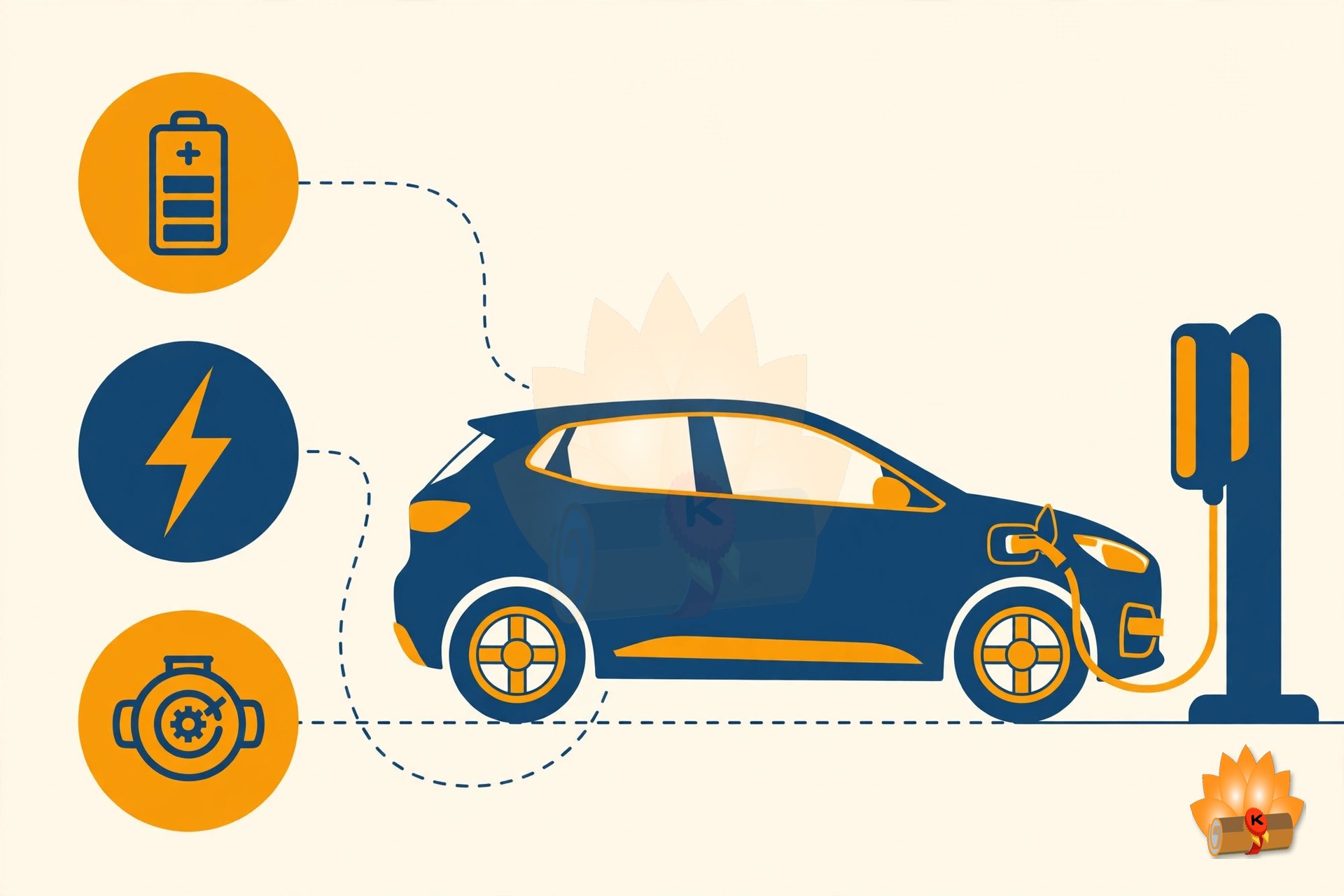
What You Will Study
Unit 1 — Introduction to Industrial Safety Practices & Electric Vehicle (4 Periods, 15%)
Fire Extinguishers & its Types, safely handling Tools & Equipment, Use of proper Tools & Equipment & its maintenance, OSH & practices to be observed as a precaution. Overview electric Vehicle Technologies, India policy regarding electric vehicles, Electric vehicle advantages and limitations, Electric vehicle effects on the economy and environment
Workshop safety first, then the big picture: EV technology, India's EV policy, and the economic and environmental case for electric vehicles.
Unit 2 — Electric Vehicle Architecture, Motors and Controllers (6 Periods, 20%)
Types of Electric Vehicles (Overview of electric vehicle technologies like BEV, HEV, PHEV and FCEV.), Basic architecture of electric vehicle drivetrains, Overview of various system and subsystem of Electrical Vehicle and their functions. Function and operation of electric vehicle motors, Classification of electrical vehicle motors, Types of loads acing on vehicle, Motor specifications, Motor calculation for electric vehicle, Motor selection, Motor controllers and its function, Motor controller selection, Function and operation of a DC-to-DC converter, Basic Wiring harness for EV, Overview of regenerative braking, function & working
The types of EVs (battery, hybrid, plug-in hybrid, fuel-cell), their drivetrains and motors, how to size and choose a motor and controller, and regenerative braking.
Unit 3 — Energy Storage System & Charging System, Electric Vehicle Battery Management System and Basic Regulatory Requirements (8 Periods, 30%)
Electric Vehicle Energy Storage & Charging System, Overview of battery pack. (Cell selection, battery connection, battery pack construction), Overview of battery pack sizing, Thermal management, charging system types, Fundamentals of constant voltage and constant current charging, Standards for electric car charging, Connector standards for charging electric vehicles, Calculation for battery recharging and discharge, Pros and Limitations of batteries for electric vehicles, Regenerative Braking Systems. Introduction to Battery Management System, function of a battery management system (BMS), Block diagram of the battery management system, Thermal control system, cell load distribution, and State of Charge (SOC) and State of Health (SOH) analysis, Difference between high voltage and low voltage system, Maintenance & repairing of electric vehicle system, Basic Regulatory Requirements.
Batteries and charging: pack construction and sizing, charging standards and connectors, and the battery management system that keeps cells safe and healthy.
Unit 4 — Electric Vehicle Circuit Protection Safety, Repair and Maintenance of EV (6 Periods, 20%)
Introduction to electrical wiring harness, Importance of colour coding and labelling on wiring harness, Materials used for wiring harness and its selection criteria, Design consideration in wiring harness, Understand wire gauge and power rating capacity, Types of Electric vehicle Fuses, Electric Vehicle Relays, Selection of relay type, Positioning Fuses and relays in Electric vehicle circuit. Preventive maintenance of EV, Standard procedure to work on high voltage systems, Diagnosis and fault finding, Schedule servicing of EV, Predictive maintenance of EV.
Wiring harnesses, fuses and relays, and how to maintain and repair an EV safely — especially its high-voltage systems.
Unit 5 — Electric Vehicle Testing and Technology Advancement in Electric Vehicle (4 Periods, 15%)
Vehicle Performance testing for acceleration, top speed, range, braking, hill climbing, vehicle structure, road handling, weather resistance, etc., Vehicle Durability testing or life expectancy of parts, materials, and components, Safety: battery safety, charging system safety, and occupant safety, Emission standard and its testing, Vehicle Noise standards and its testing, Advancements in electrical vehicle: Autonomous Driving, Battery Technology to improved range, greater efficiency, and faster charging, life span of batteries, Charging Infrastructure (public charging networks, on-the-go charge, development in vehicle overnight charging technology, wireless Charging).
How EVs are tested for performance, durability and safety, and where the technology is heading: autonomy, better batteries and wireless charging.
Complete Syllabus
The full examination scheme, the complete practicals list and the reference books from the official syllabus. The unit-wise topics are in the "What You Will Study" section above.
Examination Scheme
| Code | Paper | Type | L – P | Credits | Internal | External | Total |
|---|---|---|---|---|---|---|---|
| 4.7.1 | Open Elective-2: Electric Vehicle | Theory (Q) | 2 – 0 | 2 | 50 | — | N/A (Q) |
| Electric Vehicle Total | 2 | 50 | — | N/A (Q) | |||
Units at a Glance
| Unit | Topic | Periods | Marks Share |
|---|---|---|---|
| 1 | Introduction to Industrial Safety Practices & Electric Vehicle | 4 | 15% |
| 2 | Electric Vehicle Architecture, Motors and Controllers | 6 | 20% |
| 3 | Energy Storage System & Charging System, Electric Vehicle Battery Management System and Basic Regulatory Requirements | 8 | 30% |
| 4 | Electric Vehicle Circuit Protection Safety, Repair and Maintenance of EV | 6 | 20% |
| 5 | Electric Vehicle Testing and Technology Advancement in Electric Vehicle | 4 | 15% |
Reference Books
As listed in the syllabus:
- Electric Vehicle Technology Explained — Authors: James Larminie, John Lowry — Publisher: Wiley
- Modern Electric Vehicle Technology — Author: C.C. Chan, K.T. Chau — Publisher: Oxford University Press
- Electric and Hybrid Vehicles: Design Fundamentals — Author: Iqbal Husain — Publisher: CRC Press
- Electric and Hybrid Vehicles: Technologies, Modeling and Control – A Mechatronic Approach — Author: Amir Khajepour, M. Saber Fallah, Avesta Goodarzi — Publisher: Wiley
- Hybrid Electric Vehicles: Principles and Applications with Practical Perspectives — Author: Chris Mi, M. Abul Masrur, David Wenzhong Gao — Publisher: Wiley
- Battery Management Systems for Large Lithium Ion Battery Packs — Author: Davide Andrea — Publisher: Artech House
- Electric Vehicles: Prospects and Challenges — Editors: Tariq Muneer, Irene Illescas García — Publisher: Elsevier
- Power Electronics for Electric Vehicles and Energy Storage — Author: Anup Bhattacharya — Publisher: Springer
- Automotive Power train and Electric Vehicle Systems — Author: Alexander G. Arnold — Publisher: SAE International
- The Electric Car: Development and Future of Battery, Hybrid and Fuel-Cell Cars — Author: Michael Here ward Westbrook — Publisher: IET (Institution of Engineering and Technology)
Frequently Asked Questions
How many marks is Electric Vehicle worth in the 4th semester?
Open Elective-2: Electric Vehicle (4.7.1) is N/A (Q) marks. It is a qualifying (Q) subject: you must appear and pass, but its marks are not counted for percentage or division. The full scheme table is in the Complete Syllabus section above.
Which units carry the most weightage in Electric Vehicle?
Energy Storage System & Charging System, Electric Vehicle Battery Management System and Basic Regulatory Requirements, 30% each. The full unit-wise weightage table is in the Complete Syllabus section above.
Which books should I refer to for Electric Vehicle?
The syllabus lists Electric Vehicle Technology Explained — Authors: James Larminie, John Lowry — Publisher: Wiley, and Modern Electric Vehicle Technology — Author: C.C. Chan, K.T. Chau — Publisher: Oxford University Press, among others. The full list is in the Complete Syllabus section above.
Is Electric Vehicle a theory subject or a practical subject?
It is assessed as theory (q) — see the examination scheme in the Complete Syllabus section above.
How can I download the Electric Vehicle syllabus PDF?
The PDF is free to download — use the download link in the Download section below. It is prepared by KAMALDNP Academy from the official BTEUP syllabus.
Related Syllabus Posts
- BTEUP Electronics 4th Semester Syllabus 2026-27
- BTEUP Electronics Complete Syllabus 2026-27 — 3rd, 4th, 5th & 6th Semester (All Subjects)
- Microprocessor and Its Applications — BTEUP Electronics 4th Semester Syllabus 2026-27
- Principles of Electronic Communication — BTEUP Electronics 4th Semester Syllabus 2026-27
- Electronic Instrumentation and Measurement — BTEUP Electronics 4th Semester Syllabus 2026-27
Download the Electric Vehicle Syllabus PDF
Download the complete Electric Vehicle syllabus PDF below — prepared by KAMALDNP Academy, with the full topic list, practicals and reference books.
Download the Electric Vehicle Syllabus PDF
Source: BTEUP 2nd Year curriculum (folder2627), approved in C.D.C. meeting held on 16.07.2026. Topic lists follow the official syllabus; short explanations are the author's own plain-English summaries, not syllabus text. Please confirm with your own polytechnic for any local changes.




Comments (0)
Share your question or experience about this syllabus. Your comment will appear after review.
No comments yet — be the first to share your thoughts!