Signal and Image Processing — What This Subject Is About
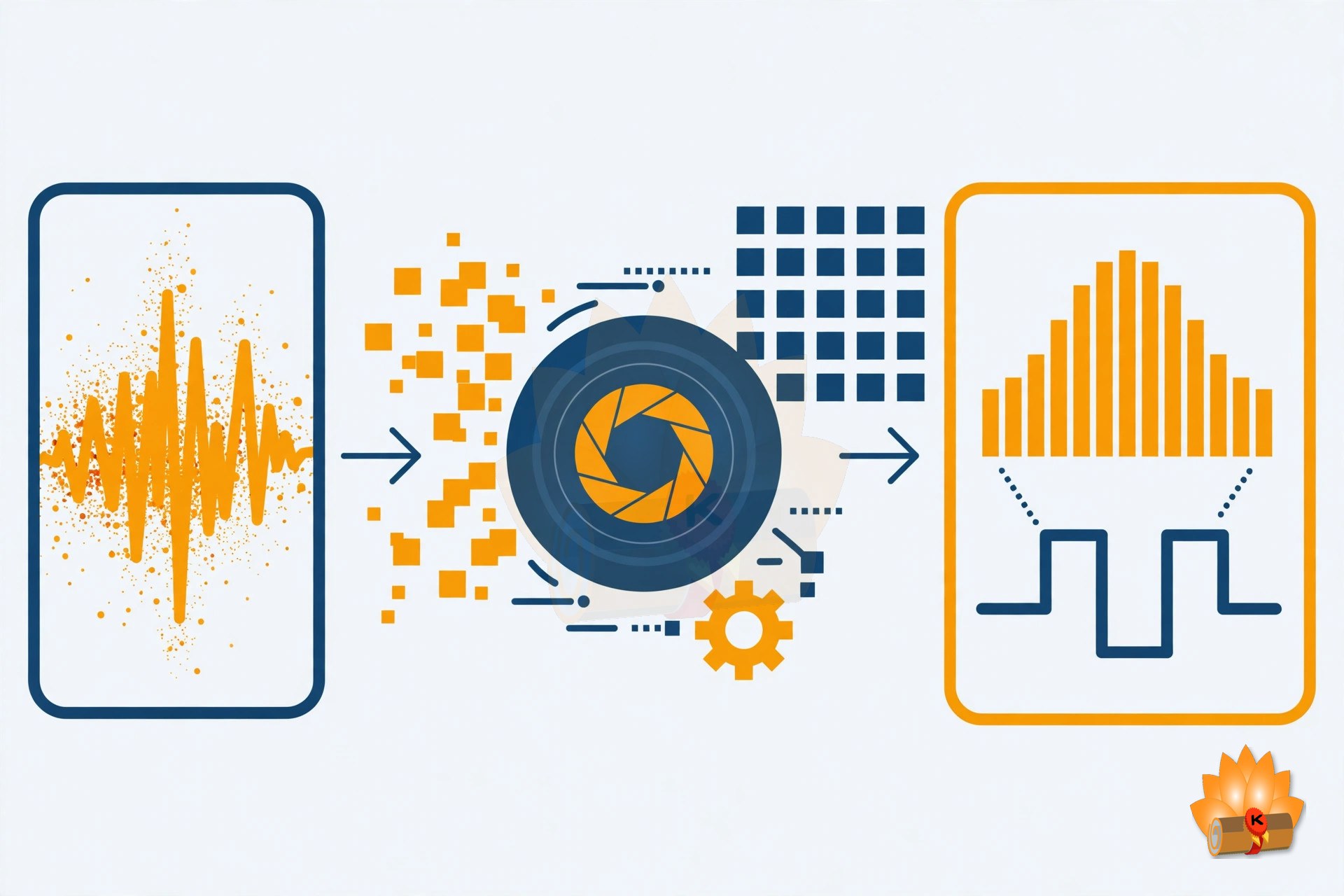
To give foundational and advanced concepts in processing digital signals and images — filtering, sampling, Fourier transforms and convolution — and in image processing: enhancement, restoration, compression, segmentation and feature extraction, with theory and practical implementation using tools such as MATLAB or Python.
Subject 5.4.2 — Program Elective-2, Option 2 (Practicum) • Total 100 Marks • 3 Credits • L 1 – P 4 • Choose this OR Mechatronics • 5th Semester — Electronics Engineering • Session 2026–27
Note: No marks-distribution table is given for this subject in the PDF, so unit weightages are not shown.
What You Will Study
Unit 1 — Basics of Signals and Systems (2 Periods)
Step, Ramp, Pulse, Impulse, Real, complex and exponentials _ Classification of signals – Continuous time (CT) and Discrete Time (DT) signals, Periodic & Aperiodic signals, Deterministic & Random signals, Energy & Power signals. Classification of systems- CT systems and DT systems- – Linear & Nonlinear, Time-variant & Time-invariant, Causal & Non causal, Stable & Unstable
The vocabulary of signals and systems: step, ramp, pulse and impulse signals, and how signals and systems are classified.
Unit 2 — Fourier Transform and Laplace Transform (4 Periods)
Fourier Transform: Fourier series for periodic signals – Fourier Transform – properties. Laplace Transform: Laplace Transforms and properties - convolution and properties
The transforms that move a signal between the time domain and the frequency domain: Fourier and Laplace, plus convolution.
Unit 3 — Basics of Image Processing (4 Periods)
Steps in Digital Image Processing – Components – Elements of Visual Perception – Image Sensing and Acquisition, Introduction to image sampling and quantization, Color Image Fundamentals: RGB models
How a digital image is captured and represented: sensing, sampling, quantisation, and the RGB colour model.
Unit 4 — Image Enhancement and Restoration (2 Periods)
Image Enhancement: Spatial Domain: Gray level Transformations-Image negative-contrast stretching - Histogram processing – Basics of Spatial Filtering–Smoothing and Sharpening Spatial filtering. Image Restoration – introduction to degradation model & Noise models
Making images clearer: contrast stretching, histogram processing, smoothing and sharpening filters, and how degraded images are restored.
Unit 5 — Image Segmentation and Compression (2 Periods)
Image Segmentation: Edge detection, Region based segmentation – Region growing – Region splitting and merging. Image Compression: Need for data compression, Huffman, JPEG standard, MPEG
Splitting an image into meaningful regions (segmentation) and shrinking image files without losing what matters (JPEG, MPEG, Huffman coding).
Note: no marks-distribution table is given for this subject in the official syllabus, so unit weightages are not shown.
Practical Work
- Understand various signal types in the time domain.
- Learn about signal operations such as addition, multiplication, and time-shifting.
- Transform signals from the time domain into the frequency domain.
- Explore critical properties of the Fourier Transform such as linearity, time-shifting, frequency-shifting, scaling, and duality.
- Introduce the Laplace transform as a tool for analyzing continuous-time signals and systems, and verify its properties such as linearity, time-shifting.
- Introduction to Digital Image Processing Environment.
And more — the complete list of 17 practicals is inside the PDF.
Complete Syllabus
The full examination scheme, the complete practicals list and the reference books from the official syllabus. The unit-wise topics are in the "What You Will Study" section above.
Examination Scheme
| Code | Paper | Type | L – P | Credits | Internal | External | Total |
|---|---|---|---|---|---|---|---|
| 5.4.2 | Program Elective-2: Signal and Image Processing | Practicum | 1 – 4 | 3 | Practical 60 | Practical 40 (3 hrs) | 100 |
| Signal and Image Processing Total | 3 | 60 | 40 | 100 | |||
Complete Practicals List
This is the complete list of practicals from the official syllabus.
- Understand various signal types in the time domain.
- Learn about signal operations such as addition, multiplication, and time-shifting.
- Transform signals from the time domain into the frequency domain.
- Explore critical properties of the Fourier Transform such as linearity, time-shifting, frequency-shifting, scaling, and duality.
- Introduce the Laplace transform as a tool for analyzing continuous-time signals and systems, and verify its properties such as linearity, time-shifting.
- Introduction to Digital Image Processing Environment.
- Understand image as a matrix and perform fundamental operations.
- Break down an image into its RGB components.
- Simulate the process of image capture using virtual sensors.
- Understand human perception of brightness and contrast.
- Improve the visual quality of images by suppressing degradation.
- Understand how reducing intensity levels affects image quality.
- Understand and apply basic pixel intensity transformations.
- Perform segmentation by dividing and combining image regions based on uniformity.
- Demonstrate how compression reduces image size and storage needs.
- Simulate the core steps of JPEG compression.
- Understand basic principles behind video compression.
Reference Books
As listed in the syllabus:
- A.V. Oppenheim, A.S. willsky and S.H. Nawab, Signals and Systems, 2nd Edition, Prentice-Hall of India, 2015
- Rafel C.Gonzalez and Richard E. woods, Digital Image processing, 4th edition, Pearson Inc, 2018
- Simon Haykin and Barry Van Veen,Signals and Systems, 2nd edition, Wiley, 2007
Frequently Asked Questions
How many marks is Signal and Image Processing worth in the 5th semester?
Program Elective-2: Signal and Image Processing (5.4.2) is 100 marks. Total: 100 marks, 3 credits. The full scheme table is in the Complete Syllabus section above.
Which units carry the most weightage in Signal and Image Processing?
No marks-distribution table is given for this subject in the official syllabus, so unit weightages are not published. The unit-wise topic list and periods are given in the Complete Syllabus section above.
What practical work is there in Signal and Image Processing?
17 practicals/experiments, including: Understand various signal types in the time domain.; Learn about signal operations such as addition, multiplication, and time-shifting.; Transform signals from the time domain into the frequency domain.. The complete list is in the Complete Syllabus section above.
Which books should I refer to for Signal and Image Processing?
The syllabus lists A.V. Oppenheim, A.S. willsky and S.H. Nawab, Signals and Systems, 2nd Edition, Prentice-Hall of India, 2015, and Rafel C.Gonzalez and Richard E. woods, Digital Image processing, 4th edition, Pearson Inc, 2018, among others. The full list is in the Complete Syllabus section above.
Is Signal and Image Processing a theory subject or a practical subject?
It is assessed as practicum — see the examination scheme in the Complete Syllabus section above.
How can I download the Signal and Image Processing syllabus PDF?
The PDF is free to download — use the download link in the Download section below. It is prepared by KAMALDNP Academy from the official BTEUP syllabus.
Related Syllabus Posts
- BTEUP Electronics 5th Semester Syllabus 2026-27
- BTEUP Electronics Complete Syllabus 2026-27 — 3rd, 4th, 5th & 6th Semester (All Subjects)
- Optical Fiber Communication — BTEUP Electronics 5th Semester Syllabus 2026-27
- Control System & PLC — BTEUP Electronics 5th Semester Syllabus 2026-27
- Microwave and Radar — BTEUP Electronics 5th Semester Syllabus 2026-27
Download the Signal and Image Processing Syllabus PDF
Download the complete Signal and Image Processing syllabus PDF below — prepared by KAMALDNP Academy, with the full topic list, practicals and reference books.
Download the Signal and Image Processing Syllabus PDF
Source: BTEUP 3rd Year curriculum (folder2627), approved in C.D.C. meeting held on 16.07.2026. Topic lists follow the official syllabus; short explanations are the author's own plain-English summaries, not syllabus text. Please confirm with your own polytechnic for any local changes.



Comments (0)
Share your question or experience about this syllabus. Your comment will appear after review.
No comments yet — be the first to share your thoughts!