
Building Construction — What This Subject Is About
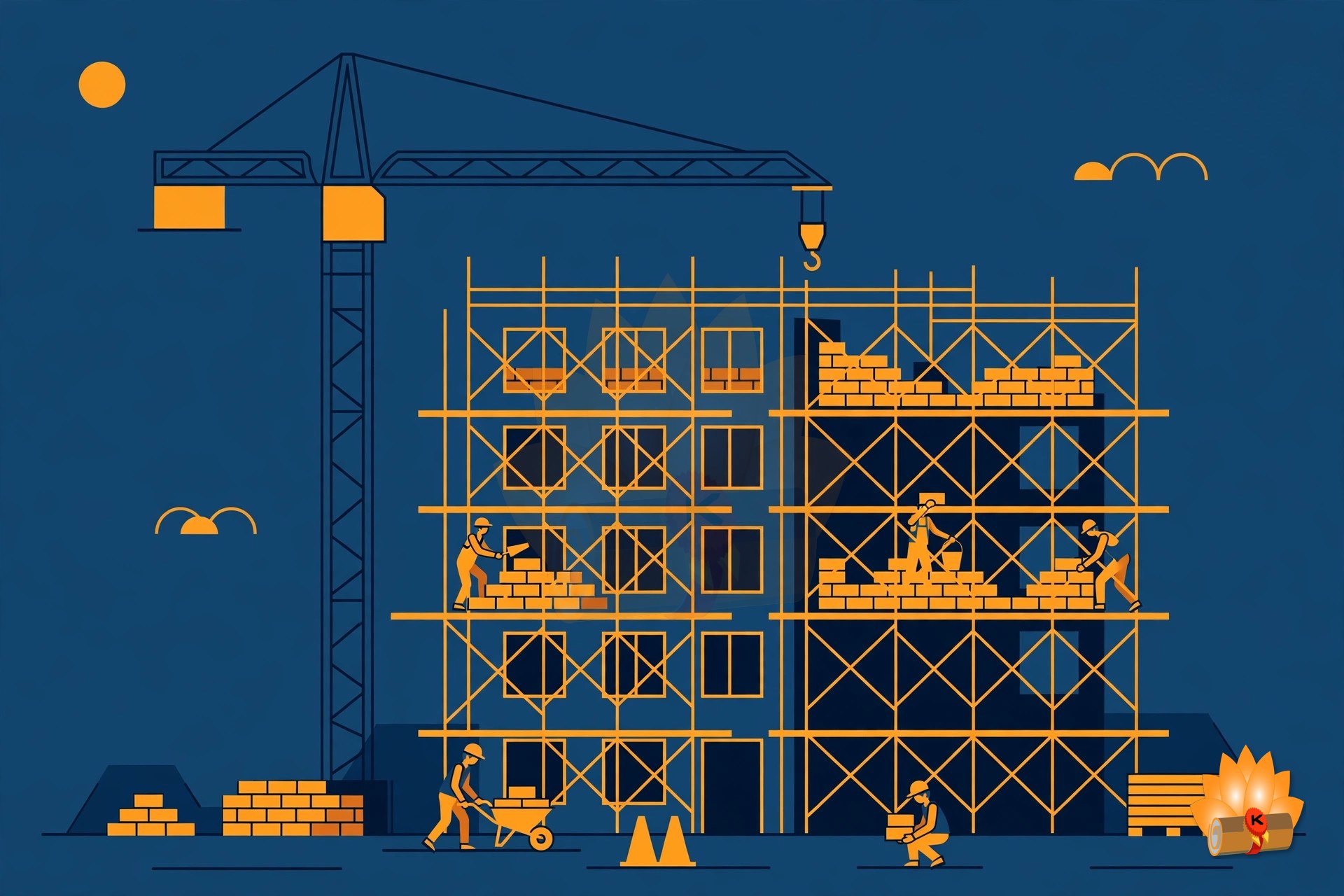
A building is not one thing — it is a foundation, walls, floors, a roof, doors, windows and stairs, all built in the right order. Building Construction teaches you how each part is actually built: how a foundation is laid, how brick and stone masonry is raised, how scaffolding and formwork work, and how doors, windows and staircases are fitted. It is a practicum subject (3.6), so the site demonstrations count as much as the theory.
The five units move from the ground up: building components and the National Building Code, substructure (foundations, earthwork and dewatering), superstructure (stone and brick masonry, scaffolding, shoring and formwork), communication and ventilation (doors, windows and staircases), and finishes (floors, roofs, plastering, pointing and painting). The practicals include laying out a two-room building and building English-bond brick walls and columns.
Subject 3.6 (Practicum/Theory) • Total 100 Marks • 3 Credits • L 2 – P 2 • 3rd Semester — Civil Engineering • Session 2026–27
Note: The 3rd-semester scheme totals imply this subject's 40 internal marks sit under Theory assessment (the extracted table's column alignment is garbled — see NOTES).
What You Will Study
Unit 1 — Overview of Building Components (4 Periods, 15%)
Classification of buildings as per National Building Code Group A to I; as per types of constructions — load bearing structure, framed structure, composite structure; building components — functions of building components; substructure — foundation, plinth; superstructure — walls, partition wall, cavity wall, sill, lintel, doors and windows, floor, mezzanine floor, roof, columns, beams, parapet.
The parts of a building — substructure and superstructure — and how buildings are classified under the National Building Code.
Unit 2 — Construction of Substructure (5 Periods, 20%)
Job layout: site clearance, layout for load bearing structure and framed structure by centre line and face line method, precautions; earthwork: excavation for foundation, timbering and strutting, earthwork for embankment, material for plinth filling, tools and plants used for earthwork; foundation: functions of foundation, types of foundation — shallow foundation, stepped footing, wall footing, column footing, isolated and combined column footing, raft foundation, grillage foundation; deep foundation — pile foundation, well foundation and caissons; pumping methods of dewatering, deep wells, well points, cofferdams (introduction only).
The substructure — setting out a site, excavation and timbering, and the types of foundation from stepped footings to pile foundations.
Unit 3 — Construction of Superstructure (6 Periods, 20%)
Stone masonry: terms used in stone masonry — facing, backing, hearting, through stone, corner stone, cornice; types of stone masonry: rubble masonry, ashlar masonry and their types; joints in stone masonry and their purpose; selection of stone masonry, precautions to be taken in stone masonry construction; brick masonry: terms used in brick masonry — header, stretcher, closer, quoins, course, face, back, hearting, bat bond, joints, lap, frog line, level and plumb; bonds in brick masonry — header bond, stretcher bond, English bond and Flemish bond; requirements of good brick masonry; junctions in brick masonry and their purpose and procedure; precautions to be observed in brick masonry construction; comparison between stone and brick masonry; tools and plants required for construction of stone and brick masonry; hollow concrete block masonry and composite masonry; scaffolding and shoring: purpose, types of scaffolding, process of erection and dismantling; purpose and types of shoring, underpinning; formwork: definition of formwork, requirements of formwork, materials used in formwork, types of formwork for slabs, beams, columns, stripping time for removal of formwork as per IS 456.
The superstructure — stone and brick masonry, the bonds that hold them together, scaffolding, shoring and formwork.
Unit 4 — Building Communication and Ventilation (7 Periods, 25%)
Horizontal communication: doors — components of doors, full paneled doors, partly paneled and glazed doors, flush doors, collapsible doors, rolling shutters, revolving doors, glazed doors; sizes of door recommended by BIS; windows: component of windows, types of windows — full paneled, partly paneled and glazed, wooden, steel, aluminum windows, sliding windows, louvered window, bay window, corner window, clear-storey window, gable and dormer window, skylight; sizes of windows recommended by BIS; ventilators; fixtures and fastenings for doors and windows — material used and functions of window sill and lintels, shed / chajja; vertical communication: means of vertical communication — stair case, ramps, lift, elevators and escalators; terms used in staircase — steps, tread, riser, nosing, soffit, waist slab, baluster, balustrade, scotia, hand rails, newel post, landing, headroom, winder; types of stair case (on the basis of shape): straight, dog-legged, open well, spiral, quarter turn, bifurcated, three quarter turn and half turn; (on the basis of material): stone, brick, R.C.C., wooden and metal.
Doors, windows and staircases — their types, their components, and the sizes recommended by BIS.
Unit 5 — Building Finishes (6 Periods, 20%)
Floors and roofs: types of floor finishes and its suitability — Kota, marble, granite, ceramic tiles, vitrified, chequered tiles, paver blocks, concrete floors, wooden flooring, skirting and dado; process of laying and construction, finishing and polishing of floors; roofing materials — RCC, Mangalore tiles, AC sheets, G.I. sheets, corrugated G.I. sheets, plastic and fibre sheets; types of roof: flat roof, pitched roof — king post truss, queen post truss, terms used in roofs; wall finishes: plastering — necessity of plastering, procedure of plastering, single coat plaster, double coat plaster, rough finish, neeru finishing and Plaster of Paris (POP); special plasters — stucco plaster, sponge finish, pebble finish; plaster board and wall claddings; precautions to be taken in plastering, defects in plastering; pointing — necessity, types of pointing and procedure of pointing; painting — necessity, surface preparation for painting, methods of application.
The finishes — floors and roofs, plastering and pointing, and painting — that make a building usable.
Practical Work
- Demonstration of tools and plants used in building construction.
- To prepare layout of a building: two rooms building with front verandah.
- To construct brick bonds (English bond only) in one, one and half and two brick thick: (a) walls for L, T and cross junction; (b) columns.
- Demonstration of the following items of work at a construction site (a report of these activities will be submitted by the students): (a) timbering of excavated trenching; (b) laying damp proof courses; (c) construction of masonry walls; (d) laying of tile flooring on an already prepared lime concrete base; (e) plastering and pointing exercise; (f) constructing RCC work; (g) pre-construction and post construction termite treatment of building and woodwork; (h) interlocking tiles.
Complete Syllabus
The full examination scheme, the complete practicals list and the reference books from the official syllabus. The unit-wise topics are in the “What You Will Study” section above.
Examination Scheme
| Code | Paper | Type | L – P | Credits | Internal | External | Total |
|---|---|---|---|---|---|---|---|
| 3.6 | Building Construction | Practicum/Theory | 2 – 2 | 3 | 40 | Theory 60 (3 hrs) | 100 |
| Building Construction Total | 3 | 40 | 60 | 100 | |||
Units at a Glance
| Unit | Topic | Periods | Marks Share |
|---|---|---|---|
| 1 | Overview of Building Components | 4 | 15% |
| 2 | Construction of Substructure | 5 | 20% |
| 3 | Construction of Superstructure | 6 | 20% |
| 4 | Building Communication and Ventilation | 7 | 25% |
| 5 | Building Finishes | 6 | 20% |
Complete Practicals List
This is the complete list of practicals from the official syllabus.
- Demonstration of tools and plants used in building construction.
- To prepare layout of a building: two rooms building with front verandah.
- To construct brick bonds (English bond only) in one, one and half and two brick thick: (a) walls for L, T and cross junction; (b) columns.
- Demonstration of the following items of work at a construction site (a report of these activities will be submitted by the students): (a) timbering of excavated trenching; (b) laying damp proof courses; (c) construction of masonry walls; (d) laying of tile flooring on an already prepared lime concrete base; (e) plastering and pointing exercise; (f) constructing RCC work; (g) pre-construction and post construction termite treatment of building and woodwork; (h) interlocking tiles.
Reference Books
As listed in the syllabus:
- S. P. Arora and Bindra., Building Construction, Dhanpat Rai Publication, Delhi.
- Sushil Kumar., Building Construction, Standard Publication.
- Rangawala, S. C., Building Construction, Charotar Publication, Anand.
- Punmia B. C., and Jain A. K., Building Construction, Firewall Media.
- D.V. Gupta, Vikram Singh, Building Construction, Asian Publishers, Muzaffarnagar, ISBN: 978-93-91541-27-9.
- Sharma S. K., Building Construction, S. Chand and Co. Pvt. Ltd., New Delhi.
- Janardan Zha, Building Construction, Khanna Publication.
- Bhavikatti S. S., Building Construction, Vikas Publication House Pvt. Ltd., Delhi.
- Mantri S., A to Z Building Construction, Satya Prakashan, New Delhi.
Frequently Asked Questions
How many marks is Building Construction worth in the 3rd semester?
100 marks in total and 3 credits. Building Construction: 100 marks (internal 40, external Theory 60 (3 hrs)).
Which units carry the most weightage in Building Construction?
Building Communication and Ventilation (25%, 7 periods) — the highest weightage in the subject. The complete unit-wise weightage table is in the Complete Syllabus section above.
What practical work is there in Building Construction?
4 experiments, including Demonstration of tools and plants used in building construction.; To prepare layout of a building: two rooms building with front verandah.; To construct brick bonds (English bond only) in one, one and half and two brick thick: (a) walls for L, T and cross junction; (b) columns.. The complete list is in the Complete Syllabus section above.
Which books should I refer to for Building Construction?
The syllabus lists 9 books, including S. P. Arora and Bindra., Building Construction, Dhanpat Rai Publication, Delhi. and Sushil Kumar., Building Construction, Standard Publication., among others. The full list is in the Complete Syllabus section above.
Is Building Construction a theory subject or a practical subject?
Building Construction is practicum/theory (L–P 2 – 2).
How can I download the Building Construction syllabus PDF?
The PDF is free to download — use the download link in the Download section below. It is prepared by KAMALDNP Academy from the official BTEUP syllabus.
Related Syllabus Posts
- BTEUP Civil 3rd Semester Syllabus 2026-27
- BTEUP Civil Engineering Complete Syllabus 2026-27 — All Years, All Semesters
- Construction Materials — BTEUP Civil 3rd Semester Syllabus 2026-27
- Basic Surveying — BTEUP Civil 3rd Semester Syllabus 2026-27
- Mechanics of Material — BTEUP Civil 3rd Semester Syllabus 2026-27
- Building Planning and Drawings — BTEUP Civil 3rd Semester Syllabus 2026-27
Download the Building Construction Syllabus PDF
Download the complete Building Construction syllabus PDF below — prepared by KAMALDNP Academy, with the full topic list, practicals and reference books.
Download the Building Construction Syllabus PDF
Source: BTEUP 2nd Year curriculum (IIMT mirror of the official curriculum), approved in C.D.C. meeting held on 16.07.2026. Topic lists follow the official syllabus; short explanations are the author's own plain-English summaries, not syllabus text. Please confirm with your own polytechnic for any local changes.


Comments (0)
Share your question or experience about this syllabus. Your comment will appear after review.
No comments yet — be the first to share your thoughts!